Hello all dear space enthusiasts,
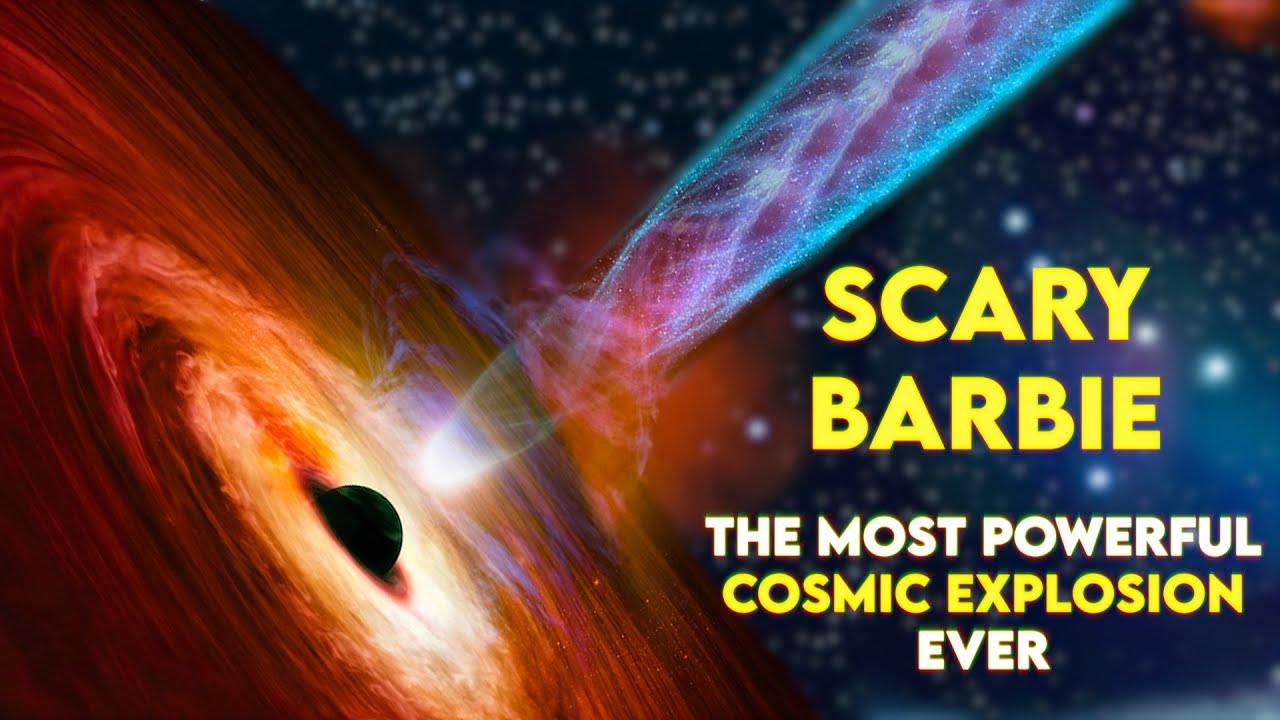
We have an exciting cosmic update for you! While many of you are eagerly anticipating the release of the movie 'Barbie' on July 21, featuring Margot Robbie and Ryan Gosling, there is another captivating phenomenon capturing the attention of the astronomy world. Deep in the cosmos, an extraordinary supermassive black hole, known as the 'terrible Barbie,' has been emitting radiation for a staggering 800 days, leaving scientists astounded.
This remarkable event, hailed as the 'most powerful cosmic explosion ever witnessed,' has taken us by surprise. Join us on this cosmic journey as we delve into the mesmerizing dance of destruction—a celestial battle that unleashes unimaginable power, revealing the true might of a black hole. Let's begin.
Far away, in the heart of a distant galaxy, a lone star glides peacefully against the cosmic backdrop. Unbeknownst to this unsuspecting celestial entity, a hidden monstrosity lurks nearby—a black hole, symbolizing darkness and the relentless grip of gravity. As the star unknowingly approaches its inevitable doom, unfathomable forces come into play.
The black hole's gravitational forces unleash a distortion in the fabric of space-time, creating an invisible vortex of cosmic proportions. Sensing the irresistible pull of the immense gravity, the star embarks on its tragic descent into the insatiable abyss. And thus, the celestial ballet commences.
This is a story as ancient as time itself—a terrifying event unfolds in the universe, releasing an extraordinary surge of energy for a fleeting moment. Then, it vanishes into the darkness, and the universe returns to its normal rhythm. Planets continue their graceful revolutions, and stars silently illuminate the cosmos.
These ephemeral cosmic events, known as transients, encompass phenomena like supernovas and gamma-ray bursts. A typical supernova explosion releases an astounding amount of energy, creating a luminous sphere brighter than entire galaxies. In fact, more energy is expelled into space during a supernova than our Sun emits in its entire lifespan of 8 billion years.
Supernovas appear suddenly, turning a region of the sky that was devoid of any remarkable sights into a radiant beacon within hours. Yet, supernovas differ from other stars in the sky—they mark the remnants of a deceased star. Statistically, every second in the Universe witnesses the scattering of material from around 30 stars in a supernova explosion. Well, as we've mentioned in our previous videos, the universe is far from a tranquil place, isn't it?
On the other hand, gamma-ray bursts are defined as some of the brightest, most powerful, abrupt, and wild events known to us. The energy released during these bursts is so immense that it can obliterate an entire galaxy or system. These bursts last anywhere from a few milliseconds to a few seconds.
During a typical gamma-ray burst, the energy emitted in a few seconds is equivalent to 1 in 20,000 of the total energy our Sun would emit throughout its lifetime. Calculations suggest that, on average, a gamma-ray burst might occur in or near a galaxy like the Milky Way once every 5 million years.
Transient outbursts like these are quite common, but some defy explanation. Consider the ephemeral phenomenon known as ZTF20abrbeie, affectionately nicknamed 'Scary Barbie.' This remote object—a startlingly bright flash of light that endured for over two years—was discovered amidst an extensive dataset collected by computer-guided telescopes.
Upon spotting this brilliantly illuminated patch of sky and cross-referencing observations from other telescopes, astronomers realized they had stumbled upon one of the most powerful cosmic explosions ever witnessed. Their findings were reported on the arXiv preprint server on April 17 and have been accepted for publication

Информация по комментариям в разработке