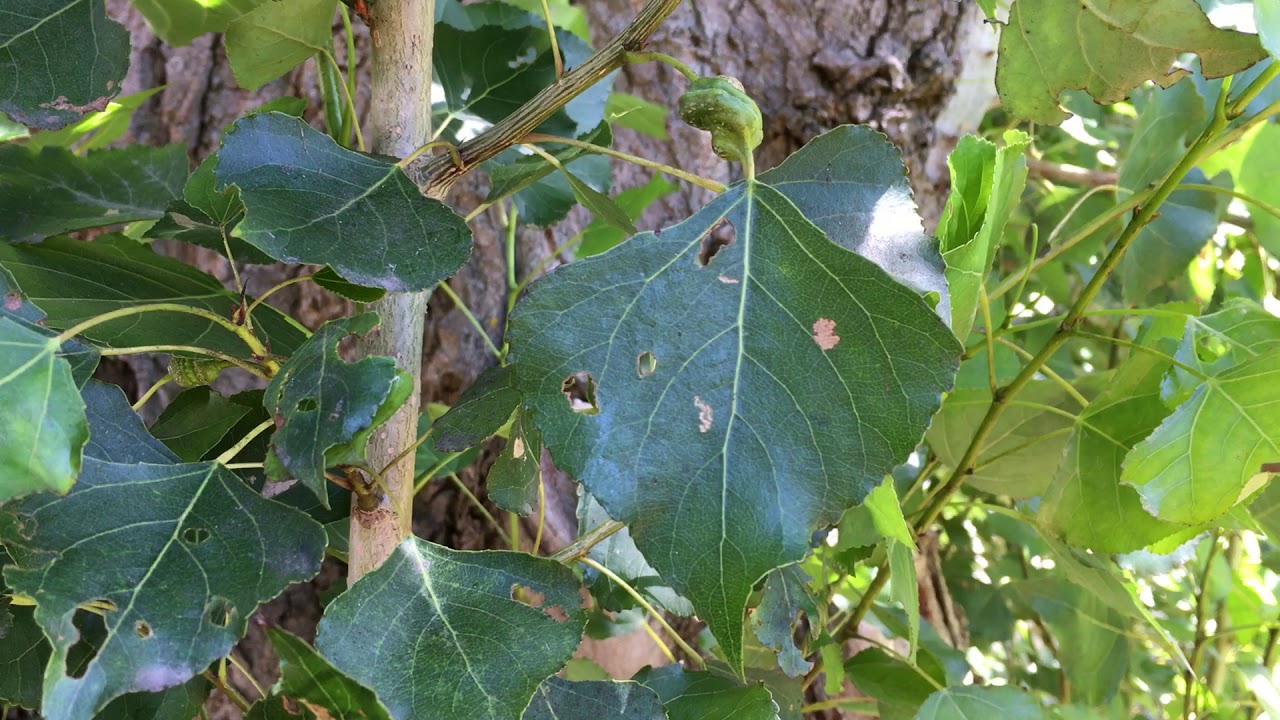
The round bumps are called galls and are caused, in this case, by a particular aphid species, Pemphigus populitransversus, or the poplar petiole gall aphid. The gall itself contains many aphid that will leave the gall when mature. Essentially the gall is a house for the immature aphids to grow up in. This aphid overwinters in the egg stage on cottonwood or poplar twigs. In spring, the eggs hatch about the same time as the flushing of the foliage. The nymphs, or juvenile aphids, feed on the developing petioles, stimulating the formation of a hollow, round or oval gall. The aphids secrete a white, waxy material which coats their body and the inside of the gall. They feed for about two weeks and the females bear live young that mature into winged aphids. These winged females will leave the gall through the slit that is apparent on the side of the gall and fly to an alternate host.
Lombardy poplar trees are commonly planted as a windbreak along property lines
'Italica' is a large, vigorous, narrowly columnar deciduous tree to 30m tall, with bright green ovate leaves and crimson male catkins before the leaves open in early spring
Lombardy poplars are dioecious; however, in the variety 'Italica' only male trees are seen; male flowers are slender, reddish to yellow-green, on hanging catkins, 2 to 3 inches long, appearing in early spring. before the leaves
Lombardy poplar leaves are alternate, simple, broadly deltoid (triangular), 2 to 4 inches long, finely serrate-crenate, straight across the base, petiole flattened, shiny dark green above, paler beneath.
The lombardy poplar tree has bark that's initially smooth and gray-green, but then becomes darker (gray to nearly black) and irregularly furrowed.
'Italica'. The true Lombardy poplar, selected in Lombardy, northern Italy, in the 17th century. The growth is fastigiate (having the branches more or less parallel to the main stem), with a very narrow crown.
Coming from the Mediterranean region, it is adapted to hot, dry summers and grows poorly in humid conditions, being short-lived due to fungal diseases. It is a male clone.
===
Scientific classification
Kingdom: Plantae
(unranked): Angiosperms
(unranked): Eudicots
(unranked): Rosids
Order: Malpighiales
Family: Salicaceae
Genus: Populus
Информация по комментариям в разработке