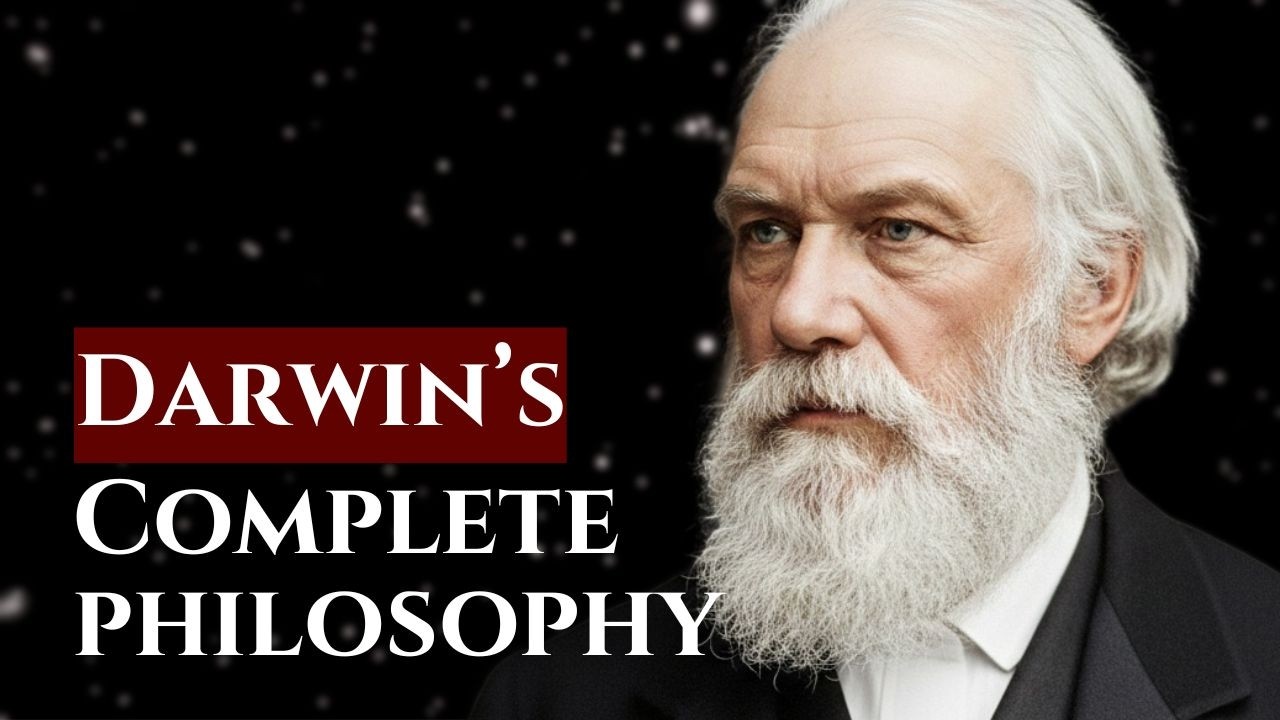
What if Darwin’s ideas about natural selection reveal a deeper, quieter philosophy about life, evidence, and change?
Charles Darwin is often read as a meticulous naturalist, yet his work also constitutes a profound philosophical inquiry into science itself: what counts as knowledge, how explanations are built from careful observation, and what it means for a theory to fit the world we experience.
In this video we untangle the philosophical threads behind Darwin’s theory of evolution, tracing its origins in nineteenth century science and literature, the influence of Thomas Robert Malthus, Jean-Baptiste Lamarck, and Carl Linnaeus, and the shift from a teleological view of life to a non teleological mechanism grounded in variation and differential survival.
Key ideas include natural selection as a process acting on heritable variation, descent with modification, and common ancestry. We examine how Darwin argued that small, incremental changes accumulate over long spans of time, producing diverse forms adapted to environments.
We also discuss counterarguments and tensions: religious objections to natural selection, debates about gradualism versus abrupt change, and later developments such as punctuated equilibrium, associated with Stephen Jay Gould and Niles Eldredge, which refined our understanding of rates of change while preserving core explanatory power.
Historical context matters: Victorian Britain, the voyage of the HMS Beagle, Darwin’s empirical method, and the public reception of On the Origin of Species. A philosophy of science lens helps us see how Darwin reconciled observation with inference, how he separated evidential support from metaphysical claims, and how this opened space for naturalistic explanations in biology that reshaped Western thought.
We contrast Darwinian explanations with earlier teleological narratives and consider how later philosophers of biology addressed questions of mechanism, intention, and function. These discussions are not purely historical. They illuminate contemporary debates in biology, cognitive science, and ethics, where similar questions about evidence, explanation, and the limits of science recur.
Darwin’s legacy extends beyond biology. The philosophical questions raised by evolution touch on determinism and free will, the nature of explanation, and the role of chance in shaping life. Understanding this framework encourages a calm, reflective approach to science, where evidence is weighed carefully, hypotheses are tested, and complex systems reveal patterns only through patient inquiry.
We trace the lineage from Darwin to modern evolutionary developmental biology, genetics, and cognitive science, showing how a single mechanism can illuminate diverse phenomena from behavior to population dynamics. The discussion also addresses ethical and social implications, clarifying how scientific theories can inform or misinform policy when detached from careful interpretation.
Within this reflective exploration we consider how the idea of fitness differs from everyday usage, and why common descent offers a unifying narrative across biology while still allowing for historical contingency and moral reflection. The aim is not to resolve every debate but to show how a rigorous philosophical reading of Darwin can enrich everyday thinking, temper haste, and cultivate patient curiosity about life and knowledge.
#Philosophy #CharlesDarwin #SnoozePhilosophy
This video is for educational purposes only and encourages reflective thinking. Always consult primary sources for deeper study.













Информация по комментариям в разработке