#psycholgyfacts #humanbehavior #socialanxiety
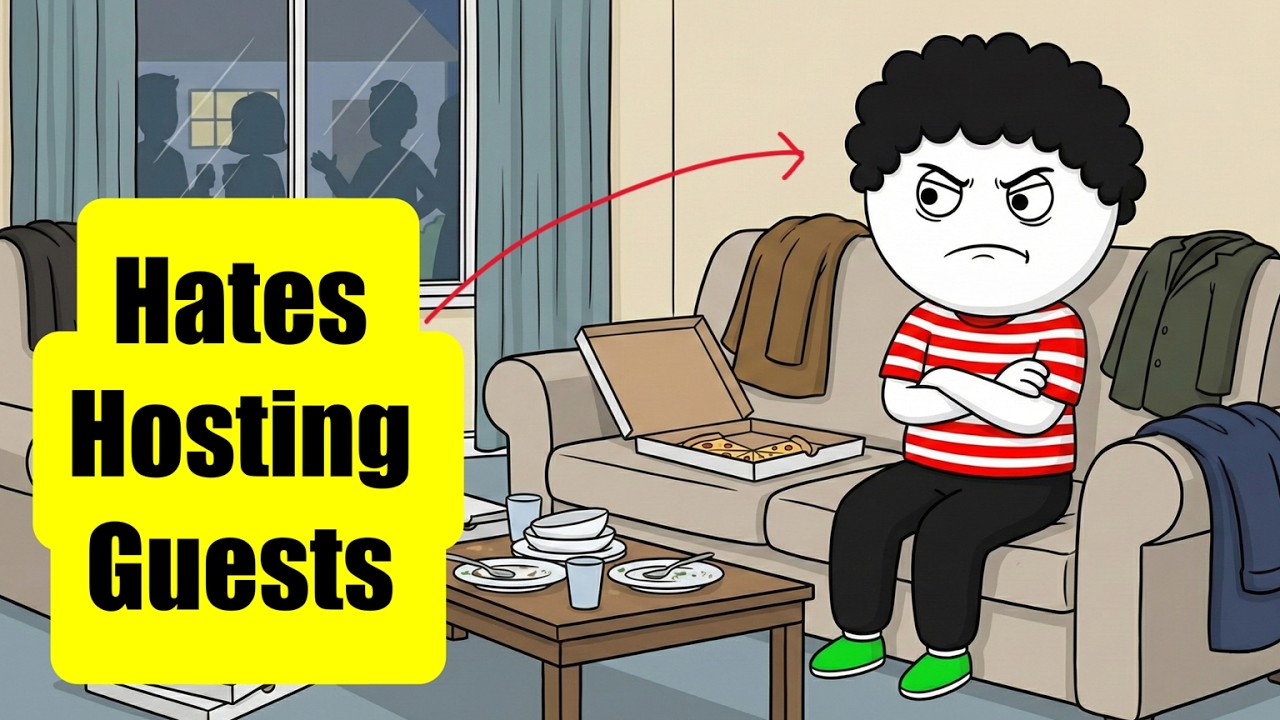
When someone texts, “We’re in the neighborhood—can we swing by?”, does your body instantly go into emergency mode? For many people, having guests over triggers hosting anxiety because home is the one place your nervous system expects to be off-duty.
In this video, we unpack why your brain treats visitors like an unpredictable variable. Predictive-processing theories describe the brain as a prediction machine that tries to minimize “surprise” and keep the world stable. When people enter your space, they change the script—noise, movement, smells, pacing, small judgments—and your system can’t fully settle.
The video explains why “I hate guests” can come from three different roots: sensory overload, social-evaluative threat, and intentional recovery boundaries.
You’ll learn:
Why surprise visitors spike anxiety
Why home turns into a stage
Why you feel judged even when nobody says anything
How sensory overload makes hosting feel like management
How to set boundaries that protect recovery
How to rebuild safety slowly if it’s fear-of-being-seen
Tell me in the comments: what part of having guests over drains you most—the unpredictability, the mess, the noise, or the feeling of being perceived?
#psycholgyfacts #humanbehavior #socialanxiety
Research the video is based on:
Friston, K. (2010). The free-energy principle: a unified brain theory? Nature Reviews Neuroscience. (Predictive processing; minimizing surprise/prediction error.)
Carleton, R. N. (2016). Into the unknown: A review and synthesis of contemporary models involving uncertainty. Journal of Anxiety Disorders. (Fear of the unknown / intolerance of uncertainty as anxiety core.)
Watson, D., & Friend, R. (1969). Measurement of social-evaluative anxiety. Journal of Consulting and Clinical Psychology. (Fear of Negative Evaluation—being judged.)
Wells, A., Clark, D. M., et al. (1995). Social phobia: The role of in-situation safety behaviors in maintaining anxiety and negative beliefs. Behavior Therapy. (Over-managing/monitoring maintains anxiety.)
Gilovich, T., Medvec, V. H., & Savitsky, K. (2000). The spotlight effect… Current Directions in Psychological Science. (Overestimating how much others notice you.)
Aron, E. N., & Aron, A. (1997). Sensory-processing sensitivity and its relation to introversion and emotionality. Journal of Personality and Social Psychology. (Sensory overload / “Type 1” hosting drain.)
Sonnentag, S., & Fritz, C. (2007). The Recovery Experience Questionnaire… Journal of Occupational Health Psychology. (Detachment + control as recovery—home as recharge space.)
Harwood, E. M., & Kocovski, N. L. (2017). Self-compassion induction reduces anticipatory anxiety among socially anxious students. Mindfulness. (Gentle approaches can reduce anticipatory social stress.)














Информация по комментариям в разработке