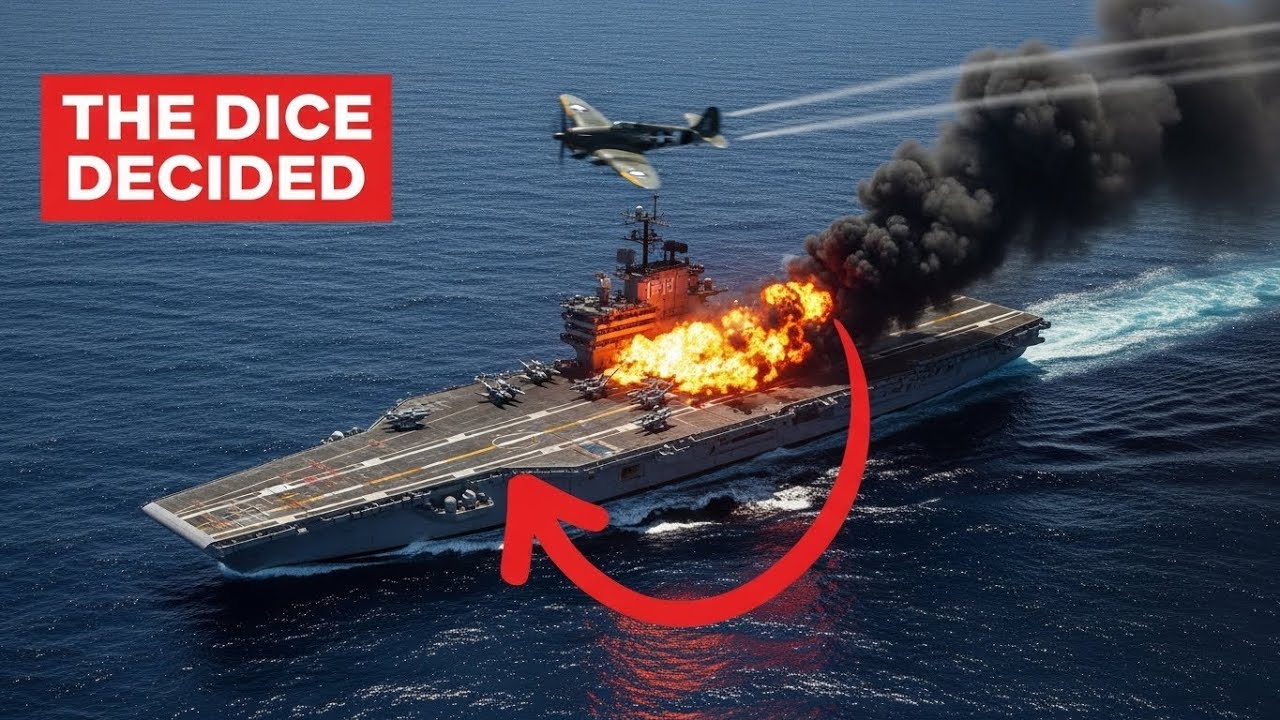
On the morning of May 1, 1942, the halls of Japan’s Naval War College in Meguro were filled with a deceptive calm. Around a forty-foot war game table representing the entire Pacific Theater, Admiral Isoroku Yamamoto and Japan’s top strategists watched dice tumble across miniature carriers, cruisers, and battleships. The result of that roll was stark: four Japanese fleet carriers would be lost in the upcoming operation against Midway Island.
But instead of accepting the mathematics, Captain Kanji Ogawa—the chief umpire—altered the dice, resurrecting two of the doomed carriers on paper. Cheers followed. Sake was poured. Confidence soared. Yet, thirty-three days later, the dice had been eerily accurate. Akagi, Kaga, Soryu, and Hiryu all lay shattered on the ocean floor, victims of a command culture that valued aggressive spirit over cold statistical reality.
This documentary explores the clash between Japanese hubris and American intelligence during the pivotal Battle of Midway:
🎯 What You’ll Learn:
How Japan’s elite Kido Butai used war games to model the Pacific campaign
The consequences of overriding mathematical predictions with wishful thinking
Station HYPO’s breakthrough code-breaking at Pearl Harbor and the role of “AF” in revealing Midway as the target
Minute-by-minute analysis of June 4, 1942, when American dive bombers turned prophecy into reality
The industrial and strategic asymmetry that doomed Japan while empowering the U.S. Navy
How Midway shaped the remainder of the Pacific War and modern military doctrine
From the dice and miniature carriers of Meguro to the smoke rising from Midway’s funeral pyres, this story reveals the fatal collision between wishful thinking and the cold mathematics of industrial warfare. Japanese officers had planned for victory—but refused to accept the truth that their own war game had predicted. Meanwhile, American intelligence, industrial capacity, and systematic planning ensured that every misstep would be punished.
Sources & References:
U.S. Naval War College After-Action Reports, Midway, July 1942
Imperial Japanese Navy Sensuishi, Volume 43, 1942
Station HYPO Intelligence Records, CINCPAC, May 1942
Technical Analysis of Japanese Carrier Operations, U.S. Naval Technical Mission, 1945-1946
Samuel Eliot Morison, History of United States Naval Operations in World War II, Volume XII: Leyte
USSBS Pacific War Reports, 1946
Gordon L. Rottman, Peleliu 1944: The Forgotten Corner of Hell
Eric M. Bergerud, Fire in the Sky: The Air War in the South Pacific
#WW2 #Midway #WW2History #ImperialJapaneseNavy #NavalWarfare #PearlHarbor #PacificWar #WW2Documentary #HistoricalAnalysis

Информация по комментариям в разработке