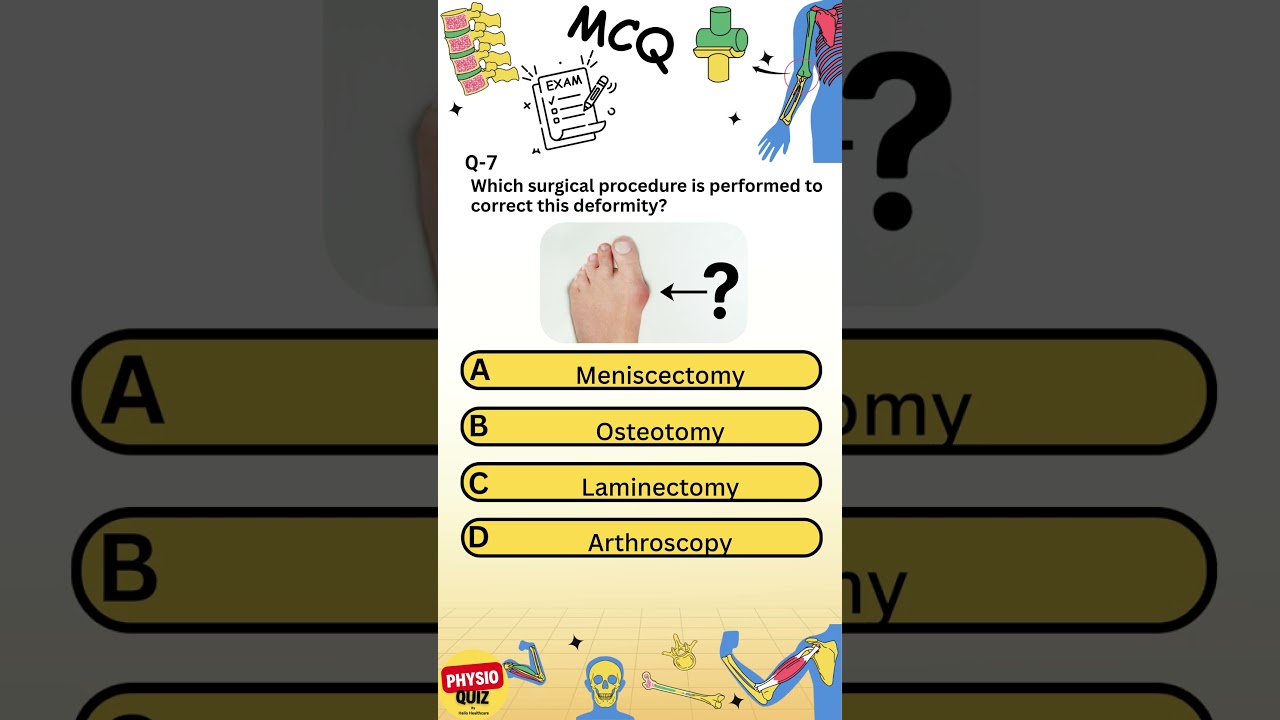
which of the following surgical procedures is commonly performed to correct hallux valgus (bunion) deformity?
A. Meniscectomy
B. Osteotomy ✅
C. Laminectomy
D. Arthroscopy
Correct Answer: B) Osteotomy
Short Explanation :
Hallux valgus (bunion) is a lateral deviation of the great toe with medial prominence of the first metatarsal head. The most commonly used surgical approach to correct symptomatic hallux valgus deformities is an osteotomy of the first metatarsal (distal or proximal), often combined with soft-tissue balancing. Meniscectomy (knee meniscal surgery), laminectomy (spinal decompression), and routine arthroscopy (unless combined for specific indications) are not standard corrective surgeries for hallux valgus. Hence, the correct option is Osteotomy.
✅ What is Hallux Valgus (Bunion)?
Hallux valgus is a common forefoot deformity characterized by lateral deviation of the great toe (hallux) and medial prominence of the first metatarsal head (bunion). It may cause pain, difficulty with footwear, callosities, impaired gait, and progressive deformity. Etiology includes genetics, footwear (narrow toe boxes, high heels), biomechanical factors (pes planus, hypermobility), and systemic conditions (arthritis, inflammatory disease).
🛠️ Why Osteotomy is the Common Surgical Choice
Osteotomy means cutting and realigning bone. For hallux valgus, osteotomies reposition the first metatarsal and/or proximal phalanx to correct alignment, restore the first metatarsophalangeal (MTP) joint angle, reduce the intermetatarsal (IM) angle, and alleviate pain.
Common osteotomies for hallux valgus include:
Distal metatarsal osteotomy (e.g., Chevron / Austin osteotomy) — for mild-to-moderate deformities.
Scarf (diaphyseal) osteotomy — versatile for moderate deformity, allows rotational correction.
Proximal metatarsal osteotomy — used for larger IM angles (severe deformity).
Lapidus procedure (first tarsometatarsal arthrodesis) — fusion of the first tarsometatarsal joint; indicated in hypermobile first ray or severe deformity.
Akin osteotomy — medial closing wedge osteotomy of the proximal phalanx (often adjunct).
Surgeons tailor the procedure according to deformity severity, patient age, bone quality, and functional demands.
🩺 Indications for Surgery
Persistent pain limiting activities despite conservative care
Progressive deformity causing shoe problems, recurrent bursitis, or painful callus
Severe intermetatarsal or hallux valgus angle causing functional impairment
Failed conservative treatments (shoe modification, pads, orthoses, analgesics, physiotherapy)
🧩 Conservative (Non-surgical) Management — When Not To Operate
Conservative approaches are first-line for mild, painless, or early-stage bunions:
Wide, comfortable footwear, toe spacers, and bunion pads
Orthoses, metatarsal pads, hallux valgus splints (night splints)
Manual therapy, joint mobilization, toe strengthening, and intrinsic foot muscle training
Activity modification and anti-inflammatory measures
Physiotherapy focuses on foot intrinsic strengthening, gait retraining, footwear advice, and biomechanical correction to reduce symptoms and slow progression — but conservative care does not permanently reverse structural deformity if severe.
🩹 Post-operative Rehabilitation (Physiotherapy Role)
Physiotherapists play a central role after osteotomy/realignment:
Phase 1 (0–2 wks): wound care, edema control, protected weight-bearing according to surgeon protocol, gentle toe ROM when allowed.
Phase 2 (2–6 wks): progressive weight-bearing, gait training with assistive device as needed, pain control, scar mobilization.
Phase 3 (6–12 wks): progressive strengthening (intrinsic & extrinsic foot muscles), proprioception, balance, progressive return to footwear.
Phase 4 (12+ wks): advanced strengthening, sport-specific return, monitoring ROM and alignment.
Key physiotherapy outcomes: restore function, normalize gait, prevent recurrence, and optimize footwear mechanics.
⚠️ Complications & Considerations
Recurrence of deformity if the correction is insufficient
Stiffness or reduced MTP joint ROM
Nonunion or delayed union at the osteotomy site (rare)
Infection, wound healing issues
Transfer metatarsalgia (pain under the lesser metatarsal heads)
Persistent hallux valgus in systemic arthritic conditions may require different strategies
📚 Exam Relevance & Keywords (High-Yield for BPT/MPT/NPTE/PCE/APC/AIIMS/DHA/SCFHS)
This question is frequently tested in orthopedics and physiotherapy exam banks.
🔖 Hashtags
#PhysioQuiz #HalluxValgus #Osteotomy
#Bunion #FootSurgery #OrthopedicMCQ #PhysiotherapyMCQ #BPT #MPT #NPTE #PCECanada #APCexam #AIIMS #DHA #SCFHS #FootAndAnkle #PostOpRehab #ScarfOsteotomy #ChevronOsteotomy #Lapidus #AkinOsteotomy

Информация по комментариям в разработке