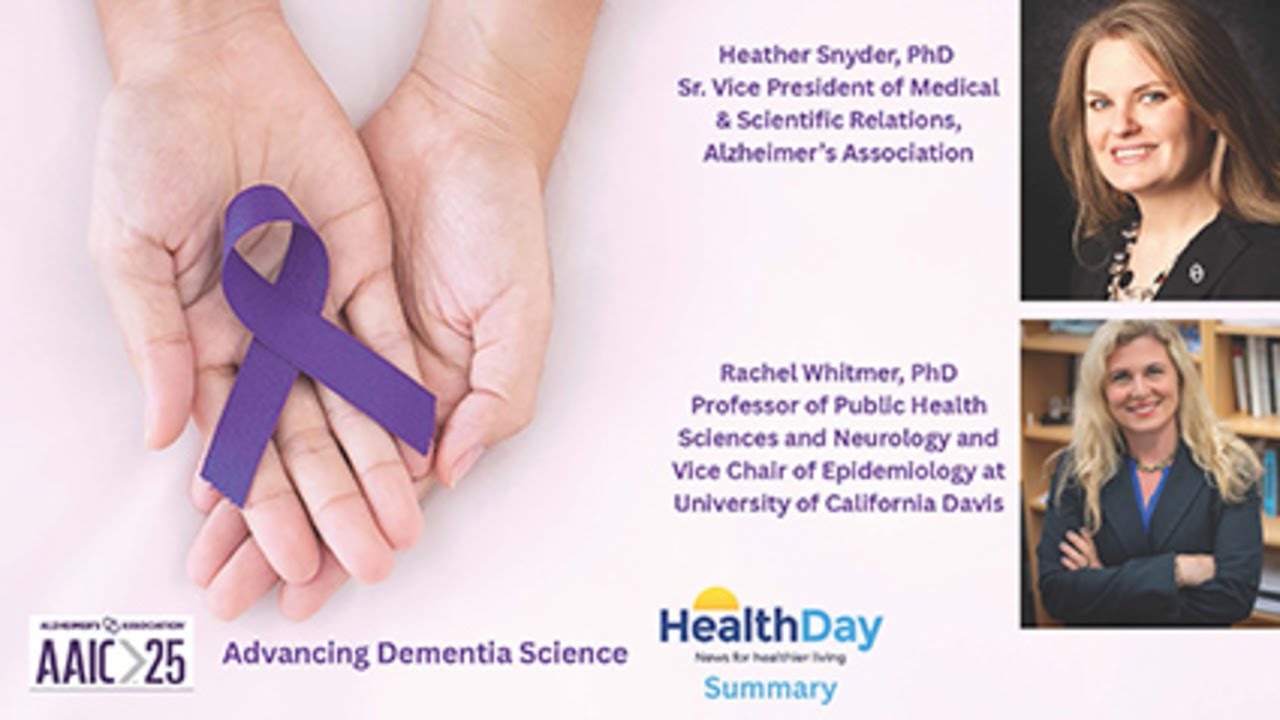
HealthDay interviews Heather Snyder, PhD, Senior Vice President of Medical & Scientific Relations, Alzheimer’s Association, and Rachel Whitmer, PhD, Professor of Public Health Sciences and Neurology and Vice Chair of Epidemiology at University of California Davis.
https://www.healthday.com/med-meeting...
Heather Snyder, PhD, Senior Vice President of Medical & Scientific Relations, Alzheimer’s Association
My name is Heather Snyder and I am the Senior Vice President of Medical and Scientific Relations at the Alzheimer's Association.
At this year's Alzheimer's Association's International Conference, we have nearly 19,000 scientists, clinicians, and others that are following the research gathered in Toronto to hear the latest trends in Alzheimer's and related diseases and what's happening in the science.
One of the things that we don't talk as much about is that of the more than seven million Americans that are living with Alzheimer's disease, two-thirds of those are women and we don't completely understand why. And I think in the last several years, we've increasingly seen studies here at AAIC that are trying to understand why there are more women than men that are leaving with Alzheimer disease. And that's true this year, too.
One of studies that I saw presented, which I think is particularly interesting, looked at women that have actually a different response to traumatic brain injury.
Women who experience a traumatic brain injury, so like a blunt force to the head, for instance, seem to have differences in their volume in certain parts of their brain that we know are also changed in Alzheimer's disease.
Another study that I think is particularly interesting that we're seeing this year is about people that have high blood pressure, high cholesterol and diabetes. Those are all conditions that are associated with greater risk of cognitive decline and dementia, including Alzheimer's as we age.
And one study that looked at individuals that are taking those medications, either two or three of them, actually found that when an individual was taking all three of those medications, like really looking at both the heart health and the metabolic health, that they actually had a benefit on their cognition, so their memory, their thinking, and their reasoning.
And they showed, when they looked in the brains of those individuals, they actually saw less brain change associated to Alzheimer's.
I think one of the things that's really striking when you walk through the halls is just the momentum that we have, that energy, because of the advances that we've had in the last several years, including U.S. Pointer, but also so many other areas as they're advancing. We must continue that momentum as we drive forward in the research.
To learn more, Please visit: https://www.healthday.com/med-meeting...
Visit HealthDay.com: https://healthday.com
Like HealthDay on Facebook: / healthdaynews
Follow HealthDay on Instagram: / healthday_news
Follow HealthDay on Twitter: / healthdaytweets
Connect with HealthDay on LinkedIn: / 418188
0:00 Introduction to Dr Heather Snyder
0:27 The Number of Alzheimer's Patients in the US
0:00 Relation Between Traumatic Brain Injury and Alzheimer's
1:15 Impact of High Blood Pressure, High Cholesterol and Diabetes
1:30 Impact of Some Medications
1:55 Dr Snyder's Finding
2:16 Introduction to Dr Rachel Whitmer
2:26 The Study of Lifestyle Intervention and Cognitive Decline
3:30 About the Participants
4:07 How the Study Was Conducted
5:16 The Result
5:34 Dr Whitmer's Finding
#AlzheimersDisease #BrainHealth #CognitiveDecline #DementiaAwareness #Neurodegeneration #CognitiveHealth #MemoryLoss #WomensBrainHealth #AlzheimersInWomen #TraumaticBrainInjury #SexDifferencesInResearch #BrainHealthForWomen #USPOINTERStudy #MINDdiet #HealthyAging #LifestyleIntervention #PreventAlzheimers #ExerciseForBrainHealth #NutritionAndBrainHealth #AlzheimersResearch #ClinicalTrials #BrainImaging #NeurologyResearch #AAIC2025 #PublicHealthScience #HealthNews #HealthAdvice #HealthTips #HealthyLiving #HealthyHabits #HealthyLifestyle #HealthyChoices #Wellness #WellnessTips #MedicalResearch #MedicalStudy #HealthResearch #HealthStudies #WellnessMatters #StayHealthy #HealthRisks #MedicalAdvice #HealthAwareness #HealthDiscussion #HealthStudy #ResearchFindings #HealthSolutions #HealthEducation #HealthInformation #MedicalFindings #ScienceNews #HealthData #ScientificFindings #MedicalNews #DimentiaDifferencesInSexes #AlzheimersDifferencesInSexes

Информация по комментариям в разработке