Drosanthemum bicolor L. Bolus
Family: Aizoaceae
Common Names: Bicolor Dewflower, Two-Colored Dewflower
Taxonomy & Etymology
Drosanthemum bicolor belongs to the family Aizoaceae, the large southern African group commonly known as the “ice plants.” The genus name Drosanthemum derives from the Greek drosos (dew) and anthemon (flower), referring to the glittering, dew-like papillae that cover the leaves and stems. The specific epithet bicolor means “two-colored,” referencing the distinctive two-toned appearance of its flowers. It was formally described by the South African botanist Louisa Bolus, an authority on the Mesembryanthemaceae.
Distribution & Habitat
This species is endemic to the winter-rainfall regions of South Africa’s Western and Southern Cape, extending from the Ceres Karoo to the Little Karoo and coastal Namaqualand. It grows in rocky slopes, clay flats, and gravelly shale soils, often among renosterveld and succulent karoo vegetation. It is well adapted to arid conditions, surviving long dry summers and cool, moist winters.
Morphological Description
Growth Habit: A low, spreading succulent shrublet reaching 15–30 cm in height and spreading to about 40–50 cm in diameter. It forms dense mats or rounded mounds that glisten with dew-like papillae under sunlight.
Stems: Branching, semi-woody at the base, becoming fleshy toward the tips. Covered in tiny bladder cells that reflect light and conserve moisture.
Leaves: Opposite, cylindrical to slightly flattened, 1–2 cm long, bright green to grey-green. Surfaces are covered in glistening papillae that act as a protective layer against desiccation.
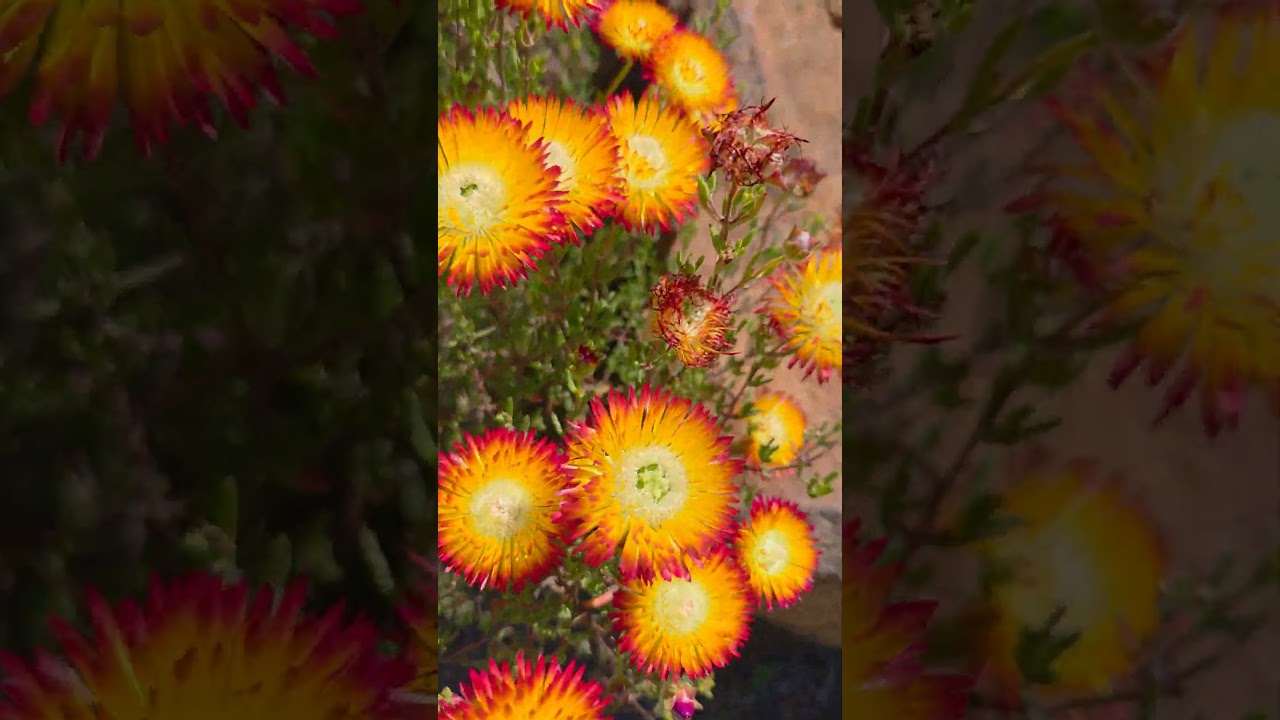
Flowers: Distinctively bicolored, with inner petals typically pink, magenta, or purple and outer petals fading to white or pale yellow. Each bloom is 2–3 cm in diameter, daisy-like, and borne singly or in small clusters on terminal stems. Flowers open in bright sunlight and close by evening.
Blooming Season: Late winter to mid-spring (August to October) in the Cape region, coinciding with the seasonal rainfall period.
Fruit: A small, five-locular capsule that opens when moistened—a typical “hygrochastic” adaptation of Aizoaceae to release seeds during wet conditions.
Ecological & Physiological Adaptations
Succulent Tissue: Stores water in both leaves and stems for survival during drought.
Papillate Surface: The glistening epidermal bladder cells reduce water loss and reflect sunlight, giving the plant its characteristic “dewy” appearance.
CAM Photosynthesis: Operates primarily via Crassulacean Acid Metabolism, enabling efficient water conservation.
Hygrochastic Fruit Mechanism: Capsules open only when wet, ensuring that seeds are released under optimal conditions for germination.
Pollination Ecology: The bright two-toned flowers attract a wide variety of insect pollinators, including bees and small beetles.
Cultivation & Care
Light: Requires full sun for compact growth and prolific flowering. Plants grown in shade become elongated and produce fewer blooms.
Soil: Thrives in well-draining, sandy or gravelly soil with low organic content. Avoid waterlogged conditions.
Watering: Water sparingly. In regions with summer rainfall, allow the soil to dry completely between waterings. Overwatering causes root rot. During the winter growing season, occasional watering promotes flowering.
Temperature: Prefers mild, frost-free climates (USDA zones 9–11). Can tolerate brief light frost if kept dry.
Fertilization: Not required; excessive nutrients encourage soft, weak growth.
Maintenance: Minimal. Prune lightly after flowering to maintain compact form and prevent woodiness. Excellent drought-tolerant groundcover for arid or coastal gardens.
Propagation
Cuttings: The easiest method. Take stem cuttings in late spring or autumn, allow to callus for several days, then plant in a gritty mix.
Seed: Can be sown in shallow trays during the cool, moist season. Seeds germinate in 2–3 weeks under bright, indirect light.
Horticultural & Landscape Value
Drosanthemum bicolor is prized for its vivid, dual-colored flowers and shimmering foliage, ideal for rock gardens, dry borders, and embankment plantings. Its resilience to drought and heat makes it a signature plant in xeriscaping and fynbos-themed designs. When planted en masse, it forms a dazzling carpet of pink, white, and gold hues that attract pollinators and brighten landscapes during the spring bloom period.
Summary
Drosanthemum bicolor is a low-growing, mat-forming succulent endemic to South Africa’s semi-arid regions. Recognizable by its dew-like foliage and two-toned flowers, it thrives in full sun and well-drained soils, offering exceptional drought tolerance and ornamental value. A hallmark of the Cape flora, it exemplifies the adaptive beauty of the Aizoaceae — a fusion of ecological resilience and striking color that transforms dry landscapes into living mosaics of light and texture.

Информация по комментариям в разработке