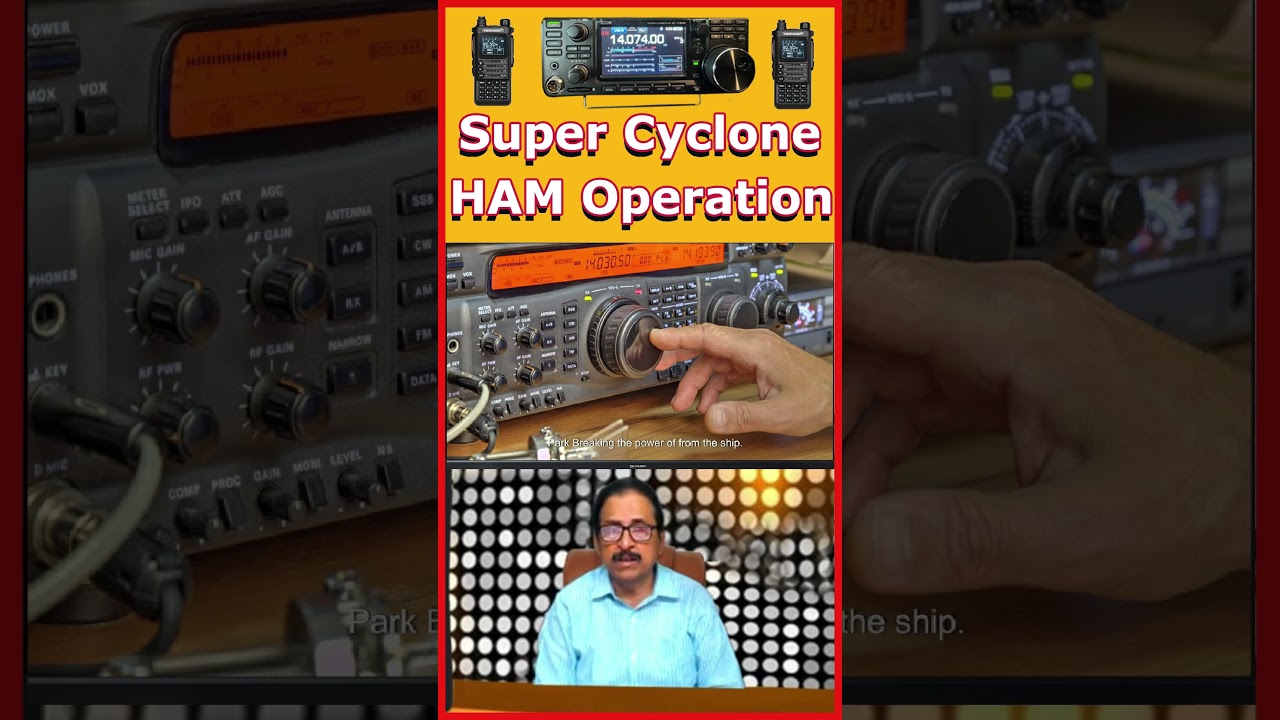
In 1999, a devastating super cyclone struck the state of Orissa, leaving behind an unimaginable trail of destruction. Prior to this event, a few smaller cyclones had caused some damage, but the scale of this super cyclone was unprecedented. As a precaution, the government had deployed ham radio operators to vulnerable areas in the neighbouring district of Srikakulam, Andhra Pradesh. I was among those sent to establish emergency communication stations. I first set up a station in Ichapuram and then returned to the Srikakulam Collector’s office. At that time, Mr. Jawahar Reddy, IAS—then the Collector of Srikakulam and now the Chief Secretary of Andhra Pradesh—commended our readiness and wisely used our presence to prepare further. Fortunately, Andhra Pradesh was spared the brunt of the cyclone. However, the storm veered into Orissa, causing catastrophic damage. Upon realising the extent of the destruction, the Government of Andhra Pradesh instructed all deployed ham radio operators to proceed to Orissa and assist in emergency communication and disaster coordination. Without delay, we travelled to Orissa, witnessing first-hand the collapsed electric poles, submerged villages, and wind speeds estimated between 230–250 km/h, which even damaged wind measuring instruments. Despite the devastation, with the help of local residents, we secured bamboo poles and managed to set up ham radio stations. With Bhubaneswar cut off from the outside world, our stations served as a vital link between the Orissa state capital and the Andhra Pradesh Secretariat. Based on the communication we provided, Andhra Pradesh responded by sending essential relief materials—cooked rice mixed with jaggery (chosen wisely over lime rice due to storage concerns), candles, matchboxes, and more via special aircraft and helicopters. Our services earned deep appreciation from the people and government of Orissa. The importance of ham radio as a lifeline during the disaster became clear. One of the most critical moments came when we decided to send a ham team to Paradeep, a coastal township of 70,000 people, situated just 40 km from Bhubaneswar. Mr. D.N. Paddy, the Relief Commissioner of Orissa, warned us of the extreme tension in the area. People, desperate for relief, were raiding government offices. He made it clear that we would have to manage on our own, without security. Despite this, two brave ham operators—Mr. Suresh (VU2IPL) and Mr. Hanumanth Rao (VU2PHR)—volunteered to proceed. They established communications in Paradeep under dire conditions, surviving on limited food like biscuits, as even the Navy personnel present were unable to assist due to protocol. On one tense evening, while I was working alongside Mr. Shankar Rao (VU2HVR) at the relief control room in Bhubaneswar, we received an urgent call from VU2PHR. He was deeply alarmed: the ammonia plant in Paradeep was on the verge of a catastrophic explosion. Due to a power failure, including backup generators, the ammonia, which needs continuous cooling, was at risk of turning into gas and causing a massive blast. A similar tragedy had occurred during the 1984 Bhopal gas disaster. This information was not public, but had been leaked by volunteers from the Anandamarga, known for their fearless disaster response. Panic set in. Some officers had already fled Paradeep. We rushed to inform Mr. D.N. Paddy. A high-level emergency meeting was convened with officers from the Navy, Air Force, and civil administration. The immediate concern was evacuating 70,000 people. However, damaged roads and fallen trees made mass evacuation by road impossible. One Indian Air Force officer proposed an aerial evacuation—the largest airlift in Indian history. But another officer offered a brilliant alternative: restore power to the ammonia plant using a high-capacity generator. This was swiftly approved. A transport aircraft (Antonov AL-34) airlifted the generator to Paradeep. Engineers parachuted down and successfully installed the generator. Just in time, power was restored, preventing the ammonia from vaporising. A major disaster, potentially worse than Bhopal, was averted. Further, additional power was sourced from a ship docked at Paradeep Port. Within hours, Paradeep, which was shrouded in darkness, lit up, while the state capital Bhubaneswar, remained in blackout. This moment was transformative. Ham radio operators had not only provided a lifeline of communication but had also played a pivotal role in saving thousands of lives. The people of Paradeep hailed us as heroes. Even the Navy officials at INS Chilka openly appreciated our efforts, saying: “Your communication bridged the impossible, and because of you, we were able to respond with precision and speed. You’ve done a great service to this nation.”

Информация по комментариям в разработке