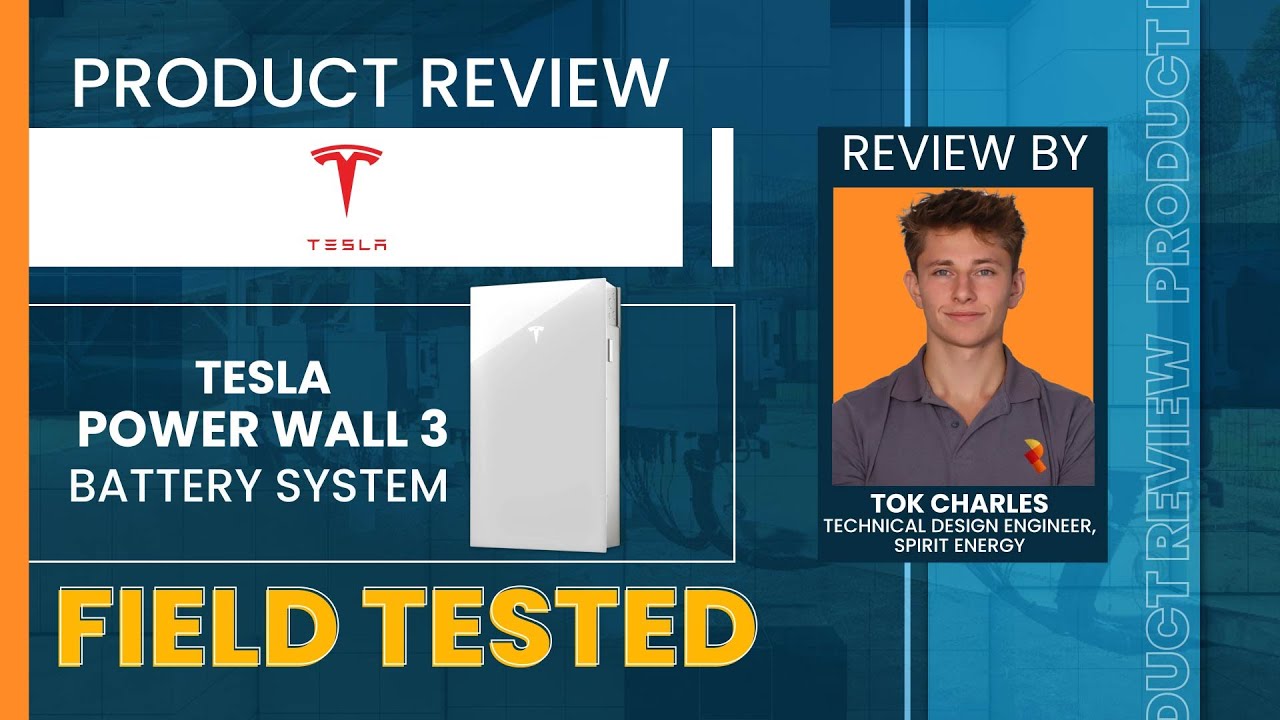
Field Tested: Tesla Powerwall 3 Integrated Solar And Battery System
Tok Charles, Technical Design Engineer at Spirit Energy and a top-10 Tesla installer in the UK, reviews the Tesla Powerwall 3 based on Spirit’s decade of field experience with Powerwall systems and their installation of the first Powerwall 3 in the UK, focusing on install practicality, UK grid constraints, and real-world support outcomes.
Key Moments:
0:00 - Introduction - Tesla Powerwall 3
0:14 - General Overview
01:22 - Primary Strength
03:10 - Market Comparison
04:07 - Potential Weakness
04:48 - Warranty & After Sales
05:51 - Final Verdict
Field Performance & Installation Practicality
The installation process was described as “really smooth” because the all-in-one design consolidates solar and battery functions without adding extra system complexity.
The ability to set the inverter rating anywhere from 3.6 kW to 11 kW was highlighted as a practical advantage for avoiding delays on jobs limited by UK grid/export constraints.
In an on-site scoring breakdown, installation was the only area not rated perfect (4/5), while performance, build quality, value, and overall were each rated 5/5.
System Design, Flexibility & Roof Utilization
The 11 kW inverter platform combined with flexible rating was framed as especially useful in weaker-grid environments where many homes cannot accommodate a full 11 kW setup.
Three PV string inputs were called out as a meaningful design benefit because it enables more workable roof layouts and better PV coverage on complex roofs.
The US version’s six PV inputs were presented as a major roof-space lever, reinforcing string-input count as a real-world differentiator rather than a minor spec detail.
Reliability, Support Experience & Downtime Risk
Long-term operating longevity was used to justify confidence in the platform, with earlier-generation units cited as still running roughly a decade later.
The after-sales approach was characterized as “replace, don’t repair,” with replacements shipped proactively instead of relying on technician repair attempts.
The only issue observed on the first UK unit was a failed firmware update that caused an afternoon of downtime, resolved by an engineer restoring operation.
Value Trade-offs & Market Positioning
Powerwall was positioned as a benchmark product that installers use as a reference point when evaluating other home battery systems.
A comparison against four similar systems concluded Powerwall 3 was technically best while also lowest on a price-per-unit-of-storage basis, even if the upfront price appears higher.
The main “hidden cost” was framed as lost savings during downtime (opportunity cost), with the key sales challenge being explaining why a larger 13.5 kWh unit costs more upfront while remaining cost-effective per kWh.
#Tesla Powerwall 3, #Powerwall 3 Review, #Tesla Powerwall, #Tesla Energy, #Integrated Solar and Battery System, #All-in-one design, #Home Energy Storage, #Solar Inverter, #Battery Storage, #Flexible Inverter Rating, #UK Grid Constraints, #PV String Inputs, #Field Tested Review, #Spirit Energy, #Installer Review, #Product Review, #Long-term reliability, #Benchmark Product, #Cost-effective per kWh, #Value Trade-offs

Информация по комментариям в разработке