Teddy Niedermaier, piano
Live recording, Feb. 12, 2018, Ganz Hall, Chicago
Princess Bari (2017), narrative suite for piano
0:00 -- I. Birth of Bari
2:09 -- II. King Ogu’s anger
4:04 -- III. Bari is drowned in the sea
4:56 -- IV. The monks rescue Bari
6:50 -- V. Lullaby
8:42 -- VI. The intelligent young girl
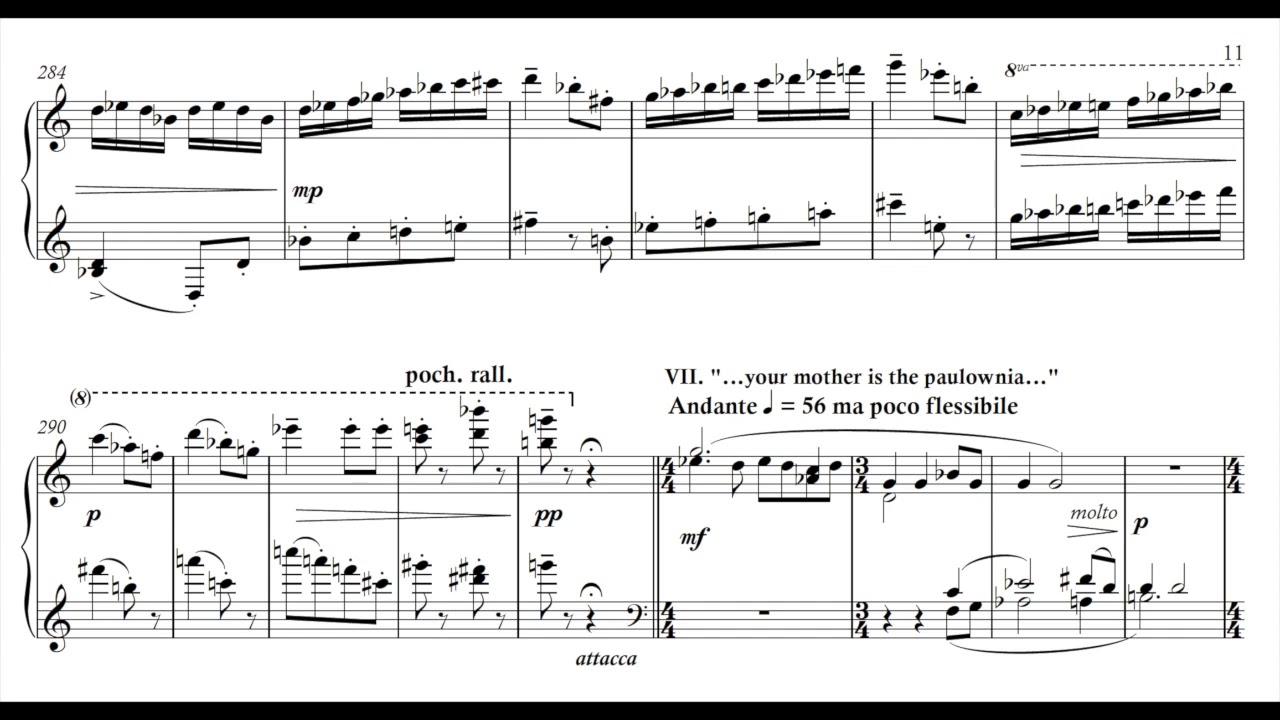
10:51 -- VII. “…your mother is the paulownia…”
13:22 -- VIII. King Ogu pleads for Bari’s return
14:59 -- IX. Bari’s journey
19:35 -- X. King Ogu is healed
22:57 -- XI. Apotheosis of Bari
This work retraces the Korean shamanic legend of Princess Bari in 11 short movements. Its structure was inspired by Schumann’s great piano suites (i.e. Davidsbündlertänze, Carnaval) and Mussorgsky’s Pictures at an Exhibition, wherein each brief movement depicts a scene, a character, or an emotional state. Each movement in Princess Bari is roughly 2 minutes or shorter, except for “Bari’s Journey” (4-5 minutes), the only movement to develop ideas from several of the preceding movements.
So who is Bari? She is the “abandoned princess,” the rejected seventh daughter of King Ogu and Lady Kildae. Ogu had no sons and six spoiled daughters. When Bari was born, he was enraged at his inability to generate a male heir. In his fury he ordered the newborn Bari to be placed in a chest and drowned in the sea. The legendary Dragon King, unable to tolerate such injustice, saved the chest and delivered it to shore, where Bari was rescued and adopted by monks. The monks raised Bari, who grew up to be talented and intelligent. Once she was old enough to consider her own roots, Bari asked the monks who her parents really were. One replied, “Your father is the spirit of the bamboo and your mother is the paulownia.”
One day the King’s servant visited the monks in desperate search for the King’s long-lost daughter. The King was now gravely ill, and a dream revealed that the only cure for his illness was an enchanted elixir that could only be obtained by a blood relative. Bari’s six older sisters had already refused the arduous journey to the distant, mythic Eastern land where the elixir might be found. Bari returned to the palace and immediately agreed to undertake the perilous journey. On her way, she ventured through the underworld, unlocked the gates of hell, married a celestial being, bore him sons, obtained the elixir, and headed home. Alas, she returned to the palace on the very day of her father's funeral, but miraculously the elixir was able to revive him.
In gratitude, Ogu offered Bari half of his kingdom. She refused, electing instead to become a goddess, shepherdess of souls, and the hearer of death rites. To this day, her story is enacted by shamans during burial ceremonies. She is a national hero and a model of filial piety, risking everything to save the father who had once abandoned her. In another sense, however, she is a fiercely independent, modern protagonist who chooses her own fate. Her invocation by Korean shamans (who are mostly female) since the 19th century is seen by scholars as an act of defiance against the neo-Confucian and patriarchal social structures of the late Joseon period.
Please visit teddycomposer.com for more information or to contact the composer.
copyright 2017 Teddy Niedermaier (ASCAP)

Информация по комментариям в разработке