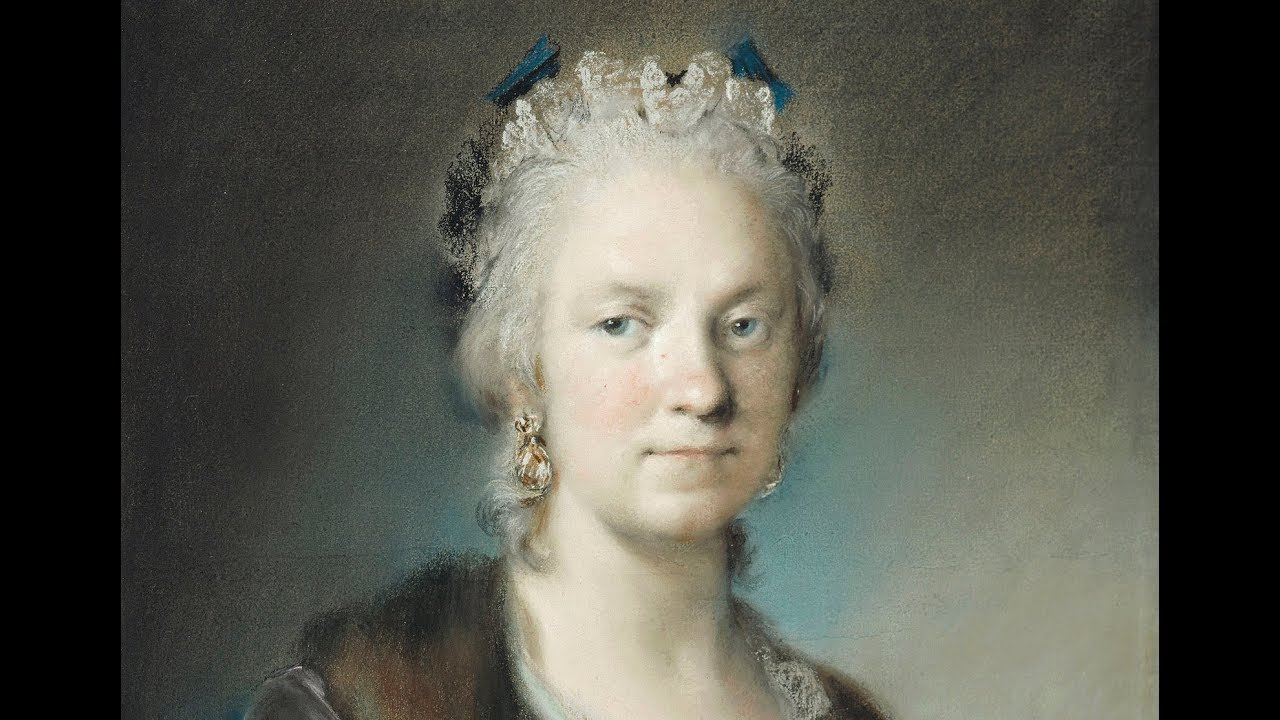
Born in Venice with two sisters, Rosalba Carriera was a prominent and greatly admired portrait artist of the Italian Rococo. Her family was from the lower-middle-class in Venice, and as a child, she began her artistic career by making lace-patterns for her mother, who was engaged in that trade. However, when interests in lace waned and the industry began to falter, Carriera had to find a new means of providing for herself and her family.
The popularity of snuff-taking gave her an opportunity to do just that. Carriera began painting miniatures for the lids of snuff-boxes, and was the first painter to use ivory instead of vellum for this purpose. Gradually, this work evolved into portrait-painting, for which she pioneered the exclusive use of pastel. Prominent foreign visitors to Venice, young sons of the nobility on the grand tour and diplomats for example, clamored to be painted by her. The portraits of her early period include those of Maximilian II of Bavaria; Frederick IV of Denmark; the 12 most beautiful Venetian court ladies; the "Artist and her Sister Naneta" (Uffizi); and August the Strong of Saxony, who acquired a large collection of her pastels.
By 1700 she was already creating miniatures and by 1703 she completed her first pastel portraits. In 1704, she was made an 'Accademico di merito' by the Roman Accademia di San Luca, a title reserved for non-Roman painters.
By 1721, Carriera's left Venice for Paris, as portraits by her were in great demand. While in Paris, Carriera was a guest of the great amateur and art collector, Pierre Crozat. She painted Watteau, all the royalty and nobility from the King and Regent downwards, and was elected a member of the Academy by acclamation. Her brother-in-law, the painter Antonio Pellegrini, married to her sister Angela, was also in Paris that year. Pellegrini was employed by John Law, a Scottish financier and adventurer, to paint the ceiling of the Grand Salle in Law's new Bank building.
Carriera's other sister, Giovanna, and her mother, were members of the party in France. Both sisters, particularly Giovanna, helped her in painting the hundreds of portraits she was asked to execute. This was because she undertook a lot of work in order to support her family. Carriera's diary of these 18 months in Paris was later published by her devoted admirer, Antonio Zanetti, the Abbé Vianelli, in 1793. Her extensive correspondence has also been published.
In later life, Carriera made a long journey to the royal court in Vienna, Austria. While there, Holy Emperor Charles VI became her benefactor and was fully committed to supporting her work. The Emperor amassed a large collection of more than 150 of her pastels. In return, the empress worked underneath her and received formal artistic training. The works she executed there were later to form the basis of the large collection in the Alte Meister Gallery in Dresden.
After her sister Giovanna's death in 1738, Carriera fell into a deep depression which was not aided by the loss of her vision (which might have been damaged by miniature-painting in her youth) some years later. She underwent two unsuccessful cataract surgeries but ended up losing her vision completely. She outlived all her family, spending her last years in a little house in the Dorsoduro district of Venice, where she died at the age of 84.
https://en.wikipedia.org/wiki/Rosalba...
The images are only being used for informational and educational purposes
Text & images:
https://commons.wikimedia.org/wiki/Ca...
https://www.rct.uk/collection/search#...
https://www.rct.uk/collection/search#...
https://www.rct.uk/collection/search#...
https://www.rct.uk/collection/search#...
https://www.rct.uk/collection/search#...
https://www.rct.uk/collection/search#...
https://www.rct.uk/collection/search#...
http://www.the-athenaeum.org/art/list...
https://www.wikiart.org/en/rosalba-ca...
Music:
Brandenburg Concerto No4-1 BWV1049 - Classical Whimsical
7:17
Kevin MacLeod
Clásica | Feliz
Puedes usar esta canción en cualquiera de tus vídeos, pero debes incluir el siguiente texto en la descripción:
Brandenburg Concerto No4-1 BWV1049 - Classical Whimsical de Kevin MacLeod está sujeta a una licencia de Creative Commons Attribution (https://creativecommons.org/licenses/...)
Fuente: http://incompetech.com/music/royalty-...
Artista: http://incompetech.com/

Информация по комментариям в разработке