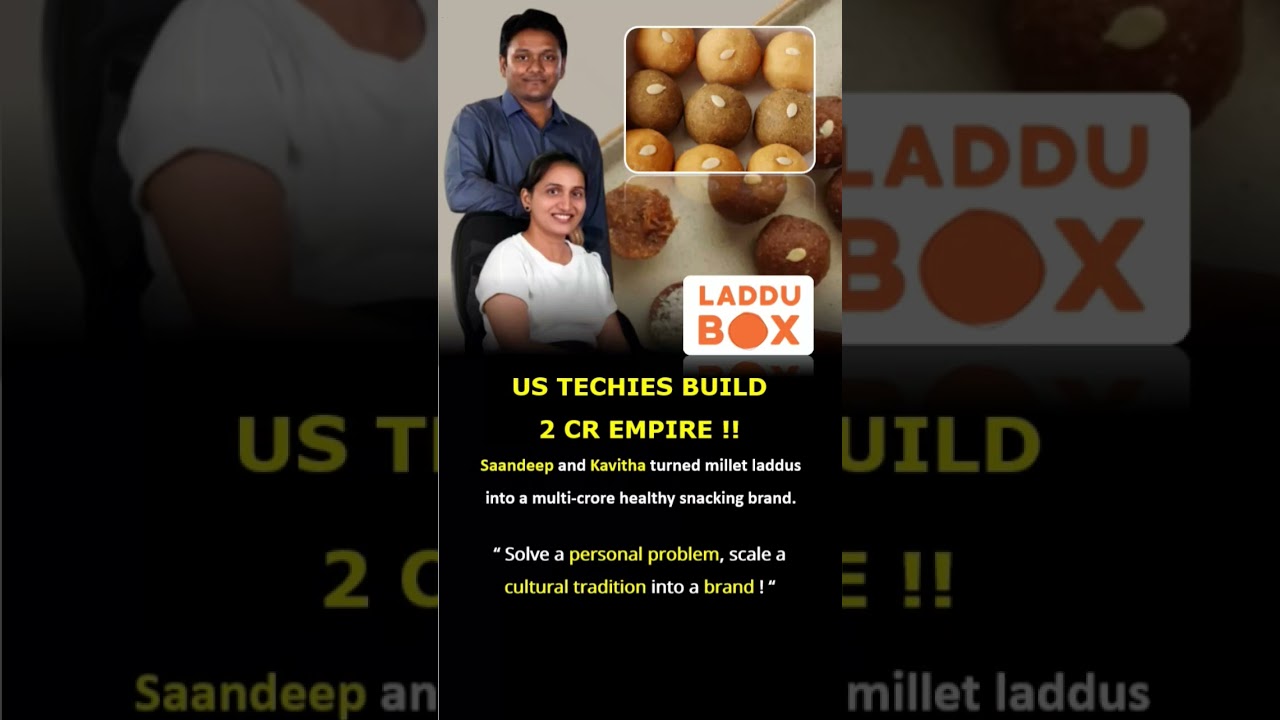
See how Saandeep & Kavitha built a ₹2 Crore brand from millet laddus, proving traditional Indian snacks can beat global junk food brands!
The story of Laddu Box is a classic "homecoming" tale—one where two software engineers traded their keyboards in Silicon Valley for the traditional kitchens of Hyderabad to solve a very personal problem: the "guilt" of a sweet tooth.
Here is the detailed journey of Saandeep Jogiparti and Kavitha Gopu.
1. The Silicon Valley Spark
Saandeep and Kavitha were living the high-life in California, working as successful software engineers. Like many Indians living abroad, Saandeep had a ritual: he needed something sweet after every meal.
However, his health-conscious family was constantly "glaring" at him for the amount of refined sugar he was consuming. His mother eventually suggested a simple swap: "Instead of a laddu, just eat a spoon of jaggery." This sparked a thought—why can’t the sweet itself be as healthy as the jaggery?
2. Leaving the "American Dream"
In 2018, the couple decided to move back to India. They spent the next six to eight months traveling across the country, not as tourists, but as researchers. They noticed a massive gap: while the market was flooded with protein bars and western snacks, the traditional Indian laddu was being ignored as a health food, despite being naturally nutrient-dense.
3. The ₹1 Lakh Launch (and a Pandemic)
In 2019, with an initial investment of just ₹1 lakh, they started Laddu Box in Hyderabad. They launched with 11 varieties, including:
Millet Magic: Using Ragi (Finger Millet), Foxtail, and Kodo millets.
The Binding Secret: They replaced refined sugar with cane jaggery and dates, and used pure ghee instead of processed oils.
No "Bad" Stuff: No preservatives, no artificial colors, and no hidden sugar alcohols.
Then, COVID-19 hit. Just as they were gaining momentum with stalls at IT parks, the world shut down. Instead of giving up, they pivoted. They turned their home-based unit into a cloud kitchen and launched an e-commerce website. Surprisingly, the pandemic’s focus on "immunity" and "healthy eating" worked in their favor.
4. Growth and Scaling
The business that started in a four-room house in Pocharam quickly outgrew its space.
Revenue: From a humble start, the brand reached a turnover of ₹55 lakh within its first year and eventually grew into a ₹2 crore business.
Global Reach: While they started locally, they soon began shipping to the USA and UK, satisfying the cravings of NRIs who, like Saandeep once did, wanted a taste of home without the chemicals.
Social Impact: They partnered with Feeding India (Zomato) to provide ragi and peanut laddus to thousands of children in Anganwadi centers in Uttar Pradesh.
Why They Are Different
Natural Sweeteners: Replaces unhealthy refined sugar with a wholesome blend of cane jaggery and dates.
Ancient Grains: Swaps processed maida and refined flours for nutrient-rich millets like Ragi, Jowar, and Foxtail.
Mindful Portions: Features smaller 28g "Bites" instead of standard 40g servings to encourage portion control and reduce food waste.
Clean Labeling: Uses a minimalist recipe of 5 or fewer pure ingredients, eliminating the long list of additives and preservatives found in commercial sweets.
Money Lesson:
Solve a personal problem, scale a cultural tradition into a brand.
It’s incredible to see how a simple 'No' to refined sugar turned into a massive business empire. If you were to leave your 9-to-5 to modernize one traditional Indian snack, which one would it be?
Let me know in the comments—the most unique idea gets a shoutout !
#LadduBox #StartupIndia #MilletMission #Entrepreneurship #HealthySnacking #SuccessStory #MakeInIndia

Информация по комментариям в разработке