XII International Scientific Symposium On Byzantine And Medieval Studies: “Days Of Justinian I” Skopje, 31 October -2 November, 2025
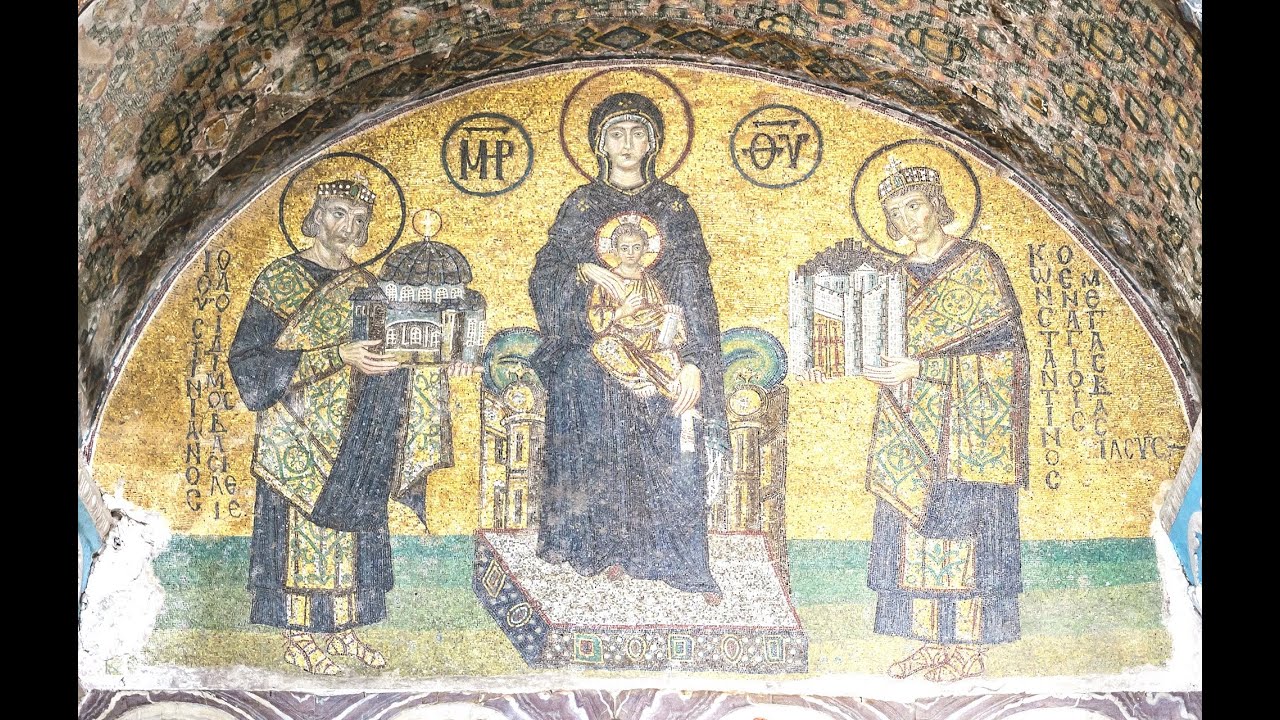
The author continues his investigations on various problems concerning the mosaic in the south vestibule of the Hagia Sophia in Constantinople. At the 2024 Symposium in Skopje, he proved this mosaic represents the patronage of state power by the Theotokos in the victories of Basil II over Bulgarians in the Balkans and other enemies in the Eastern provinces, too. Now he is involved in the debates on the date of the mosaic. The starting point is the fact that there are depicted Emperor Constantine the Great offering the city of Constantinople to the Mother of God, to the right, and Emperor Justinian I the Legislator (Lawgiver), as offering the Hagia Sophia (which was built by him) to the Mother of God, to the left. It will be given an overview of the main arguments about different dates in the literature, and we argue with the structure and iconographic message of the mosaic, instead of the material, the style of inscriptions, and the shaping of the figures. The latter arguments were already dealt with very accurately in the works of Th. Whittemore, who restored the mosaic and first described it in the 1930s, was followed by Ch.R. Morey in the 1940s, who provided an even earlier date. Viewpoints were then discussed in the 1945 Dumbarton Oaks conference, and the works providing the later date in the 11th century were summarised in Beckwith (1961). As for the iconography, it seems more likely that Basil II wished to commemorate his victories over Bulgarians in 1017, rather than John Tzimisces, who usurped power during Basil’s childhood, and defeated the Eastern Slavs, Svjatoslav, Prince of Kyiv, in 971. In our view, Basil could and wished to commemorate his entire conquering activity, including his victories in the East, too, and he compared himself with Justinian I. – The Theotokos in the centre was a copy of the Theotokos in the great apse of the Hagia Sophia, therefore, the arguments based on the depiction of the Mother of God (thus the veil-argumentation by Mango, and the inscriptions comparing with miniatures by Morey, and considerations from the main inscription Μήτηρ Θέου by Whitemore, etc.) should be evaluated with considering that the “main” Thetokos in the great apse was created earlier and gave the pattern to this mosaic. These “material” arguments should be completed by “functional” arguments, too: why was this mosaic created, in which position, and with what purposes?
We consider for an argument that the South Vestibule was a special entrance, earlier for the Patriarch, then for the Emperor exclusively; therefore, this mosaic served as a visual representation of the power and glory of the Empire. The entrance under this mosaic is named “patriarchal door”. (Niewöhner & Teteriatnikov, 2014) The mosaic in the south vestibule has explicit secular content, too, with the two greatest emperors of the Byzantine Empire, namely, the founder of Constantinople, Constantine the Great, and the greatest conqueror and codifier of the Empire, Justinian the Legislator; thus, those whose reign gave the largest territory and greatest power to the Empire. Such a great conqueror, after Justinian, was only one, although his territory was far less than that of Justinian’s empire, but after the latter, he was relatively the greatest and strongest: the Bulgar Slayer, Emperor Basil II, under whose direction this mosaic might have been created. Basil II not only broke the power of the Tsar Samuel of the Bulgars and recovered Syria, Antioch, and Mesopotamia from Islam. A date after the victory of 1017 seems the most probable for the creation of this mosaic, because usurper Tzimisces was not in such a position that he could compare himself to Justinian I but to Emperor Basil II. However, the date is a subject of debate, and heated discussions took place between the supporters of the Basil-epoch and the Tzimisces-epoch. Preparing studies and the referred literature were published in our previous draft paper here: Földvári, S. (2025) “The Visual Representation of the State Power in the Mosaic of the South Vestibule in the Hagia Sophia” https://www.academia.edu/129165092/ -- The full paper will be given to Skopje cumulating this lecture on the dating of the mosaic (2025) and the previous (2024) on the represantation of the state power.

Информация по комментариям в разработке