Bavarian Radio Symphony Orchestra & Choir conducted by Rafael Kubelik. For a list of singers: https://tinyurl.com/2bwnh4mz
I - Akt I
Vorspiel (0:00) - "He! Ho! Waldhüter Ihr" (12:03) - "Sehr Dort, Die Wilde Reiterin!" (17:38) - "Recht So! - Habt Dank!" (20:54) - "He, Du Da! Was Liegst Du Dort Wie Ein Wildes Tier?" (27:02) - "Das Ist Ein Andres" (34:31) - "Titurel, Der Fromme Held, Der Kannt' Ihn Wohl" (39:04) - "Vor Allem Nun: Der Speer Kehr Uns Zurück!" (47:26) - "Weh! - Hoho! - Auf! - Wer ist der Frevler?" (50:14) - "Du Konntest Morden, Hier Im Heil'gen Walde" (51:43) - "Wo Bist Du Her?" (55:33) - "Den Vaterlosen Gebar Die Mutter" (58:56) - "So Recht! So Nach Des Grales Gnade" (1:02:21) - "Vom Bade Kehrt Der König Heim" (1:05:10) - "Nun Achte Wohl, Und Lass Mich Seh'n" (1:11:06) - "Mein Sohn Amfortas, Bist Du Am Amt" (1:19:06) - "Nein! Lasst Ihn Unenthüllt!" (1:22:01) - "Nehmet Hin Meinen Leib" (1:32:44) - "Was Stehst Du Noch Da?" (1:46:43)
II - Akt II
Vorspiel (1:49:29) - "Die Zeit Ist Da" (1:51:30) - "Erwachest Du? Ha!" (1:54:14) - "Jetzt Schon Erklimmt Er Die Burg" (2:02:06) - "Hier War Das Tosen" (2:05:33) - "Iht Schönen Kinder" (2:07:46) - "Komm, Komm! Holder Knabe!" (2:09:54) - "Parsifal! - Weile" (2:14:58) - "Ich Sah Das Kind An Seiner Mutter Brust" (2:21:23) - "Wehe! Wehe! Was Tat Ich?" (2:26:59) - "Amfortas! - Die Wunde" (2:31:46) - "Grausamer! Fühlst Du Im Herzen" (2:40:47) - "Auf Ewigkeit Wärst Du Verdammt" (2:47:06) - "Vergeh, Unseliges Weib!" (2:53:09) - "Halt Da! Dich Bann Ich Mit Der Rechten Wehr!" (2:54:28)
III - Akt III
Vorspiel (2:56:53) - "Von Dorther Kam Das Stöhnen" (3:01:49) - "Du Tolles Weib! Hast Du Kein Wort Für Mich?" (3:06:12) - "In Düstrem Waffenschmucke?" (3:09:16) - "Heil Mir, Dass Ich Dich Wiederfinde!" (3:16:32) - "O Gnade! Höchstes Heil!" (3:21:02) - "Nicht So! - Die Heil'ge Quelle Selbst" (3:28:27) - "Du Wuschest Mir Die Füsse" (3:32:21) - "Wei Dünkt Mich Doch Die Aue Heut So Schön" (3:38:42) - "Mittag. - Die Stund Ist Da" (3:48:34) - "Geleiten Wir Im Bergenden Schrein" (3:52:47) - "Ja, Wehe! Wehe! Weh über Mich" (3:56:32) - "Nur Eine Waffe Taugt" (4:03:39)
Wagner's "Parsifal" was conceived in 1857, while he was working on "Tristan and Isolde". It took several plot ideas from "The Victors" (Die Sieger), a 1856 unrealised opera based on a story from the life of Buddha. Wagner briefly returned to the project to write a prose draft between August 27-30 of 1865, while composing "The Master-Singers of Nuremberg". He then devoted his energies to completing the Ring cycle. It wasn't until 1876 that he returned to "Parsifal", completing it on January 13 of 1882. It was premiered at the Bayreuth Festival Theatre on July 26 of that year, conducted by Hermann Levi.
Parsifal is the story of a young man whose virtue and compassion become the salvation of the Knights of the Holy Grail. He wards off temptation and danger to regain the spear with which Christ's side was pierced on the cross; in the process he heals the king, Amfortas, of a cursed wound, and relieves the fallen woman, Kundry, from her eternal wandering. His major sources were the epic poem "Parzival" by the thirteenth century poet Wolfram von Eschenbach (who incidentally, appears as a character in Tannhäuser), and the medieval romance "Perceval, ou li Contes de Graal", by Wolfram's near-contemporary, Chrétien de Troyes. "Parsifal" shows Wagner’s highly idiosyncratic views on religion, heroism, and art, views he had elucidated in a series of essays published from 1878 (“Modern”) to 1881 (“Heroism and Christianity”) as the opera was taking shape.
Musically, the work reaches both backwards and forward. The extraordinary music of the first act Transformation scene combines a triadic ground bass with progressively chromatic harmonies, creating an almost tangible sense of movement from the outside world to a hidden place of awe. The haunting milieu of the Grail castle in Act One is conjured by the tolling bells, the deliberately archaic a cappella choruses (Wagner studied Palestrina for these), and Titurel's offstage voice, punctuated by timpani. Kundry's raging solo passages in Act Three are almost Expressionistic in nature, with their wide, dissonant leaps, laughs, cries, and groans. The Transformation of Act Three (Titurel's funeral march) and the knights' double chorus, is constructed on harrowing dissonances, and swerves closer to atonality than any previous Wagnerian work.
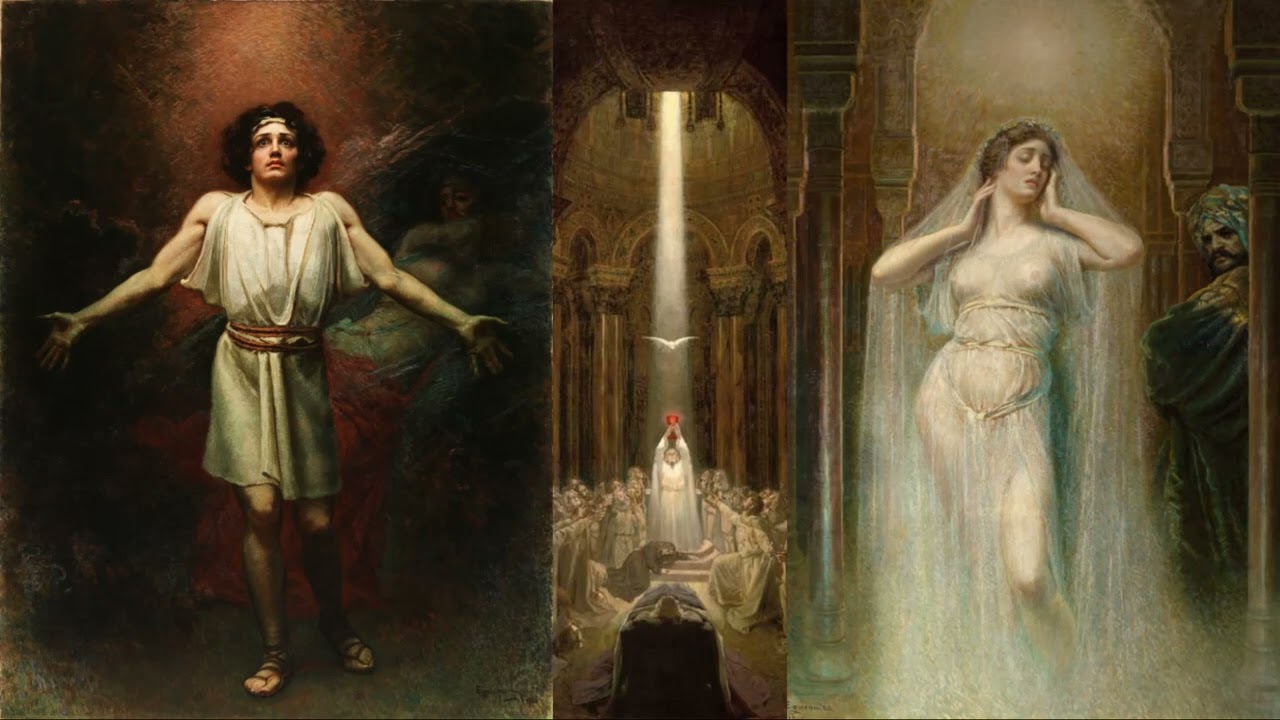
Pictures: Left: "Parsifal" (1910), Right: "Kundry" (1906) by Spanish painter Rogelio de Egusquiza.
Sources: https://tinyurl.com/23o83hx8 and https://tinyurl.com/2cll5gvl
Score: https://tinyurl.com/2xk5frdf

Информация по комментариям в разработке