Polycrystalline CVD Diamond plates - [email protected]
CVD diamond plates
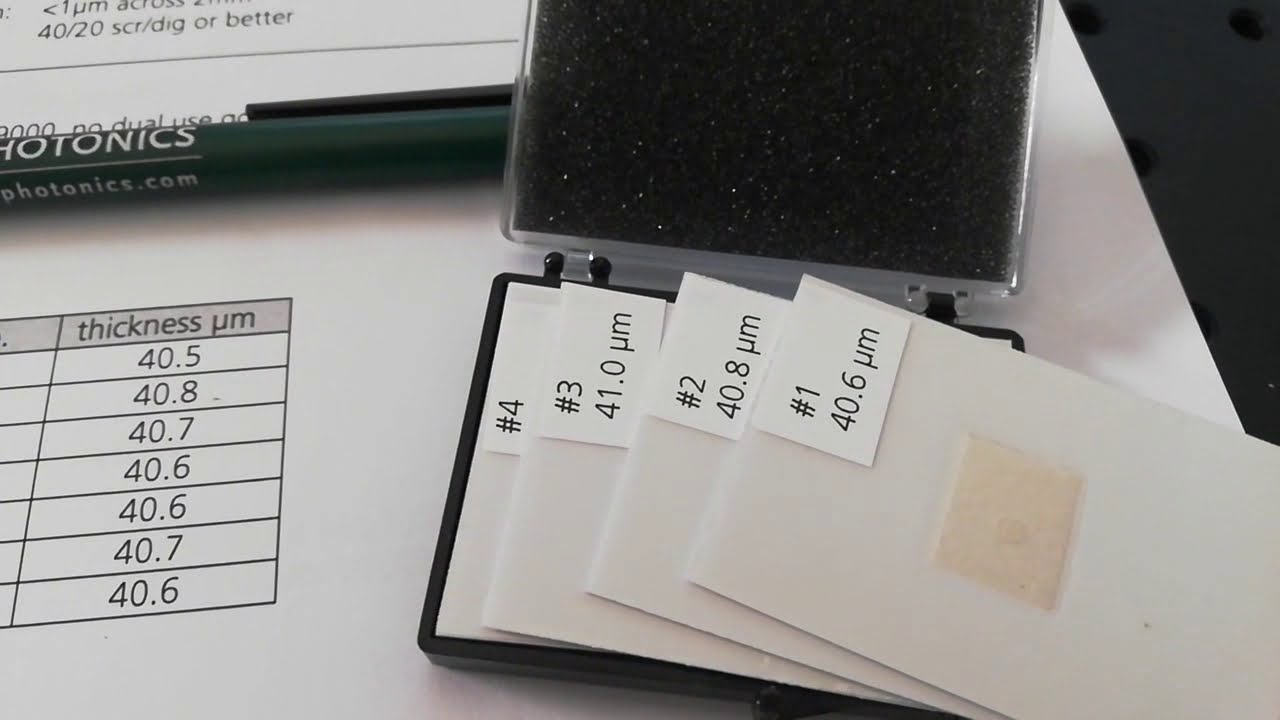
Incl. thickness data for each sample
Specifications:
Dimensions: 2 x 2 x 0.02mm +/- 0.1mm lateral, +/- 0.003mm thickness.
Parallelism less than 1um across 2mm
Polishing: 40/20 scr/dig or better
Pos. 1: single crystalline, orientation 110
Pos. 2: polycrystalline
Featured research:
Each directorate is asked to submit nominations that support institutional goals and have significant, positive impact on the Laboratory’s work. The NIF & Photon Science award went to the team responsible for developing the capability to perform one cryogenic layer shot per week on NIF.
Growing the wafer-thin layer of cryogenically cooled, solid deuterium-tritium (DT) fuel in the target capsule is one of the most demanding aspects of preparing targets for NIF ignition experiments. Only 69 microns wide—about two-thirds the average width of a human hair—and frozen to 18.5 kelvins (minus-426 degrees Fahrenheit), the “DT ice” layer must be extremely smooth and free of grooves or other defects before the target can be approved for use in an experiment.
Lab Director Bill Goldstein and Deputy Director for Science and Technology Pat Falcone presented the 2018 S&T and Excellence in Publication awards to 18 project teams, conference presenters and journal authors for their exceptional endeavors in science and technology.
The Director’s S&T Awards Program was implemented in 2000 to acknowledge, celebrate, and reward recent significant scientific and technical accomplishments by Laboratory staff. NIF&PS recipients were:
First Experimental Evidence for Superionic Water
Members of the Superionic Water Team
Members of the Superionic Water Team (from left): Timothy Uphaus, Renee Sharlaine Posadas, Eric Folsom, James Emig, Dayne Fratanduono, Marius Milot, Peter Celliers, Sébastien Hamel, Antonio Correa Barrios, Carol David, and Federica Coppari.
The team developed the first experimental evidence that water may become “superionic” when heated to several thousand degrees at high pressure, similar to the conditions inside giant planets like Uranus and Neptune. This exotic state of water is characterized by liquid-like hydrogen ions moving within a solid lattice of oxygen—in effect, water behaving as both a liquid and a solid simultaneously.
Team members are Marius Millot, Sébastien Hamel, Peter Celliers, Federica Coppari, Dayne Fratanduono, Damian Swift, Jon Eggert, Antonio Correa Barrios, Carol David, James Emig, Eric Folsom, Renee Sharlaine Posadas, and Timothy Uphaus of LLNL; Raymond Jeanloz of UC Berkeley; and Rip Collins and J. Ryan Rygg of the University of Rochester.
Development and Fielding of a High-energy X-ray Backlighter for NIF
Members of the High-Energy X-ray Backlighter Team
Members of the High-Energy X-ray Backlighter Team (from left): Front Row: Thomas Dittrich, Shahab Khan, David Martinez, Stephan MacLaren, Riccardo Tommasini, David Palmer, Elvin Monzon, and Sharon Glendinning; Back Row: Warren Hsing, Jonathan Ward, Thomas Zobrist, and Shon Prisbrey.
The team developed hard x-ray point projection sources generated by NIF’s Advanced Radiographic Capability laser system to record high spatial- and temporal-resolution radiographs of a driven high-energy-density target.
Team members are David Martinez, Thomas Dittrich, Sharon Glendinning, Mark Hermann, Shahab Khan, Daniel Kalantar, Riccardo Tommasini, Richard Seugling, Jonathan Ward, Elvin Monzon, Matthew Arend, Christopher Santos, Warren Hsing, Abbas Nikroo, Stephan MacLaren, Kevin Baker, Danielle Hare, Shannon Ayers, Shon Prisbrey, Alan Wan, Ronald Sigurdsson, Jared Okui, Thomas Zobrist, Michael Rubery, and David Palmer.
Jae-Hyuck Yoo
Jae-Hyuck Yoo
Deputy Director for Science and Technology Excellence in Publication Awards
Postdocs
“Lifetime Laser Damage Performance of β-Ga2O3 for High Power Applications,” by Jae-Hyuck Yoo, published on March 20, 2018, in APL Materials.
Yoo’s paper reported on systematic laser damage performance tests that established that gallium oxide (Ga2O3) has the highest lifetime optical damage performance of any conductive material measured to date, above 10 joules per square centimeter. This has direct implications for its use as an active component in high-power laser systems and may give insight into its utility for high-power switching applications.
Team Awards
“Thermonuclear Reactions Probed at Stellar-core Conditions with Laser-based Inertial-confinement fusion,” published on August 7, 2017, in Nature Physics.
The paper, a collaboration among LLNL, MIT, Los Alamos National Laboratory (LANL), and Ohio University, reported on the first thermonuclear measurements of nuclear reaction cross-sections—a quantity that describes the probability that reactants will undergo a fusion reaction—in high-energy-density plasma conditions that are equivalent to the burning cores of giant stars, 10 to 40 times more massive than the sun.

Информация по комментариям в разработке