Logo video2dn
  • Сохранить видео с ютуба
  • Категории
    • Музыка
    • Кино и Анимация
    • Автомобили
    • Животные
    • Спорт
    • Путешествия
    • Игры
    • Люди и Блоги
    • Юмор
    • Развлечения
    • Новости и Политика
    • Howto и Стиль
    • Diy своими руками
    • Образование
    • Наука и Технологии
    • Некоммерческие Организации
  • О сайте

Скачать или смотреть "Morning Heroes" Choral Symphony - Arthur Bliss

  • Sergio Cánovas
  • 2025-08-11
  • 796
"Morning Heroes" Choral Symphony - Arthur Bliss
musicclassical musicBlissArthur BlissChoralChoral SymphonyMorning HeroesBliss Morning HeroesArthur Bliss Morning Heroes Choral SymphonyArthur Bliss SymphonySymphonyLondon Philharmonic OrchestraHarlow ChorusEast London ChorusHertfordshire ChorusMichael KibblewhiteBrian BlessedWorld War 1 classical musicWar classical musicEnglish classical musicEnglish musicEnglandClassical music of World War 1
  • ok logo

Скачать "Morning Heroes" Choral Symphony - Arthur Bliss бесплатно в качестве 4к (2к / 1080p)

У нас вы можете скачать бесплатно "Morning Heroes" Choral Symphony - Arthur Bliss или посмотреть видео с ютуба в максимальном доступном качестве.

Для скачивания выберите вариант из формы ниже:

  • Информация по загрузке:

Cкачать музыку "Morning Heroes" Choral Symphony - Arthur Bliss бесплатно в формате MP3:

Если иконки загрузки не отобразились, ПОЖАЛУЙСТА, НАЖМИТЕ ЗДЕСЬ или обновите страницу
Если у вас возникли трудности с загрузкой, пожалуйста, свяжитесь с нами по контактам, указанным в нижней части страницы.
Спасибо за использование сервиса video2dn.com

Описание к видео "Morning Heroes" Choral Symphony - Arthur Bliss

London Philharmonic Orchestra, Harlow Chorus, East London Chorus and the Hertfordshire Chorus conducted by Michael Kibblewhite. Brian Blessed as the narrator.

I - Hector's Farewell to Andromache. Maestoso - (attacca): 0:00
II - The City Arming. Allegro alla marcia (with great spirit and elation) - Poco meno - Più mosso - Meno mosso (Moderato) - Alla marcia - Più mosso - Pochissimo meno - Andante moderato: 13:20
III - Vigil. Andante sostenuto - L’istesso tempo (Tranquillo) - Agitato - Tempo I - The Bivouac's Flame. Adagio maestoso - Più mosso - A tempo maestoso - Tempo I - Largamente: 24:47
IV - Achilles Goes Forth to Battle. Allegro con fuoco - Tranquillo - The Heroes. Allegro con fuoco - Molto animato: 37:54
V - Now, Trumpeter, for thy Close: Spring Offensive. Andante maestoso - Più animato - Andante molto tranquillo - Dawn on the Somme. Grave (quasi chorale) - Andante tranquillo - Pochissimo più mosso - Più mosso - Maestoso - Molto tranquillo: 46:26

Bliss's "Morning Heroes" Symphony was composed in 1930, being commissioned by the Norfolk and Norwich Festival. It was premiered on said festival on October 22 of 1930, performed by the Queen’s Hall Orchestra and the Festival Chorus conducted by the composer, with Basil Maine as the narrator. The work was very well-received, and had several performances until the 1960s, when it was then overshadowed by Britten's "War Requiem". It wasn't until the century commemorations of World War 1 that the score was revived. He dedicated the work to the memory of his brother and the fallen comrades.

Morning Heroes comprises settings of an anthology of poems in which experiences germane to war: "common" (wrote Bliss) "to all ages and all times" are explored. Through a meticulously chosen succession of texts, Bliss created a formal design of architectural unity and achieved as well an emotional momentum. The work’s five sections form a symmetrical sequence, the first and fifth movements acting as a prologue and epilogue, with fast second and fourth movements framing a slow third. Two further notable aspects of the texts are the shifting emphasis from the personal to the collective experience of war, and their relevance to Bliss himself.

Bliss served with distinction in that conflict; although physically he survived relatively unscathed, his autobiography details some horrific experiences. He was injured at the Somme in 1916 and gassed at Cambrai 1918. He also lost a brother, Kennard, in September 1916 and many friends and fellow officers. A few years after the war he revisited his battlefields by bicycle and located his brother's grave. However, long after Bliss began to have frequent nightmares that always took the same form: "I was still in the trenches with a few men; we knew the armistice had been signed, but we had been forgotten; so had a section of the Germans opposite. It was as though we were both doomed to fight on till extinction."

The first movement is a setting of "Hector’s Farewell to Andromache" from Book VI of Homer's "Iliad". It begins with a sombre and melancholic theme on strings, unfolding with great expression. The music reaches a dramatic climax. The narrator then begins declamating, supported by a tender and lilting orchestral background. From childhood Bliss had been familiar with the story of the Trojan War, and "Hector’s Farewell to Andromache" represented for him the parting of every "husband and wife separated by war". A powerful climax is reached with Hector's address to the Greek gods, then returning to the previous tenderness. This introductory movement then leads directly into the next one

The second movement is a setting of "The City Arming" from "drum-Taps", which is a part of Walt Whitman's "Leaves of Grass". It opens with a heroic entrance of chorus and orchestra with the poem, which in turns leads to a resolute march that reaches a dissonant climax. Here the perspective moves from the personal to the collective view; describing a whole city rising in arms. Bliss chose this text as the closest he could find to convey the atmosphere of summer 1914, in which "The First Hundred Thousand" volunteered. But even within its context of mass activity, the poem focuses briefly on the personal as the mother bids farewell to her son, a parallel to the situation described in the previous movement at the words "The tearful parting". A fiercely dissonant climax is reached when war is declared, but the music winds down and the movement ends with a poignant coda.

[Musical analysis continued in the comments section].

[Activate subtitles to follow the lyrics].

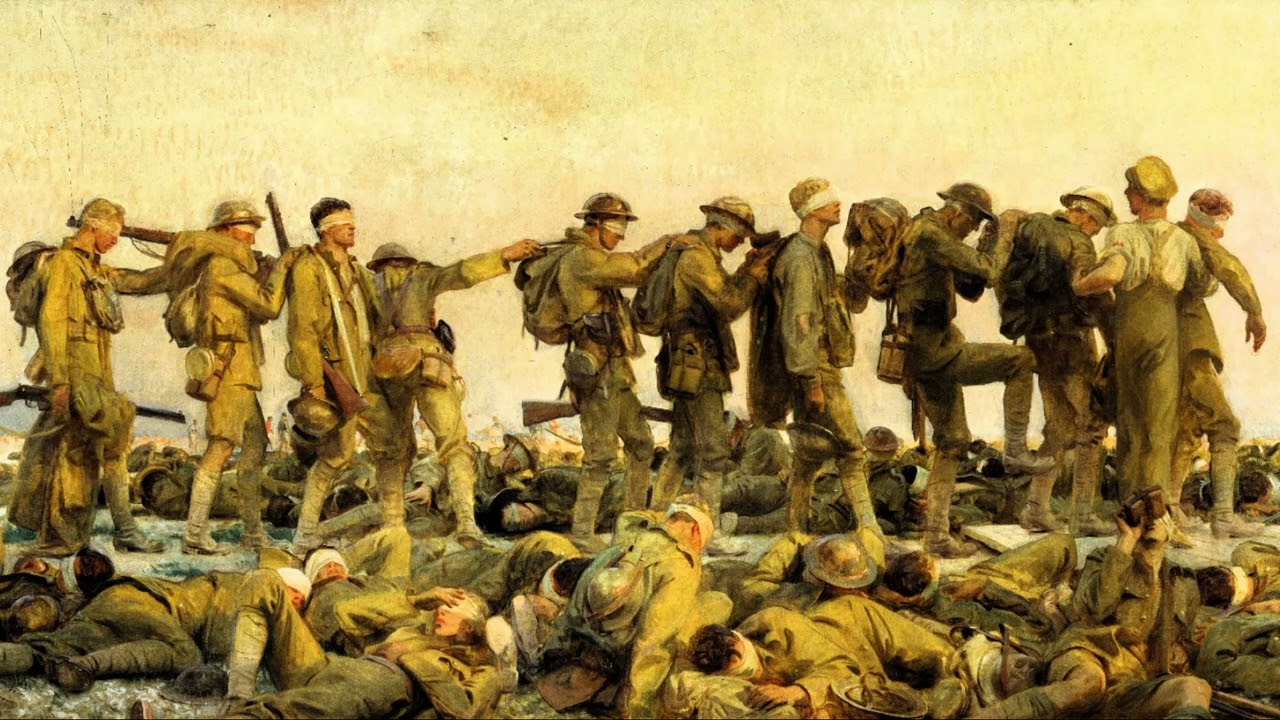
Picture: Fragment of "Gassed" (1919) by the American painter John Singer Sargent.

Musical analysis written by myself. Sources: https://tinyurl.com/2dafhslv, https://tinyurl.com/29so5haa and https://tinyurl.com/22dn7jpe

To check the score: https://tinyurl.com/24l69kay

Комментарии

Информация по комментариям в разработке

Похожие видео

  • О нас
  • Контакты
  • Отказ от ответственности - Disclaimer
  • Условия использования сайта - TOS
  • Политика конфиденциальности

video2dn Copyright © 2023 - 2025

Контакты для правообладателей [email protected]