-A courthouse that dared to be modern—where justice found form in brick, glass, and rhythm.
If you love stories of radical design, subscribe now and join us as we uncover the icons of architecture: / @spaceshapescale
About the Project
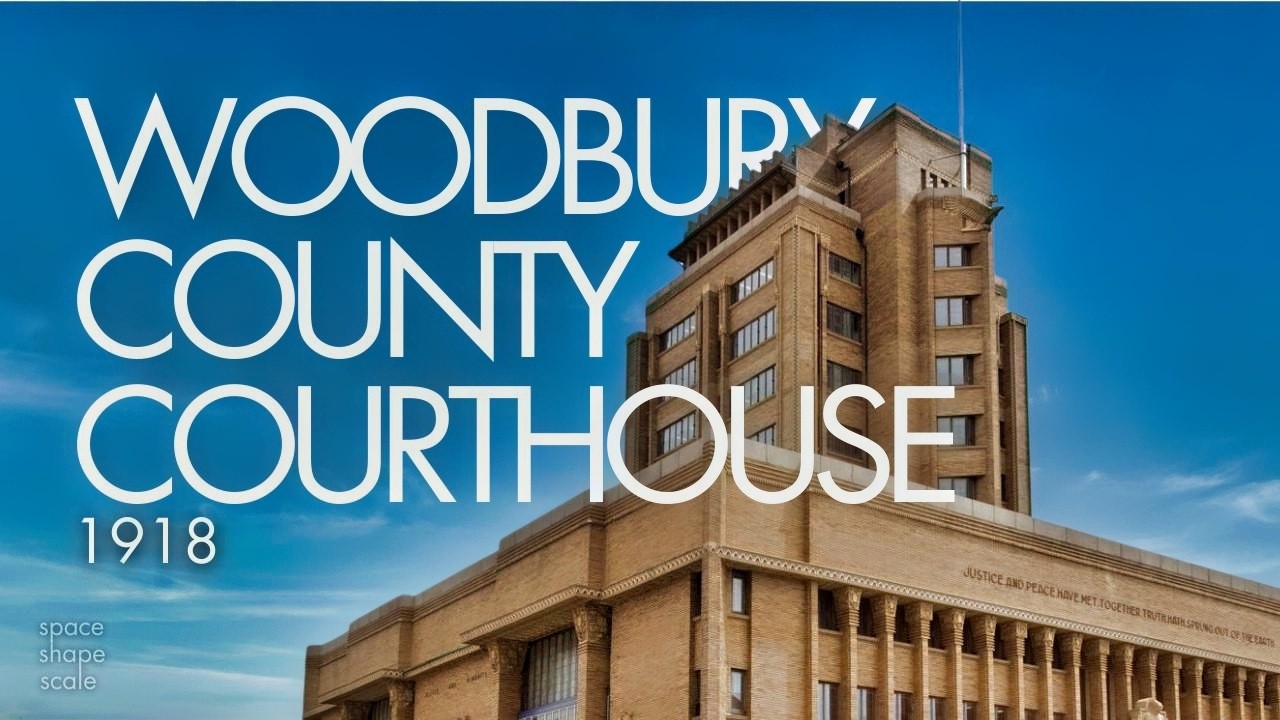
Completed in 1918 in Sioux City, Iowa, the Woodbury County Courthouse stands as the finest example of Prairie School civic architecture in the United States. This architectural landmark was designed by William L. Steele in collaboration with George Grant Elmslie and William Gray Purcell a trio that defied convention by replacing marble columns and neoclassical pediments with a bold, distinctly American language of design.
Breaking from European traditions, the courthouse features strong horizontality, rhythmic window bands, earth-toned brickwork, and ornamentation inspired by nature and the machine age. These elements echo the philosophies of Frank Lloyd Wright and the Prairie School, but here, they are reinterpreted on a monumental civic scale proof that organic architecture could speak not just to homes, but to the very seat of public justice.
Inside the Gesamtkunstwerk
Step inside, and the experience becomes a total work of art—or Gesamtkunstwerk. Rich terra cotta detailing, luminous stained glass skylights, intricate mosaic floors, and murals by John Norton merge into a unified vision where architecture and the decorative arts are inseparable. Every surface is alive with color, texture, and meaning, transforming the solemnity of a courthouse into an uplifting civic experience.
Why It’s Revolutionary
More than a building, the Woodbury County Courthouse is a manifesto in brick. It stood against the tide of neoclassicism dominating early 20th-century civic design, asserting instead that public architecture could be modern, democratic, and uniquely American. The courthouse symbolizes transparency, progress, and the belief that architecture should serve—and inspire—the people.
Architectural Highlights
-The only major civic building in the Prairie School style
-Collaboration between William L. Steele, Purcell & Elmslie
-Strong horizontal massing and rhythmic window bands
-Earthy brick and terra cotta ornamentation rooted in natural forms
-Stained glass, mosaic details, and murals by John Norton
-Frank Lloyd Wright’s influence meets civic scale
-Embodiment of the Arts & Crafts Movement in a public building
-A rare example of American civic modernism in the 1910s
Influential Figures Timeline
From Victorian engineering to radical modernism, these architects shaped the path that led to the Woodbury County Courthouse:
Joseph Paxton (1803) – Victorian Engineering / Proto-Modernism
Otto Wagner (1841) – Vienna Secession
Lluís Domènech i Montaner (1850) – Catalan Modernisme
Antoni Gaudí (1852) – Catalan Modernisme
Louis Sullivan (1856) – Prairie School / Functionalism
Josep Puig i Cadafalch (1867) – Catalan Modernisme
Frank Lloyd Wright (1867) – Prairie School / Organic Architecture
Charles Rennie Mackintosh (1868) – Art Nouveau / Arts and Crafts
Charles & Henry Greene (1868) – American Arts and Crafts
Peter Behrens (1868) – Industrial Modernism
Giacomo Mattè-Trucco (1869) – Industrial Architecture
George Grant Elmslie (1869) – Prairie School
Adolf Loos (1870) – Rationalism / Early Modernism
Auguste Perret (1874) – Concrete Modernism
Antonin Nechodoma (1877) – Caribbean Prairie Style / NeoGothic
William Gray Purcell (1880) – Prairie School
Adolf Meyer (1881) – Bauhaus / Functionalism
Walter Gropius (1883) – Bauhaus / Modernism
Pierre Chareau (1883) – Industrial Modernism
Erik Gunnar Asplund (1885) – Nordic Classicism / Functionalism
Sigurd Lewerentz (1885) – Nordic Classicism / Brutalism
Ludwig Mies van der Rohe (1886) – International Style
Rudolf Schindler (1887) – Early California Modern
Le Corbusier (1887) – International Style / Modernism
In an era where civic buildings often default to generic glass boxes, the Woodbury County Courthouse reminds us that architecture can embody cultural values and inspire civic pride. It’s not just a relic of the past—it’s a challenge to architects, designers, and citizens today to imagine bold new forms for public space.
#WoodburyCountyCourthouse #PrairieSchoolArchitecture #WilliamLSteele #PurcellAndElmslie #FrankLloydWrightInfluence #AmericanModernism #CivicArchitecture #ArchitecturalIcons #TerraCottaArchitecture #SiouxCityArchitecture #ModernismInAmerica #spaceshapescale #HistoricLandmarks #PrairieSchool #ArchitectureHistory #OrganicArchitecture #ArtsAndCraftsMovement #ArchitecturalHeritage
/ @spaceshapescale
What if justice didn't rise like a marble temple but grew from the soil like wheat from the prairie? The Woodbury County Courthouse uses *horizontal lines* and *open floor plans* to achieve *unity with nature**. This courthouse achieved **architectural brilliance* by using *organic architecture* to achieve a unique design.

Информация по комментариям в разработке