Logo video2dn
  • Сохранить видео с ютуба
  • Категории
    • Музыка
    • Кино и Анимация
    • Автомобили
    • Животные
    • Спорт
    • Путешествия
    • Игры
    • Люди и Блоги
    • Юмор
    • Развлечения
    • Новости и Политика
    • Howto и Стиль
    • Diy своими руками
    • Образование
    • Наука и Технологии
    • Некоммерческие Организации
  • О сайте

Скачать или смотреть Book Einstein's Spacetime Belied ByA New Short Perihelion Precession Equation

  • Antoine Khai Nguyen
  • 2025-06-24
  • 6
Book Einstein's Spacetime Belied ByA New Short Perihelion Precession Equation
  • ok logo

Скачать Book Einstein's Spacetime Belied ByA New Short Perihelion Precession Equation бесплатно в качестве 4к (2к / 1080p)

У нас вы можете скачать бесплатно Book Einstein's Spacetime Belied ByA New Short Perihelion Precession Equation или посмотреть видео с ютуба в максимальном доступном качестве.

Для скачивания выберите вариант из формы ниже:

  • Информация по загрузке:

Cкачать музыку Book Einstein's Spacetime Belied ByA New Short Perihelion Precession Equation бесплатно в формате MP3:

Если иконки загрузки не отобразились, ПОЖАЛУЙСТА, НАЖМИТЕ ЗДЕСЬ или обновите страницу
Если у вас возникли трудности с загрузкой, пожалуйста, свяжитесь с нами по контактам, указанным в нижней части страницы.
Спасибо за использование сервиса video2dn.com

Описание к видео Book Einstein's Spacetime Belied ByA New Short Perihelion Precession Equation

Antoine Khai Nguyen
https://www.amazon.com/dp/B0CVG4LSNG

Mercury's perihelion precession anomaly was discovered in 1859 by Urbain Le Verrier.

The calculation of Mercury's perihelion precession angle gets more and more precise over time with the latest one as:
42.9195 arc-seconds per century
which is deduced from the value of
0.1034 arc-seconds per orbital revolution

Einstein's Two Mercury Perihelion Precession Equations:
To calculate Mercury's perihelion precession angle (ε):
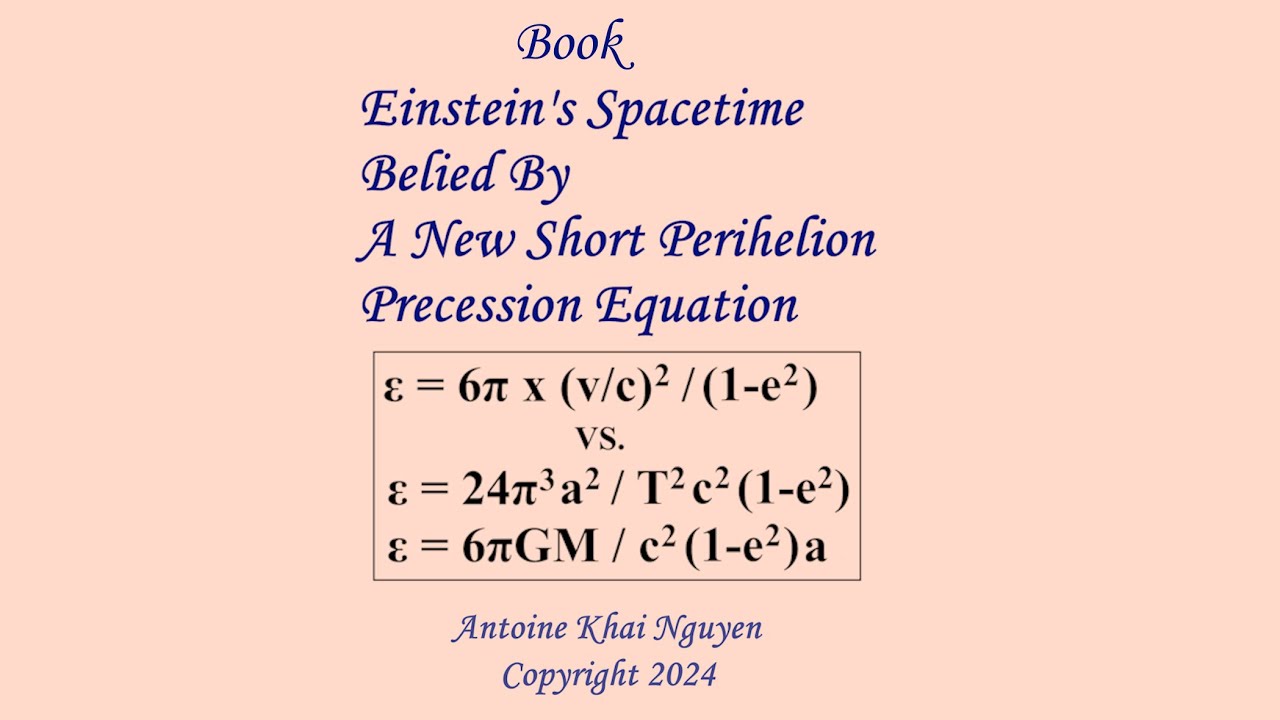
ε = 24π^3 a^2 / T^2c^2(1-e^2)
ε = 6πGM / c^2(1-e^2)R

where
ε is the angle of perihelion precession/shift of the involved captive (celestial object)
a/R is the semi-major axis of the orbit of this captive
T is the orbital period of this captive
c is the speed of light in vacuum
e is the eccentricity of the orbit of the captive
M is the mass of the captor (celestial object)
G is Newton's gravitational constant

My Simpler Alternative To Einstein's Main Mercury Perihelion Precession Equation:

Based on my potential findings,
Einstein's main equation of Mercury perihelion precession (angle ε):
ε = 24π^3 a^2 / T^2c^2(1-e^2)
appears to have a simpler mathematical alternative as:
ε = 6π (v/c)^2 / (1-e^2)
where
ε is the perihelion precession angle (in radians) of the captive (celestial object)
v is the orbital velocity of this captive
c is the speed of light in vacuum
e is the eccentricity of the orbit of this captive

Origin Of My Simpler Alternative To Einstein's Main Mercury Perihelion Precession Equation:

Based on my potential findings, it turns out that
Einstein's main equation of Mercury perihelion precession (angle ε):
ε = 24π^3 a^2 / T^2c^2(1-e^2)

can be reformulated as:
ε = 6π x [4π^2 a^2 / T^2c^2(1-e^2)]

then as:
ε = 6π x [(2πa/Tc)^2 / (1-e^2)]

And again as:
ε = 6π x [((2πa/T) / c)^2 / (1-e^2)]

It turns out that
The last reformulated equation of Mercury perihelion precession (angle ε):
ε = 6π x [((2πa/T) / c)^2 / (1-e^2)]
contains the formula of a hidden orbital velocity of the captive as follows:
V = (2πa/T)
And that leads to the final alternative equation of Mercury perihelion precession (angle ε):
ε = 6π (v/c)^2 / (1-e^2)

Revelations From My Mathematical Alternative To Einstein's Main Mercury Perihelion Precession Equation:

Based on my analysis,
The term (v/c) inside the newly discovered alternative equation of Mercury's perihelion precession (angle ε) reveals that the perihelion precession of captive celestial objects takes place only within the first second of its entire orbital period. Therefore, should any physics interpretation from this equation assume that the perihelion precession action repeats itself for every second during the entire orbital revolution, it then commits a fatal flaw.

Revelation About Einstein's Main Mercury Perihelion Precession Equation:
In light of this discovery,
Einstein's orbital-period-based perihelion precession angle equation (ε):
ε = 24π^3 a^2 / T^2c^2(1-e^2)
turns out to be an unnecessarily complex, hence misleading equation to describe Mercury's perihelion precession anomaly.

By the same token,
Einstein's use of his orbital-period-based perihelion precession equation as a key piece of evidence of his spacetime curvature paradigm to explain gravity is MATHEMATICALLY INVALID.

Комментарии

Информация по комментариям в разработке

Похожие видео

  • О нас
  • Контакты
  • Отказ от ответственности - Disclaimer
  • Условия использования сайта - TOS
  • Политика конфиденциальности

video2dn Copyright © 2023 - 2025

Контакты для правообладателей [email protected]