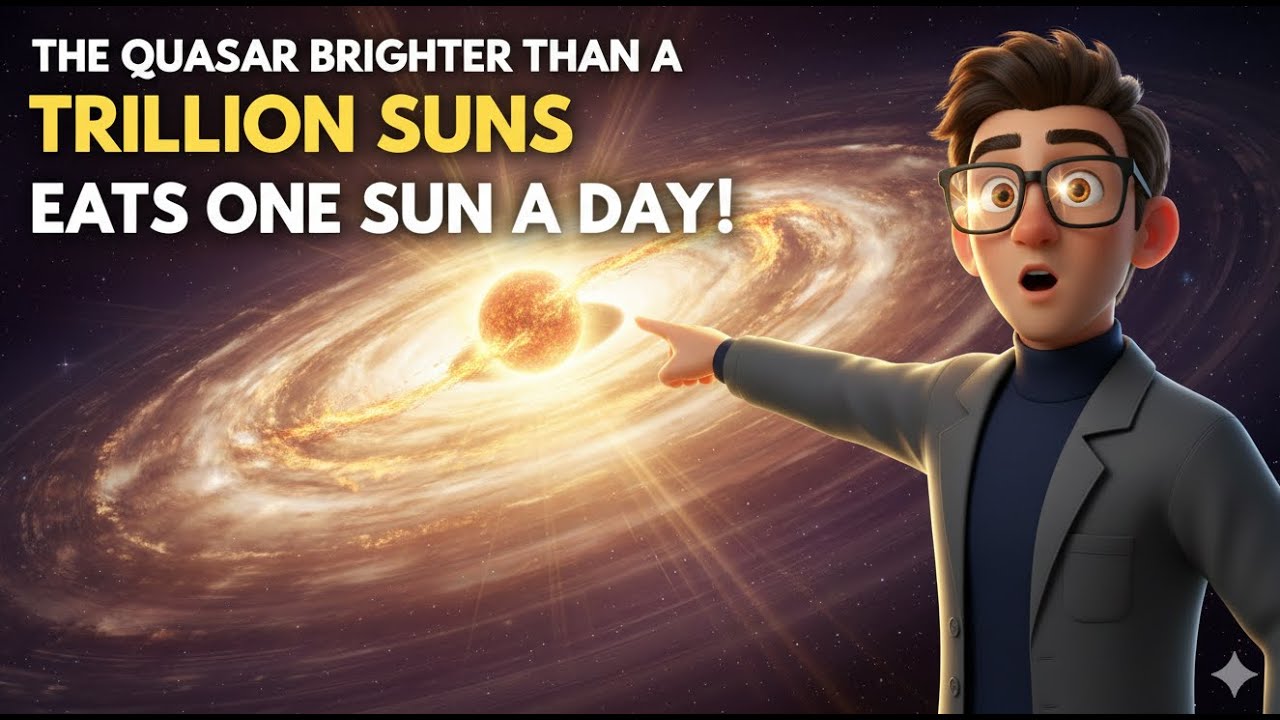
Deep in the distant universe sits a monster that defies logic: J0529-4351. This isn't just a star; it is the brightest known object in the cosmos, shining with the power of 500 trillion suns. Powered by a supermassive black hole with a record-breaking appetite, this quasar consumes the equivalent of one entire Sun every single day. In this video, we dive into the extreme physics of accretion disks and relativistic jets to understand how the darkest objects in space create the most brilliant light imaginable. We explore the 12-billion-year journey this light took to reach our telescopes and what it reveals about the violent, energetic youth of our universe.
The Big Question Does the idea of a black hole eating a whole sun every day make you feel small, or does it make you realize how incredible it is that we can even detect something so far away?
Sources & Citations
Wolf, C., et al. (2024). "The accretion of a solar mass per day by a 17-billion-solar-mass black hole." Nature Astronomy.
European Southern Observatory (ESO) - "Brightest Quasar Ever Seen."
NASA Jet Propulsion Laboratory (JPL) - "Understanding Active Galactic Nuclei."
Chapters 0:00 - The Brightest Object in the Universe
0:55 - How Black Holes Create Light
2:10 - The Accretion Disk Explained
2:40 - A Sun for Breakfast: The Quasar's Appetite
4:15 - Hidden in Plain Sight: The Discovery
6:00 - Looking Back 12 Billion Years
6:45 - Final Thoughts
Hashtags #SpaceScience #BlackHole #Quasar #Astronomy #Universe #JamesWebb #SciCuriousID #Cosmology
SEO Tags & Keywords brightest quasar, J0529-4351, supermassive black hole, accretion disk explained, space documentary 2026, most luminous object in universe, astronomy news, how black holes work, astrophysics, 500 trillion suns, extreme space phenomena, NASA, ESO, Very Large Telescope.
------------------------------------------------------------------------------------------------------------------
⚠️ DISCLAIMER
SciCuriousID is an independent educational initiative dedicated to exploring science, history, technology, culture, and global phenomena. All content is produced for learning and public knowledge purposes, prioritizing accessibility, accuracy, and a research-based approach.
Digital avatars, AI-generated narration, and visual elements featured on this channel are entirely fictional. They serve solely as creative tools for educational storytelling and do not depict or impersonate any real individuals, organizations, or endorsements. Any resemblance to actual persons is purely coincidental.
Information presented is based on reputable academic sources, established scientific consensus, and publicly available research available at the time of production. However, as knowledge continually evolves, SciCuriousID cannot guarantee absolute completeness or perpetual accuracy. Viewers are encouraged to verify information independently through credible scholarly literature and professional sources. This content should not be used as a substitute for professional advice in fields such as medicine, law, psychology, finance, engineering, or other specialized disciplines.
All visual, audio, and written materials are original, properly licensed, or used under fair educational use. If any copyrighted material appears inadvertently, SciCuriousID will promptly take corrective action upon receiving valid notice.
AI-assisted tools may support aspects of production—including visuals, narration, and scriptwriting—in a transparent and ethical manner. No AI systems used in production collect, store, or process personal viewer data. All viewer interactions are governed solely by the privacy and data-handling policies of the hosting platform.
By accessing SciCuriousID content, viewers acknowledge that the material is intended exclusively for educational and informational purposes. SciCuriousID assumes no liability for interpretations, applications, or decisions made beyond this educational scope.
© 2025 SciCuriousID — All Rights Reserved.
















Информация по комментариям в разработке