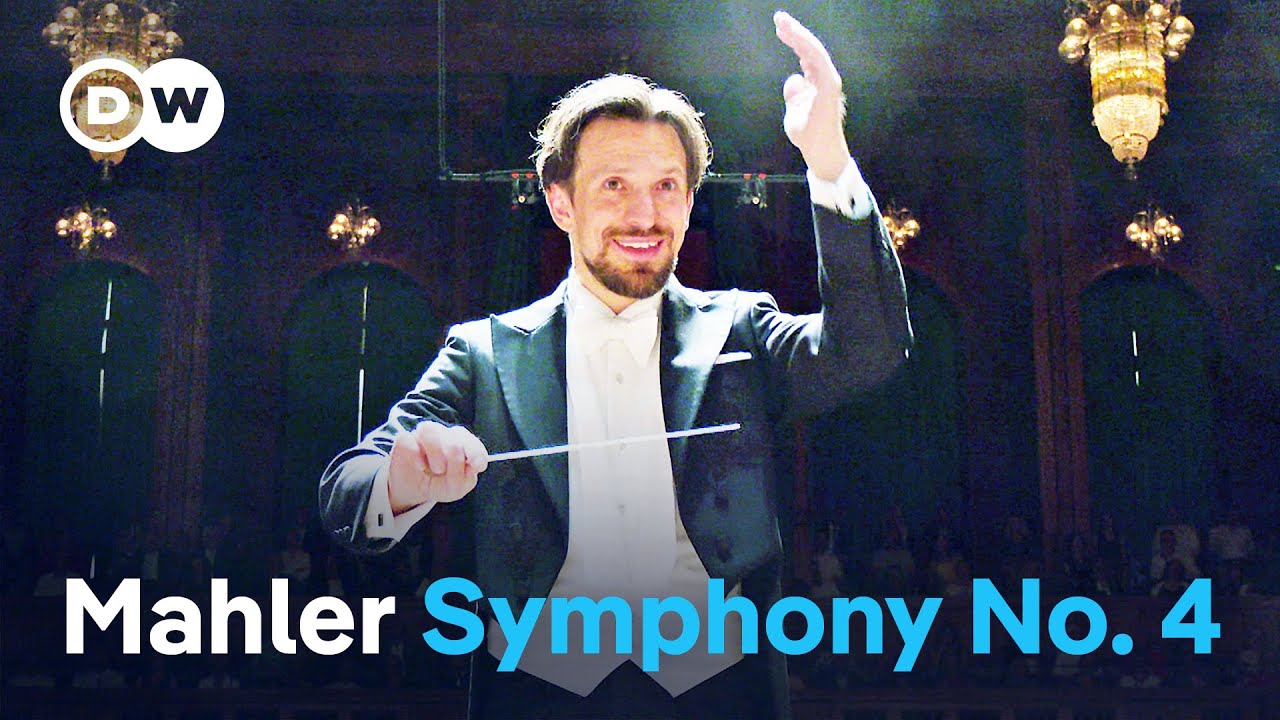
Watching Cornelius Meister conduct the Deutsches Symphonie-Orchester Berlin, it is clear that Gustav Mahler's Symphony No. 4 in G major is music to revel in. The concert took place on July 11, 2025, at the international music festival Kissinger Sommer in Bad Kissingen, Germany. Hanna-Elisabeth Müller sings the soprano part in the fourth movement.
(00:00) I. Bedächtig, nicht eilen (Deliberate, not hurried)
(16:28) II. In gemächlicher Bewegung, ohne Hast (At a comfortable pace, without haste)
(27:15) III. Ruhevoll (Poco adagio) (Peaceful, somewhat slow)
(45:50) IV. Sehr behaglich (Very comfortably)
Gustav Mahler (1860–1911) once told a friend that he had set out to write nothing more than a "symphonic humoresque" when he began work on his Fourth Symphony. The piece indeed retains the defining qualities of a humoresque: its contrasting structure is suffused with cheerfulness, yet it also reveals moments of depth and profundity. Mahler himself regarded the Fourth Symphony as one of his finest works.
Mahler began composing the symphony during his summer vacation in 1899 and made his final revisions in 1901. The premiere took place in Munich in November of that year, with the composer conducting. The work was poorly received by the audience at the time, provoking loud hissing during the performance, and many critics were openly hostile. Mahler’s friend Ernst Otto Nodnagel, however, praised the premiere as "the first truly musical event of the 20th century." In hindsight, this judgment seems remarkably apt, and it is hardly surprising that the symphony has remained popular with audiences and continues to be performed regularly.
Formally, the Fourth Symphony is classical in structure. It consists of four movements that are well balanced in both length and character. Only the final movement departs from this classical model — it's comprised of the orchestral song "Das himmlische Leben" ("Life in heaven"), which Mahler had previously composed in 1892. Mahler described this unusual finale as "the rejuvenating peak" of the symphony.
The text is taken from from Des Knaben Wunderhorn ("The boy’s magic horn"), which is perhaps the best-known collection of folk poems and songs from the German Romantic period. It was originally titled "Der Himmel hängt voll Geigen" ("The sky is full of violins"). Mahler later retitled the piece to better capture the poem’s meaning. It presents an enchanting vision of heaven, portraying a joyful celebration filled with sensual pleasures and culminating in music and dance. Mahler brilliantly sets this scene of naive, innocent delight to music.
Overall, Mahler’s Symphony No. 4 has such a playful lightness that it can be likened to a work of Jugendstil, also known as Art Nouveau. Art Nouveau was an artistic movement around 1900, particularly prominent in Germany and Austria. It was marked by a tension between clear, often stylized forms and organic, decorative lines that intertwine in a lively, playful way. Whether the term Art Nouveau, typically used to describe visual art, can also be applied to music remains a matter of debate. If one accepts this broader usage, Mahler’s Fourth Symphony would seem to embody the style in every respect.
Compare this interpretation of Mahler's Symphony No. 4 with another version at DW Classical Music: • Mahler: Symphony No. 4 | James Conlon and ...
Text: Rita Kass
© 2025 Deutsche Welle
Watch more great concerts here: • LISTEN AND WATCH - your personal concert hall
Find more famous symphonies here: • SYMPHONIES
And if you like music from the Romantioc period, look here: • ROMANTIC MUSIC
Subscribe to DW Classical Music: / dwclassicalmusic
#symphony #mahler #romanticmusic

Информация по комментариям в разработке