#treetopsjunglelodge#wildlife#littlegreenbeeeater#birds
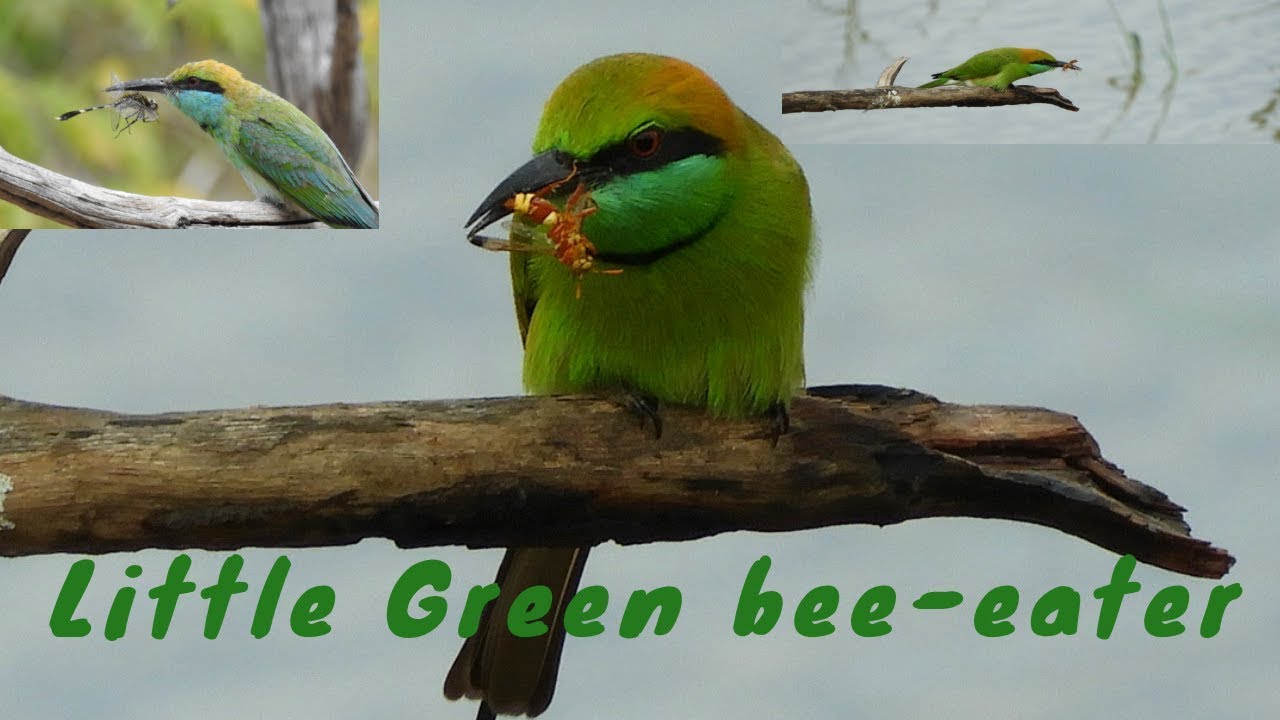
The green bee-eater is a near passerine bird in the bee-eater family. It is resident but prone to seasonal movements and is found widely distributed across sub-Saharan Africa from Senegal and the Gambia to Ethiopia, the Nile valley, western Arabia and Asia through India to Vietnam.
• Blue-tailed bee-eater . Northern yala Sri ...
BIOMETRICS :
Length: 16-18 cm – 10 cm more with the tail
Wingspan: 29-30 cm
Weight: 15-20 g
DESCRIPTION:
Green Bee-eater is the smallest species.
It is mostly bronze-green, with golden-green crown and nape, black eye line, pale bluish-green cheeks, chin and throat, and narrow black half-collar between throat and breast.
Wings show black trailing edges.
Outer undertail feathers are shiny grey, and median rectrices are long and purplish. Streamers may reach up to 7 cm in male.
Black bill is long and down-curved. p rEyes are deeed. Legs and feet are blackish.
Female is similar to male, but she has shorter streamers, duller throat and narrower half collar.
Juvenile is duller. It lacks half collar. Eye line is duller and paler. Breast is pale green and belly almost white.
We can find several races (8 subspecies) which differ by throat, crown and nape colours. We can notice some differences in black half collar’s width and streamers’ length.
The subspecies « beludschicus » from south Iraq and NW India (displayed here), has golden-green crown and nape, pale blue chin turning greener on lower throat, very narrow half collar and streamers of about 6 cm.
VOICE: SOUNDS BY XENO-CANTO
Green Bee-eater utters a repeated, sweet trill “triiie”. Sometimes, it may give a shrill “tit-tit-tit”, or a loud ‘prrrit’.
HABITAT:
Green Bee-eater frequents wooded areas with scattered trees and bushes, near streams and shores. It is also found in arid areas with Acacia and date palms, dunes, close to cultivated areas and large gardens. It likes sandy and bare soils. This species can be seen from sea-level up to 2000 metres of elevation.
RANGE:
Green Bee-eater is found in W India, E Bangladesh, S Sri Lanka, Central Africa, S and E Asia.
This species is resident or partially migratory in Africa, whereas it is mainly migratory in Asia. It also performs post-breeding dispersions and some altitudinal migrations, according to the range.
It is more resident in Israel and Egypt.
BEHAVIOUR:
Green Bee-eater is usually less gregarious than other bee-eaters. It often nests alone or in small groups. They sleep in flocks at roosts, perched high in trees.
Outside the night, this bird perches fairly low. It hunts from a perch, fence, small thorny tree, but it is less aerial than other bee-eaters. It usually hunts low from the ground, performing short swoop before to return to its perch.
It may sometimes perch on cattle’s back or grazing antelope, and perform sallies close to the ground into vegetation for catching some insect.
Before swallowing its prey, it removes the dart by striking several times the insect against a hard surface.
FLIGHT:
Green Bee-eater has agile flight. It sallies low from the ground into vegetation in order to catch preys.
REPRODUCTION:
Breeding season varies from March to June and sometimes from July to August according to the range.
Green Bee-eater is solitary nester in Africa and Arabia, whereas we can find small colonies in India, and larger colonies (10 to 30 pairs) in Pakistan and Myanmar.
Green Bee-eater nests in burrows, dug by both adults into flat ground or gentle slope in Africa, or often into low shore in Asia.
The burrow is between one and two metres length, with a nest-chamber of about 15 cm at the end.
Female usually lays 4-8 white eggs in this chamber. Incubation lasts about 18 to 22 days, mainly by female. Young remain at nest during 22 to 31 days and they are fed by both parents.
DIET:
Green Bee-eater feeds on Hymenoptera, bugs, termites, beetles, moths and a lot of flies. It also consumes some butterflies, crickets, dragonflies, spiders and caterpillars.
PROTECTION / THREATS / STATUS:
This species is not threatened at this moment. Green Bee-eater is common or locally common throughout the large range.
• Tree Tops Jungle Lodge. Video by Jess Tayl...
https://birdandwildlifecampyala.wordp...
http://www.treetopsjunglelodge.com
https://www.facebook.com/kamal.malli....
https://www.instagram.com/treetopsjun...
/ kamalmalli
/ kamaltops
http://www.aliyasafari.com

Информация по комментариям в разработке