Logo video2dn
  • Сохранить видео с ютуба
  • Категории
    • Музыка
    • Кино и Анимация
    • Автомобили
    • Животные
    • Спорт
    • Путешествия
    • Игры
    • Люди и Блоги
    • Юмор
    • Развлечения
    • Новости и Политика
    • Howto и Стиль
    • Diy своими руками
    • Образование
    • Наука и Технологии
    • Некоммерческие Организации
  • О сайте

Скачать или смотреть Decoding the epitranscriptome at single-molecule resolution: towards clinical applications

  • Oxford Nanopore Technologies
  • 2025-05-30
  • 127
Decoding the epitranscriptome at single-molecule resolution: towards clinical applications
  • ok logo

Скачать Decoding the epitranscriptome at single-molecule resolution: towards clinical applications бесплатно в качестве 4к (2к / 1080p)

У нас вы можете скачать бесплатно Decoding the epitranscriptome at single-molecule resolution: towards clinical applications или посмотреть видео с ютуба в максимальном доступном качестве.

Для скачивания выберите вариант из формы ниже:

  • Информация по загрузке:

Cкачать музыку Decoding the epitranscriptome at single-molecule resolution: towards clinical applications бесплатно в формате MP3:

Если иконки загрузки не отобразились, ПОЖАЛУЙСТА, НАЖМИТЕ ЗДЕСЬ или обновите страницу
Если у вас возникли трудности с загрузкой, пожалуйста, свяжитесь с нами по контактам, указанным в нижней части страницы.
Спасибо за использование сервиса video2dn.com

Описание к видео Decoding the epitranscriptome at single-molecule resolution: towards clinical applications

Biography

Eva Maria is an ICREA (Catalan Institution for Research and Advanced Studies) Research Professor and Group Leader of the Epitranscriptomics and RNA Dynamics Laboratory at the Center for Genomic Regulation in Spain. Her laboratory is focused on deciphering the language of RNA modifications, and how its orchestration can regulate our cells in a space-, time-, and signal-dependent manner. Eva is an EMBO Young Investigator.

Abstract

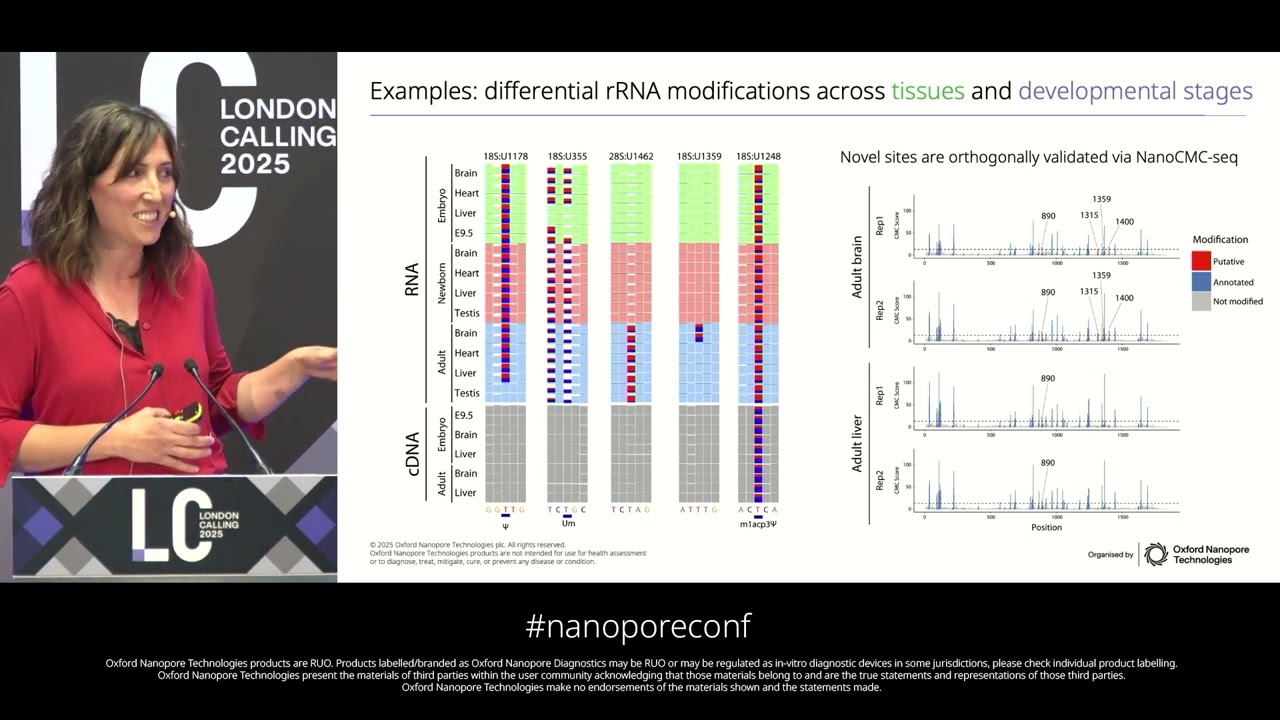
Ribosomes have been historically considered as uniform macromolecular structures with identical composition across cell types, tissues, and conditions. This view, however, has been challenged in recent years, leading to a change in paradigm: ribosomes are now surveyed as dynamic entities that can be heterogeneous in their composition.
The heterogeneity of these ‘specialized ribosomes’ can arise from the use of ribosomal protein paralogs, distinct rRNA variants, or differential rRNA modifications, among other factors. While the rRNA modification landscape has been previously characterised for some species, most studies and rRNA databases do not consider the tissue and/or cell type of origin in their annotations. Although the different types of rRNA modifications are likely interconnected, detailed maps of all rRNA modification patterns are lacking.
In this context, nanopore direct RNA sequencing (DRS) has emerged as a promising technology that can overcome these limitations, as it is, in principle, capable of mapping all RNA modifications simultaneously, in a quantitative manner, and in full-length native RNA molecules. Notably, previous studies have already shown that rRNA modifications can be identified using DRS.
Here, I will first present our latest work on how we can use DRS to study the mammalian rRNA epitranscriptomic landscape across tissues, cell types, developmental stages, and cancer types. We identify rRNA modification signatures that are characteristic and distinct across tissues, cell types, and developmental

Комментарии

Информация по комментариям в разработке

Похожие видео

  • О нас
  • Контакты
  • Отказ от ответственности - Disclaimer
  • Условия использования сайта - TOS
  • Политика конфиденциальности

video2dn Copyright © 2023 - 2025

Контакты для правообладателей [email protected]