Timestamps
0:00 – Introduction
4:28 – Tropical Evergreen Forest
8:06 – Deciduous Forest
10:20 – Thorn Forest
12:10 – Mountain Forest
17:16 – Littoral & Swamp Forest
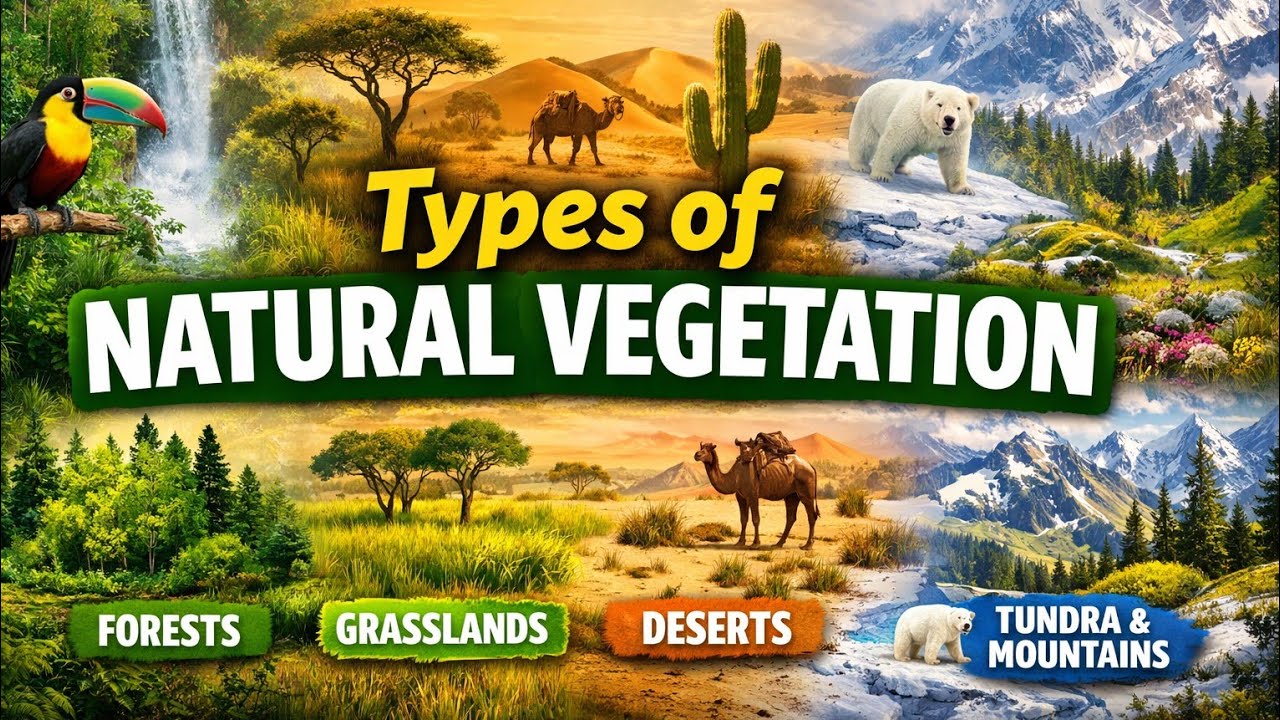
Natural vegetation refers to plants that grow on their own without human help. Based on climate and location, it is divided into the following types:
1. Forest Vegetation
Forests are areas covered mainly with trees. They are of three main types:
• Tropical Rainforests
These are very thick and evergreen forests found near the equator. They receive heavy rainfall throughout the year.
Example: The Amazon Rainforest
• Temperate Forests
These forests are found in regions with moderate climate and clear seasonal changes. Many trees shed their leaves in autumn.
Example: Deciduous forests of North America and Europe
• Boreal Forests (Taiga)
These are coniferous forests located in high-latitude cold regions. Trees like pine and fir are common.
Examples: Forests in Canada and Russia
🌾 2. Grassland Vegetation
Grasslands are regions where grasses are the main plants and trees are few.
• Tropical Grasslands (Savannas)
These are found in warm regions with distinct wet and dry seasons. They have tall grasses and scattered trees.
Example: The Serengeti in Africa
• Temperate Grasslands
These occur in temperate regions with moderate rainfall. They mainly consist of short grasses.
Examples:
The Great Plains (Prairies)
The Eurasian Steppe
3. Desert Vegetation
Deserts have very little rainfall, so plants are sparse and specially adapted.
• Hot Deserts
These deserts have high temperatures and very low rainfall. Plants like cacti store water in their stems.
Example: The Sahara Desert
• Cold Deserts
These are found in high-altitude or high-latitude areas. The climate is cold and dry.
Example: The Gobi Desert
4. Tundra Vegetation
Tundra vegetation is found in extremely cold polar regions where the ground remains frozen (permafrost). Only small plants like mosses, lichens, and short shrubs can grow.
Example: The Arctic
🏔 5. Mountain Vegetation
Mountain vegetation changes with height (altitude).
Lower slopes have mixed forests.
Higher areas have alpine grasslands.
Near the peaks, vegetation becomes sparse like tundra.
This type of vegetation is common in mountain ranges such as the Himalayas.
Connect to us
Mail : svijay14@gmail.com
Phone : 9995916183
WhatsApp Chat : https://wa.me/919995916183
Insta : / victorgrowth_coaching
Telegram : https://t.me/VictorGrowthIAS
Welcome to Victor Growth IAS – Your Trusted Partner in UPSC Civil Services Preparation
Victor Growth IAS is a comprehensive YouTube channel dedicated to aspirants preparing for the UPSC Civil Services Examination, including IAS, IPS, IFS, and allied services. Under the expert leadership of Vijay Sir, this channel provides structured, conceptual, and exam-oriented guidance for Prelims, Mains, and Interview (Personality Test) stages of the UPSC exam. Our mission is simple: to make high-quality UPSC preparation accessible, affordable, and effective for every serious aspirant across India.
At Victor Growth IAS, we believe that success in UPSC is not about studying more, but studying smart. With a well-planned strategy, right mentorship, consistent practice, and clarity of concepts, every aspirant can achieve their dream of becoming a civil servant. This channel is designed to guide you step-by-step through the vast UPSC syllabus with clarity, discipline, and confidence.
What You Will Learn on Victor Growth IAS
This channel covers the entire UPSC syllabus in a systematic and integrated manner. Each subject is taught from the basics to advanced level, keeping both beginners and experienced aspirants in mind. Our videos are aligned with the latest UPSC exam pattern, syllabus, and trends.
UPSC Prelims Preparation
Polity, Constitution, Governance, and Current Affairs
History: Ancient, Medieval, Modern, and Art & Culture
Geography: Physical, Human, Indian, and World Geography
Economy: Basics to advanced concepts with current relevance
Environment, Ecology, Climate Change, and Biodiversity
Science and Technology for UPSC
International Relations and Security Issues
Daily and monthly current affairs analysis
Prelims MCQs, PYQs, and high-level practice questions














Информация по комментариям в разработке