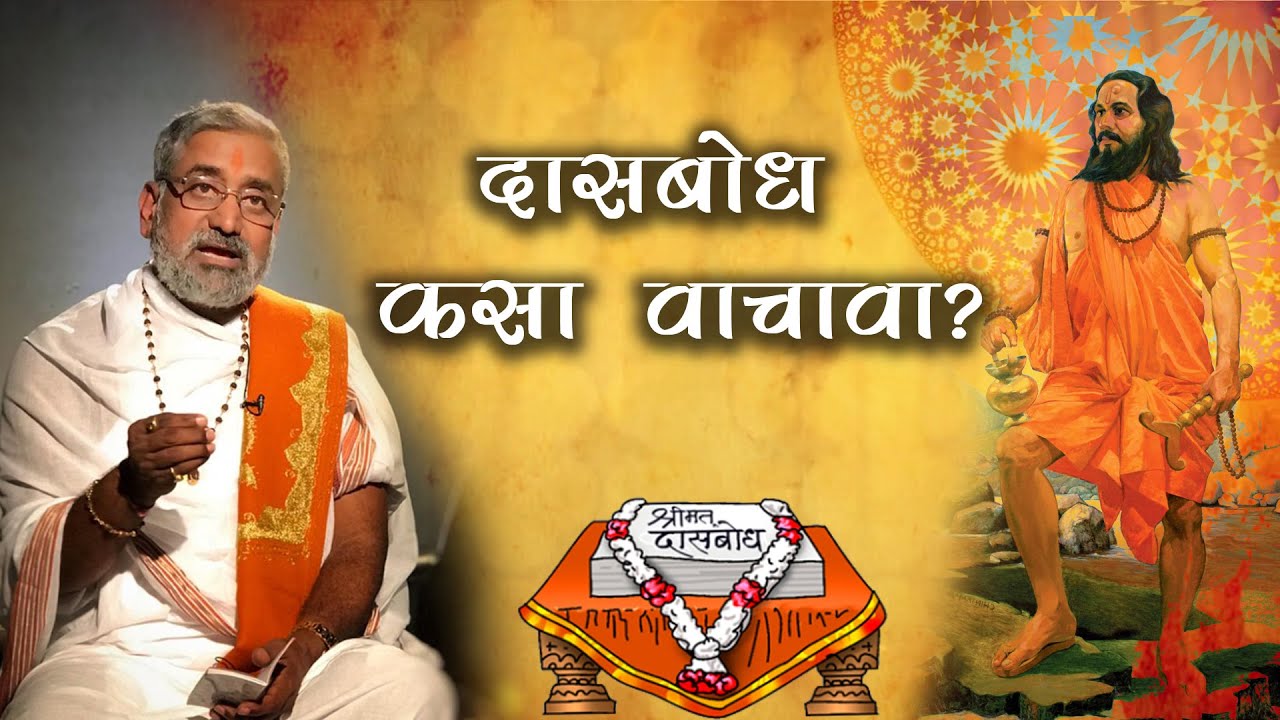
#DasbodhallDashaks#dasbodhinenglish
** Please subscribe and get notified as The Full Episodes of All Dasbodh Dashaks are uploaded shortly**
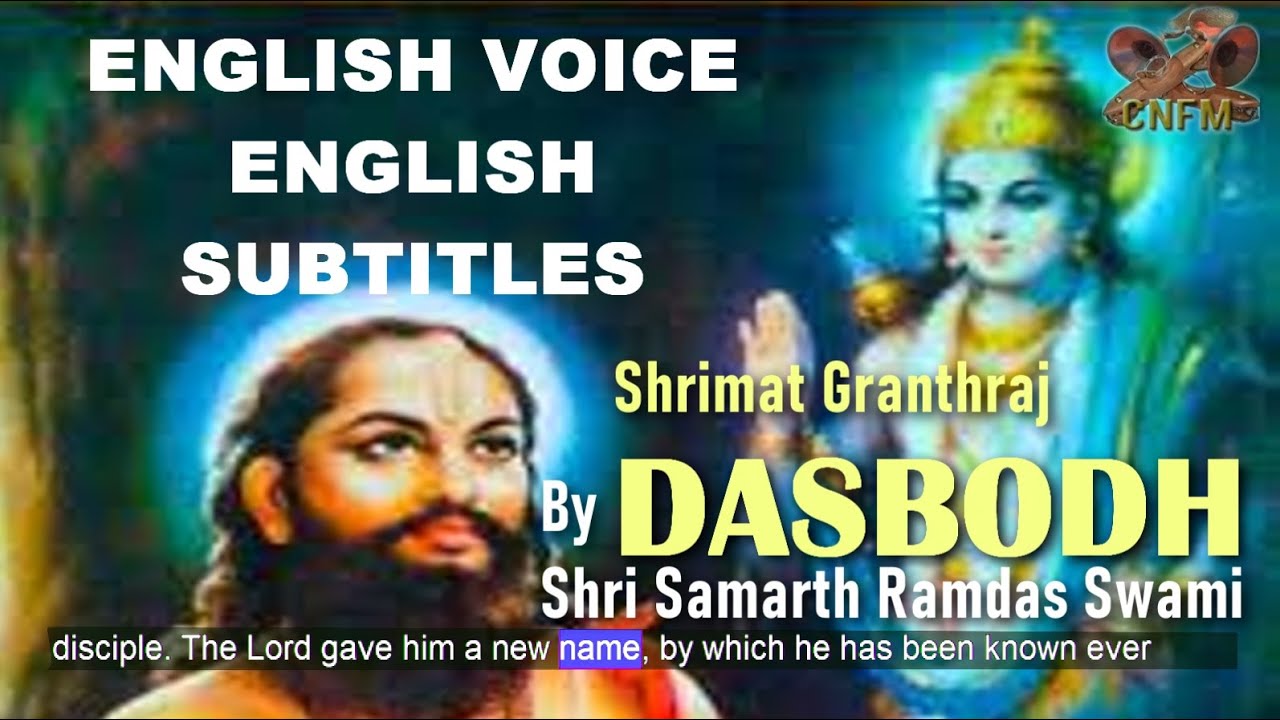
Dasbodh Introduction in English | English VO & Subtitles | Shri Samarth Ramdas swami Biography |
A BRIEF OUTLINE OF THE BIOGRAPHY OF SHREE SAMARTH RAMDAS SWAMI
Shree Samarth Ramdas Swami (Hereinafter referred to as Shree Samarth) was a Sage of the highest order as compared to all the Saints throughout the world if one considers his knowledge of the Parbrahma, his unflinching worship, his being an unparalleled Guru, his literature and the tremendous adulation he received from the masses not only during his times but even now. He was born in a village, Jamb to Mr. Suryaji and Mrs. Ranoobai Thosar. His original name was Narayan. He lost his father at the age of eight, which turned him into an introvert. After a lot of introspection he finally arrived at the thought of the God, at that tender age. He used to be engrossed in these thoughts and try and find out the ways to meet The God. Then at the age of 12 years Lord Ram himself appeared in front of him and advised him to count the 13 lettered Ram tarak Mantra 108 times at least once a day. Then Lord Ram accepted him as his own disciple. The Lord gave him a new name by which he has been known ever since, Ramdas. Such a thing had never happened after Lord Ram who was an incarnation of Lord Vishnu, left his mortal body, thousands of years ago. At the age of 12 years while he was standing on the
podium during his marriage ceremony he heard the Brahmins clattering loudly, “Beware”! Immediately after hearing it he knew what it meant and just ran away from the scene and went to the holy city, Nasik, where he started his worship of Lord Ram which lasted for 12 years. He did it the hard way, many a times remaining without food or water, for days together. Every millisecond of this time he spent in the worship of Lord Ram. During this time he was constantly guided from within by greatest worshipper of Lord Ram, Hanuman. After 12 years of extensive Sadhana he got the blessings of Lord Ram again and through him he also got the real knowledge and then he embarked on a pilgrimage of most of the holy places of India which he completed in 12 years, bare feet. After finishing the pilgrimage he went back to Mahabaleshwar. Then at Masur he celebrated the birth day of Lord Ram wherein thousands of people took part in the religious activities. He started gathering people around him which was essential for his ultimate goal of establishing the Hindu religion in its original form which was in a shambles because of hundreds of years of Muslim rule in the country. Next year he found the statues of Lord Ram in the deep waters of the river Krishna near Angapur. After coming back to Sajjangad, Shree Samarth started writing his epic, “The Dasbodha”. He also established a temple of the Goddess at the Pratap Fort. Shivaji Maharaj used to visit him frequently for advice and seeing the qualities of this disciple of his, Shree Samarth told him the crux of the ultimate knowledge which one has to acquire to merge with the Parbrahma. He then completed the remaining chapters of the Dasbodha. After the death of Shivaji Maharaj he wrote a letter to the heir to the throne, Sambhaji (Shivaji’s son) which is considered a milestone by even today’s political scientists. His job of the Hindu religious renaissance done Shree Samarth left his mortal body and finally united with the Parbrahma ending a life which was so multifaceted that without his mention almost no field can be considered as complete. He left his mortal body at Sajjangad at the age of 73 years.
#dasbodh,ramdas swami,swami ramdas,दासबोध,रामदास स्वामी,दासबोध निरूपण,dasbodh nirupan,nirupan on dasbodh,parmarth shravan,chalu samas,vartaman samas,appasaheb dharmadhikari,sadguru nirupan,चालू समास निरुपण,वर्तमान समास,परमार्थ श्रवण,जय जय रघुवीर समर्थ,english explaination,dasbodh introduction,dasbodh in english,dasbodh english,dasbodh english VO,dasbodh english subtitles,ramdas swami biography,smarth ramdas swami biography in english
















Информация по комментариям в разработке