💕💕 Welcome to Unit 7 of Oxford Word Skills Elementary – Part 2! 👋🌹
In this lesson, you will learn how to tell the time in American English 🇺🇸, with a special focus on exact times and periods of time. You will practice using time expressions naturally in American English, including how to talk about time clearly and correctly in everyday situations.
📘 Part 1 of Unit 7 focused on reading and saying different times, including analog and digital clocks, as well as expressions like half past, quarter past, and quarter to.
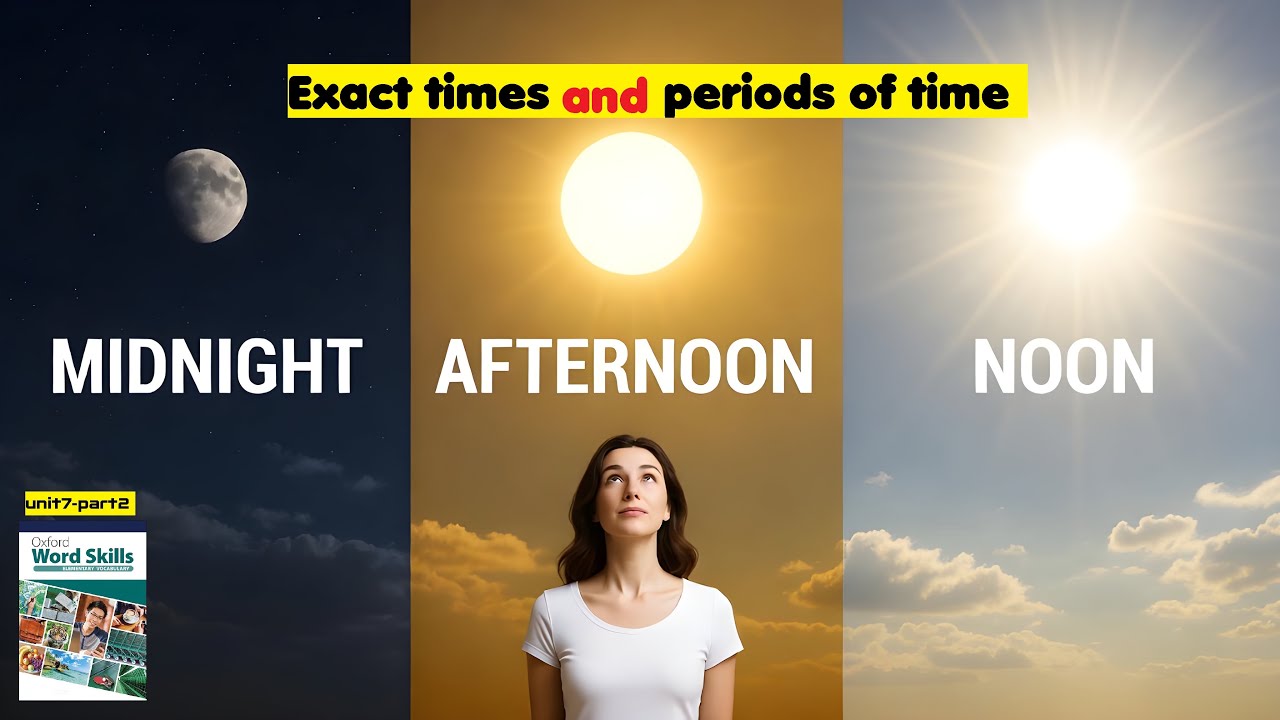
📘 Part 2 focuses on exact times and periods of time, helping you understand how to talk about time more naturally in everyday American English.
This lesson is based on Oxford Word Skills Elementary – Unit 7 (Telling the Time) and is perfect for beginner and elementary learners who want to read, say, and understand time confidently in American English.
------------------------------------------------------------------------------------------------------------------------
🔗British
Watch Part 1 of Unit 7 here 👉 • How to tell the time in English | Unit 7 -...
Watch Part 2 of Unit 7 here 👉 • Exact times and periods of time | Unit 7 O...
🔗American
Watch Part 1 of Unit 7 here 👉 • How to Tell the Time in American English ...
-----------------------------------------------------------------------------------------------------------------------
📘 Unit 7 | Telling the Time: Exact Time & Time Periods (American English)
🌟 Golden Tips
🔴 1️⃣ All morning / all afternoon / all day (British English vs American English)
In British English, all morning, all afternoon, and all day are used to talk about the whole active time period when activities happen, usually work, school, or classes.
👉 I was at work all morning.
👉 She studied all afternoon.
👉 It rained all day.
⚡ all + time period means from the beginning to the end of that period.
In American English, all morning, all afternoon, and all day usually just mean the whole morning, afternoon, or day in general, and are not limited to work or school hours. The meaning can change depending on the situation.
🔴 2️⃣ Using “at” with exact times (noon & midnight)
We use at for exact times in American English.
👉 at noon (more common in AmE)
👉 at midnight
👉 at 7:00 a.m.
👉 at 3:30 p.m.
🔴 3️⃣ Using “at” with noon, midday, and midnight (BrE vs AmE)
In British English, it is optional to use “at” before midday / noon / midnight in everyday speech:
👉 It’s (at) midday.
👉 It’s (at) midnight.
In American English, it is standard and recommended to always use “at” with noon and midnight:
👉 It’s at noon.
👉 It’s at midnight.
⚡ Summary:
BrE: at → optional
AmE: at → usually required
🔴 4️⃣ Noon vs Midday (American English vs British English)
In American English, people usually say “noon” to mean 12:00 p.m. ✅
👉 It’s at noon.
In British English, people often say “midday” instead of noon ✅
👉 It’s at midday.
⚡ Summary:
AmE: noon → very common
BrE: midday → more common
🔴 5️⃣ Digital clocks (British English vs American English)
In British English, digital clocks are usually written with a dot (.) between hours and minutes:
👉 7.30 a.m.
👉 3.45 p.m.
In American English, digital clocks are usually written with a colon (:) between hours and minutes:
👉 7:30 a.m.
👉 3:45 p.m.
-----------------------------------------------------------------------------------------------------------------------
📢🎧 Viewing Guide:
📍 All lessons have an British English ( uk version ).
📍 This lesson also has one — you can watch it in British accent if you want.
Link:
-----------------------------------------------------------------------------------------------------------------------
🤖📚 About MindVision English Vocabulary:
We bring Oxford Word Skills Elementary to life using visual learning, AI-powered explanations, and memory-based techniques.
Our mission: 👉 See words, remember forever! 🔒
Perfect for elementary learners, intermediate review, and anyone who wants to learn English vocabulary, pronunciation, and listening skills faster using images, animations, and AI visuals.

Информация по комментариям в разработке