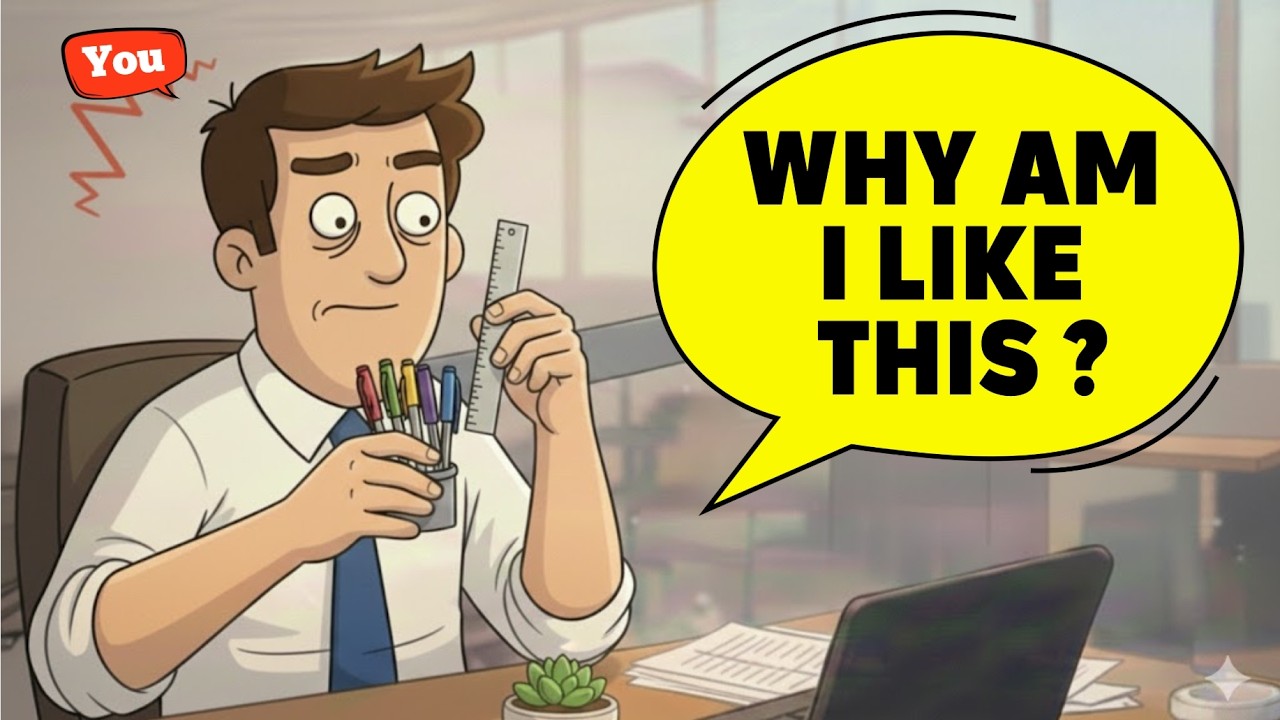
It's 2 PM. You've reorganized your desk four times. And you still haven't started the report. Your coworker asks, "Don't you have work to do?" Yeah. You do. But look how perfectly aligned these pens are now. That wasn't procrastination. That was anxiety wearing a productivity costume.
In this video, we dive deep into topics such as:
Locus of control: Why your brain hunts for controllable things when work feels chaotic
How reorganizing creates dopamine hits and instant wins when real tasks take weeks to finish
Visual clutter as mental battery drain: Why organizing closes "background apps" in your brain
The fear of uncertain outcomes: Why guaranteed wins (desk organization) beat risky ones (actual work)
How people avoid work not because they're lazy, but because they're afraid of failure
The feedback loop: Organizing creates the anxiety that makes you organize more
Why deep work looks like "nothing" but desk reorganization looks "busy"
How companies measure visible activity over actual productivity
The "clean desk vs. messy desk" double standard: Damned either way
Why the chaos isn't coming from your desk—it's coming from everything else
The Five-Minute Freeze tactic: How to distinguish organizing-to-start from organizing-to-avoid
Why seeking control in a chaotic environment isn't dysfunction—it's survival
How your desk becomes the battleground when your job denies control
Why the bravest thing is starting work anyway, even when the stapler isn't perfectly aligned
If you've ever reorganized your desk five times and still didn't start the actual work, or been told "just start working" while your brain screams for order first, or wondered why you can't stop rearranging when you know you're avoiding something—this video explains it with clarity and evidence-based psychology. You're not procrastinating. You're regulating anxiety.
👇 Comment below: How many times did you reorganize your desk today? And what's the weirdest thing you've organized to avoid real work? Paperclips by color? Cables by length?
👍 Like & Subscribe ➡️ @9to5Psych for more workplace psychology, anxiety management insights, and procrastination analysis.
🔔 Hit the bell so you never miss a video on work psychology, control-seeking behaviors, and adaptive coping mechanisms.
Check out the full playlist on workplace and behavioral psychology here:
🎬 • Psychology of Work Habits
If you'd like to support the channel and help us continue making more videos, you can do so by becoming a channel member! Your support is genuinely appreciated and helps us dive deeper into the psychology of work and anxiety disorders. 🙏
References:
Locus of control and compensatory control: Kay, A. C., et al. (2008). "Compensatory control: Achieving order through the mind, our institutions, and the heavens." Current Directions in Psychological Science, 17(4), 264-268.
Physical organization during uncertainty: Whitson, J. A., & Galinsky, A. D. (2008). "Lacking control increases illusory pattern perception." Science, 322(5898), 115-117.
Dopamine and task completion: Schultz, W. (2007). "Behavioral dopamine signals." Trends in Neurosciences, 30(5), 203-210.
Visual clutter and cognitive load: McMains, S., & Kastner, S. (2011). "Interactions of top-down and bottom-down mechanisms in human visual cortex." Journal of Neuroscience, 31(2), 587-597.
Procrastination and fear of failure: Steel, P. (2007). "The nature of procrastination: A meta-analytic and theoretical review of quintessential self-regulatory failure." Psychological Bulletin, 133(1), 65-94.
Task avoidance and certainty preference: Rothblum, E. D., Solomon, L. J., & Murakami, J. (1986). "Affective, cognitive, and behavioral differences between high and low procrastinators." Journal of Counseling Psychology, 33(4), 387-394.
Deep work vs. visible productivity: Newport, C. (2016). "Deep Work: Rules for Focused Success in a Distracted World." Grand Central Publishing.
Anxiety and control-seeking behaviors: Abramson, L. Y., Seligman, M. E., & Teasdale, J. D. (1978). "Learned helplessness in humans: Critique and reformulation." Journal of Abnormal Psychology, 87(1), 49-74.
Check out the full playlist on workplace and behavioral psychology here:
🎬 • Psychology of Work Habits
Disclaimer: This channel is created for educational and informational purposes only. It is not intended to replace professional psychological, medical, or therapeutic advice. If you're struggling with anxiety, obsessive behaviors, or work-related stress affecting your well-being, please consult a qualified mental health professional.















Информация по комментариям в разработке