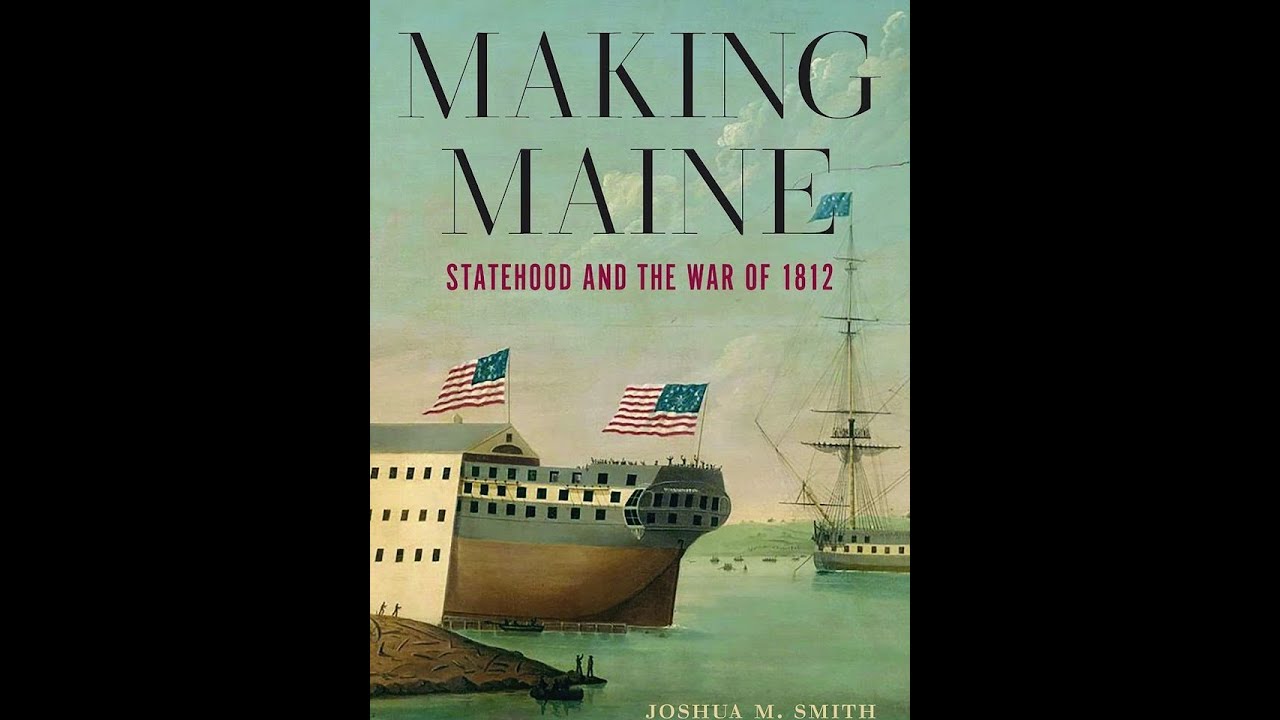
Border Historical Society is very pleased to host author Dr. Josh Smith as he introduces his latest work - "Making Maine: Statehood and the War of 1812".
This is fifth in the series of books that Border Historical Society has published/helped publish in its 40 years of existence.
Josh's synopsis below is a fun read in itself, as he recounts misadventures, comeuppances, dead skunks as weapons, vainglorious militia officers, venal office holders - what's not to like?
From Josh:
Today Americans obsess about disorder in the nation. Politics have become bitterly partisan, and the news media blatantly takes sides, urban elites and their rural counterparts vie for moral ascendency. There are widespread concerns about riots, coups, and what role the states and federal government have in maintaining order or quelling dissent. Some alarmists even predict the end of American democracy. My message to the reader is: fear not. The republic has witnessed all these travails before and has not only survived but generally thrived. My evidence lies in a detailed analysis of Maine’s search for a new identity separate from Massachusetts from roughly 1805 to 1820.
The choice of Maine may surprise many who know it as the land of quaint villages, Moxie, lobster rolls, and L.L. Bean, a political and economic backwater tucked in an obscure corner of the nation. But Maine in the early 1800s was a dynamic place, well placed for international trade with the British Empire, with a rapidly growing population. Increasingly its citizens sought independence from Massachusetts, ultimately becoming a separate state in 1820. Why did Mainers seek separation from a large, prosperous, and important state like Massachusetts? In part, its leading citizens decided that the time was ripe for them to take control. Another factor was a growing perception that Massachusetts treated Maine as a colony to be commercially exploited and its inhabitants disdained as uncouth rustics.
The timing of a resurgent statehood movement after 1814 also bears examination. Ronald F. Banks noted that the War of 1812 was the catalyst for Maine’s statehood. That conflict left its citizens starving, humiliated by enemy occupation, businesses driven to bankruptcy, the people oppressed by taxes, and returning veterans maimed or disabled. Furthermore, the war demonstrated that the institutions of Massachusetts governance, such as the Congregational clergy and a heavily mythologized militia, could not protect Maine. The reasons Maine sought statehood can be found in the catalog of miseries the war imposed upon its people. It is a story rooted in the darker side of human nature, with ambitious politicians, sly smugglers, venal officeholders, politicized clergy, semi-piratical privateersmen, and vainglorious militia officers playing outsized roles. Furthermore, the road to statehood was filled with plots and cabals, shouting matches, slanderous editorials, fistfights at town meetings, riots in the streets, and in one case, a dead skunk thrown into a meetinghouse.
Joshua M. Smith is the author of numerous books and articles on American maritime history, including Borderland Smuggling: Patriots, Loyalists, and Illicit Trade in the Northeast, 1783-1820, which won the John Lyman Award in American Maritime History in 2007, and Making Maine: Statehood and the War of 1812, which The University of Massachusetts Press published in 2022. He lives with his family on Long Island, where he is the Director of the American Merchant Marine Museum in Kings Point, New York.










Информация по комментариям в разработке