This episode was originally released 09/2018.
Earlier in the 1940s, there was strong interest in the new FM band by station owners, but construction restrictions that went into place during World War II limited the growth of the new service.
During the war, Armstrong also turned over his patents for us by the government. Many of the communications systems employed by the US army during World War II used FM, and Frequency Modulation's superiority to Amplitude Modulation was readily apparent.
Although the Germans had the superior Panzer tanks, they were equipped with AM, whereas the US Sherman tanks were equipped with an SCR-508 or 528 FM transmitters. These FM transmitters sent power out of 25 watts between 20 and 27.9 MHz
It gave the US previously unattainable reduction of the effects of ignition and other motor noises, which played havoc on AM transmitters. The German's communication systems often jammed.
As the War wound down, the FCC undertook a number of investigations of spectrum allocation and use.
It was feared that the lowest layers of the earth's atmosphere and ionized atmospheric gas that resides on the earth between 50 and 100 miles off the ground could cause bad interference. Armstrong contested that there was nothing to suggest this was possible. Other scientists stepped in and agreed.
Then, a particularly controversial proposal, spearheaded by RCA, was that the FM band needed to be shifted to higher frequencies in order to avoid this potential problem. The change was also thought to have been favored by AT&T, as the elimination of FM relaying stations would require radio stations to lease wired links from the company.
The FCC made its decision final on June 27, 1945, shifting FM service higher in the VHF band, to 88 -108 MHz.
It made more than 50 FM radio station transmitters and half a million FM receivers obsolete after a three-year transition period.
In the end the scientists and engineers lost to the big corporation.
Although Armstrong contested them, these actions by the FCC nearly terminated FM radio broadcasting for more than a decade while the industry turned to developing television and expanding AM.
Meanwhile, unwilling to pay Armstrong the royalties he sought, RCA began developing FM circuits of its own, which its engineers claimed did not use Armstrong's patents.
By using these circuits, RCA would not have to pay Armstrong any royalties on the sale of TV sets. All TV sets used FM for the audio portion of their signal. RCA convinced other TV manufacturers to do the same.
Curiously, Television Channel 1, which in 1946 was an experimental TV station used by NBC, operated it's FM audio on a frequency of 44-50 MHz. Apparently the concerns RCA had for FM radio didn't translate to their TV production.
In 1948, Armstrong filed suit against RCA and NBC, accusing them of patent infringement and "deliberately setting out to oppose and impair the value" of his invention.
Although he was confident that this suit would be successful and result in a major monetary award, the protracted legal maneuvering that followed eventually began to impair his finances, especially after his primary patents expired in late 1950.
That was RCA's trial strategy—to delay the proceedings as long as possible, to a date after the expiration of Armstrong's patents. As wealthy as Armstrong had made himself with his inventions, he lacked the capital of a giant corporation.
With no royalty revenues, he would soon be unable to continue prosecuting the case.
The strategy worked.
By 1952, Armstrong had run out of money and had to rely on credit to pay his lawyers.
In August 1953 Armstrong proposed to settle the suit against RCA, seeking $3.4 million over a ten -year period. In December RCA responded by agreeing to pay $200,000 initially,
with an "option" to pay more the next year if they chose
Armstrong rejected the offer.
The years of litigation had taken their toll. David Sarnoff, once his closest ally, had become his bitter enemy.
In a fit of rage in November of 1953, Armstrong took his anger out on Marion, his wife of 30 years, who he'd met while visiting his friend David Sarnoff at work one day when Marion was employed as his secretary.
She fled their apartment at the River House in New York City.
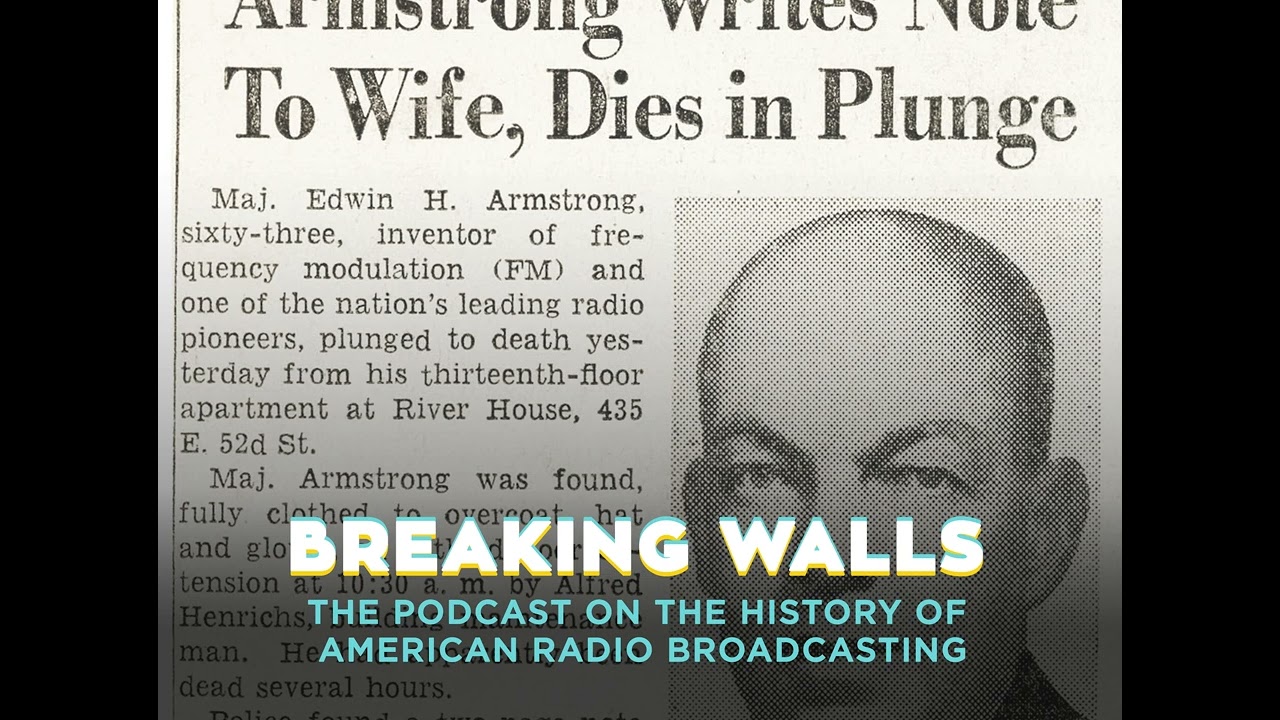
Bankrupt and ashamed by his actions, on the evening of 31 January 1954, Armstrong wrote a note to Marion apologizing for his actions. He then put on his heavy trademark winter coat, gloves, and hat, opened the window of their 13th floor apartment, and stepped out.
The next morning, an employee found his body on a third-floor balcony.
He was 63.
#goldenageofradio #history #oldtimeradio #oldtimeradioclassics #podcast #oldtimeradioshows #radiohistory #oldtimeradioshows #worldwar2 #worldwarii #rca #davidsarnoff #edwinhowardarmstrong













Информация по комментариям в разработке