“Stern Tone II” combines two distinct composing strategies: granularism, and polymeter. Granularism is a preference for change by the smallest possible gradation. Polymeter is the use of multiple time signatures simultaneously.
The original version (“Stern Tone I”) is for orchestral strings, and was written in stages. First the central trichords were developed. The central trichords constitute three different orderings of the {333} interval set, which has 27 permutations. The trichords exhibit completism, meaning each of the 27 permutations is used exactly once before being reused. Optimal orderings of the {333} interval set were found by the BalaGray crawler, optimal meaning only one note changes at time, each voice transitions the same number of times (or as close to that as possible), and the span lengths are as short and uniform as possible. The three voices were spaced to maximize consonance, and remapped to maximize common tones. A harmonization was chosen for each trichord, and the bass line was then written, avoiding chromatic clusters and doubling. The resulting tetrachords were reharmonized, and inspired by these bolder tonalities, the melody line was finally written, again avoiding chromatic clusters and doubling. The result is pentachordal harmony, with five distinct non-overlapping parts.
“Stern Tone II” is the same structure but arpeggiated in polymeter on a piano. The trichord changes occur on a 5/16 grid, whereas the arpeggio notes are on a 3/16 grid. The loop lengths utilized are 3, 5, 45, 135, 270, and 405, all in sixteenths. None of these lengths are evenly divisible by four, thus the influence of four is eliminated, which is unusual. The prime factors are 2, 3, and 5, but the strongest influence is 27, or 3 cubed. The velocities modulate in a 5/16 pattern which stays synchronized with the chords. Each trichord part is periodically offset in time by one or two sixteenth notes, using a feature of the Polymeter MIDI Sequencer called position modulation, and this contributes to the syncopated feel.
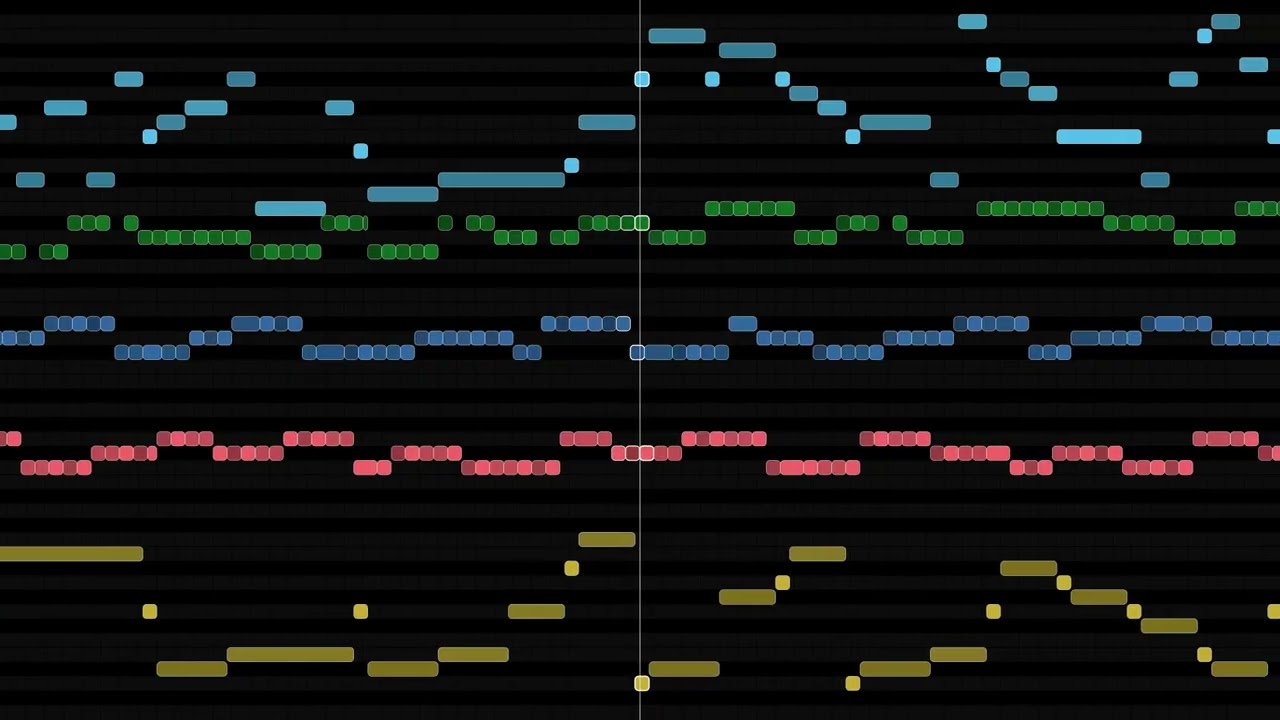
This song is from my album “Granularism” available on Bandcamp, Spotify, etc. A score is available on my website, chriskorda.com and my composition software is also freely available there. The visualization was created via another one of my apps, called MidiRoll. Each part is drawn in a different color, and velocity is mapped to alpha, so that softer notes are more transparent.

Информация по комментариям в разработке