What was the Great Wall really like —
before it became a monument, symbol, or national icon?
Long before tourism, maps, and modern borders, the Great Wall functioned as infrastructure — a system built to organize labor, control movement, and sustain state presence across vast and hostile landscapes.
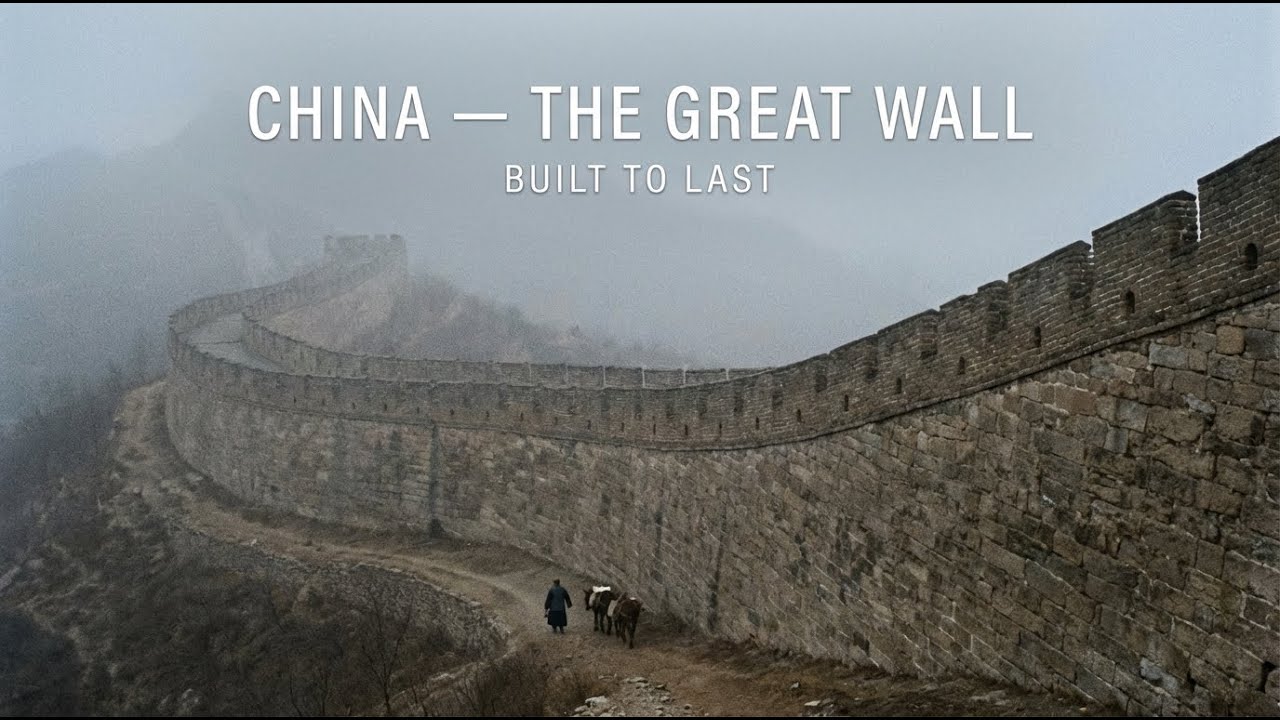
In this video, Quiet History reconstructs the historical reality of the Great Wall of China, focusing not on emperors or battles, but on how the wall was built, maintained, inhabited, and endured as part of everyday life during the Ming dynasty.
Rather than treating the wall as architecture or myth, this reconstruction examines it as a system:
a response to geography, logistics, manpower limits, and long-term state control.
Using historical records, archaeological evidence, period illustrations, and landscape studies, we reconstruct how the wall functioned in practice — not as a symbol, but as work.
These reconstructions are rendered as ultra-realistic AI visuals, animated with restrained, documentary motion, allowing the viewer to observe the wall not as spectacle, but as lived structure.
Guided by our AI historian, this video explores the Great Wall as part of everyday systemic reality:
• Forced and inherited labor behind construction and maintenance
• Logistics of stone, earth, transport, and storage
• Patrol routines, surveillance, and communication along vast distances
• Families living beside and within the wall system
• Climate, erosion, repair, and constant upkeep
• Dynastic change without dismantling the structure
• Lives absorbed into stone without record, name, or memory
• Architecture as infrastructure — not symbolism
This is not a celebration of greatness.
This is not national mythology.
There are no heroic victories, no legendary generals, and no timeless glory.
What we see instead is ordinary endurance —
where the wall is repetitive, demanding, and necessary,
and where human life is structured by routine more than ideology.
From a single stretch of stone emerges a larger truth:
history is carried forward not only by rulers and wars —
but by systems maintained every day, across generations, in silence.
🎓 Narration & Historical Perspective
Presented by Doktor Li Vong
Historian (AI Reconstruction)
⚠️ Disclaimer
This video is an AI-assisted historical reconstruction created for educational and documentary purposes.
The reconstruction is based on available historical research, written sources, archaeological findings, and period-accurate references.
Where precise visual details are unavailable, careful and informed interpretation is used to approximate everyday life.
The goal is to present history as lived experience —
not to replace academic scholarship, but to visualize how ordinary people may have lived, worked, and eaten.
🔔 Support the Channel
If you found this reconstruction valuable:
👍 Like the video
🗨️ Comment which Chinese or Japanese era, city, or daily activity we should reconstruct next
🔔 Subscribe to Quiet History for future AI-based historical reconstructions
Your support helps us continue exploring history beyond kings, wars, and monuments.
🌏 Upcoming Reconstructions
Ancient China • Imperial China • Song Dynasty Cities • Ming Dynasty Streets
Edo Japan • Japanese Street Life • Food & Daily Routines • Crafts & Trades
Everyday Life in East Asian History
🏷️ Hashtags
#AIHistoricalReconstruction
#AncientChina
#AncientJapan
#EverydayHistory
#EastAsianHistory
#StreetLifeHistory
#FoodHistory
#NoodleHistory
#HistoricalDocumentary
#Quiet History

Информация по комментариям в разработке