What if one of the most productive food crops in human history was deliberately pushed out of agriculture — not because it failed, but because it couldn’t be controlled?
For centuries, a single plant fed Indigenous nations through frozen winters, sustained European estates for generations, and produced more calories per acre than potatoes — without fertilizer, pesticides, irrigation, or replanting.
That plant still exists.
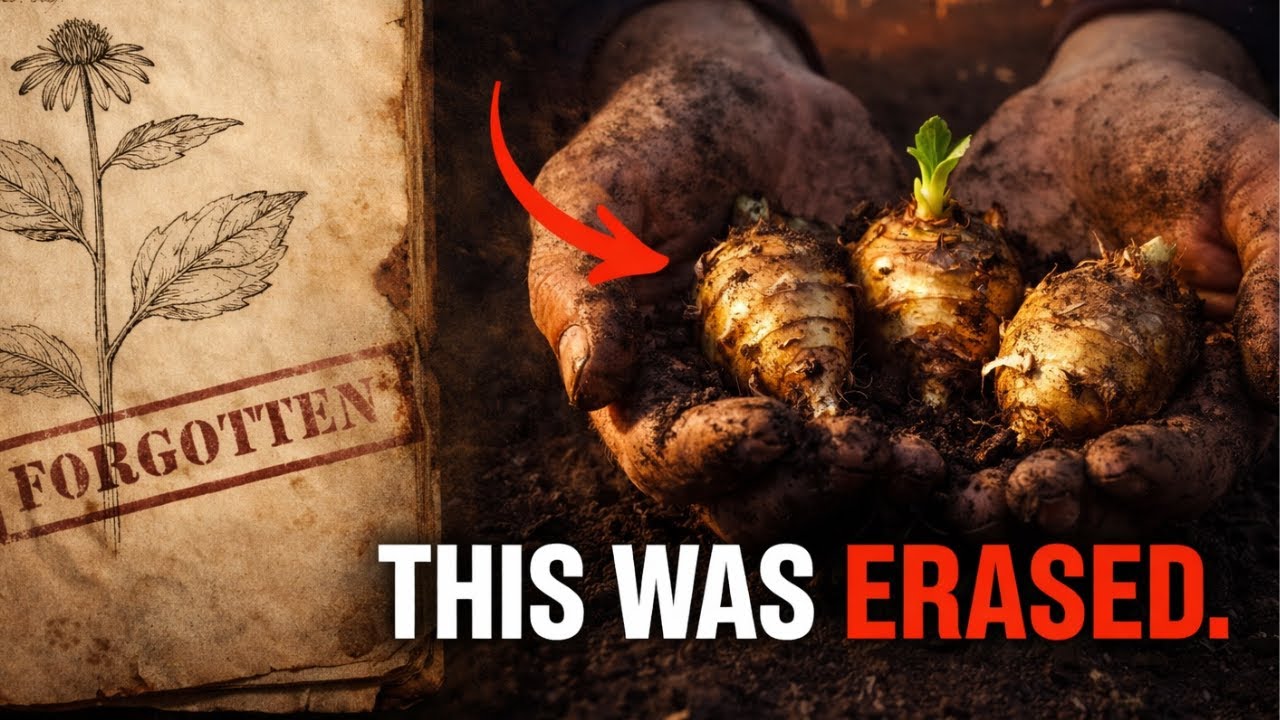
It’s called the sunchoke (Jerusalem artichoke), and it grows back every year on its own.
In this documentary, we uncover how a perennial crop that made famine nearly impossible was quietly removed from mainstream agriculture and reclassified as a “problem plant,” while industrial crops that require constant inputs took its place.
You’ll discover:
• How sunchokes fed Indigenous nations through −40°F winters
• Why early European estates treated them as permanent food infrastructure
• Documented yields that rival and exceed potatoes
• Why modern agriculture labeled them “unsuitable” — despite superior productivity
• The role of standardization, logistics, and recurring revenue in crop selection
• Peer-reviewed research on sunchoke nutrition, inulin, and soil regeneration
• Why crops that grow forever threaten industrial food systems
This isn’t anti-science.
It’s about data that exists — and was quietly ignored.
📚 SOURCES & REFERENCES BELOW
Historical accounts & primary records
Champlain, S. de. (1603–1615). Voyages of Samuel de Champlain.
Primary journals documenting Indigenous food systems and tuber cultivation in northeastern North America.
Parkinson, J. (1629). Paradisi in Sole Paradisus Terrestris. London.
Early English horticultural reference describing widespread cultivation of Jerusalem artichokes.
de L’Écluse, C. (1613). Rariorum Plantarum Historia.
Botanical documentation of early European distribution of Helianthus tuberosus.
Lewis, M., & Clark, W. (1805–1806). The Journals of the Lewis and Clark Expedition.
Accounts of sunchoke consumption during food shortages.
Agricultural productivity & yield data
Ohio Agricultural Experiment Station. (1918). Root Crop Yield Comparisons.
Documented yields of Jerusalem artichokes exceeding potatoes under low-input conditions.
Cornell University. (2003). Field trials on perennial root crops.
Yield comparisons of sunchokes vs potatoes without irrigation or fertilizer.
Journal of Sustainable Agriculture
Kays, S.J., & Nottingham, S.F. (2008). Biology and Chemistry of Jerusalem Artichoke. CRC Press.
Nutrition & inulin research
University of Guelph. (2009).
Analysis of inulin content and prebiotic potential of Jerusalem artichoke tubers.
Roberfroid, M.B. (2005). Inulin-Type Fructans: Functional Food Ingredients.
Journal of Nutrition, 135(11), 2673–2677.
Gibson, G.R., et al. (2017). The concept of prebiotics revisited.
ISAPP Consensus Statement, Nature Reviews Gastroenterology & Hepatology.
Industrial agriculture & standardization
USDA. (1943). Wartime Food Production: Maximizing Yields on American Farms.
Classification of crops unsuitable for standardized market logistics.
Kloppenburg, J.R. (2004). First the Seed: The Political Economy of Plant Biotechnology.
University of Wisconsin Press.
Fitzgerald, D. (2003). Every Farm a Factory. Yale University Press.
Busch, L., et al. (1991). Plants, Power, and Profit. Basil Blackwell.
Potato industrialization & economics
FAO. (2022). Global Potato Production and Value.
Seed dependency, input costs, and market structure.
Hartmann, H.T., et al. (2011). Plant Propagation: Principles and Practices.
Discussion of seed certification and disease accumulation.
Ecology & resilience
Monti, A., et al. (2005). Jerusalem Artichoke as a Crop for Marginal Lands.
Biomass and drought resilience studies.

Информация по комментариям в разработке