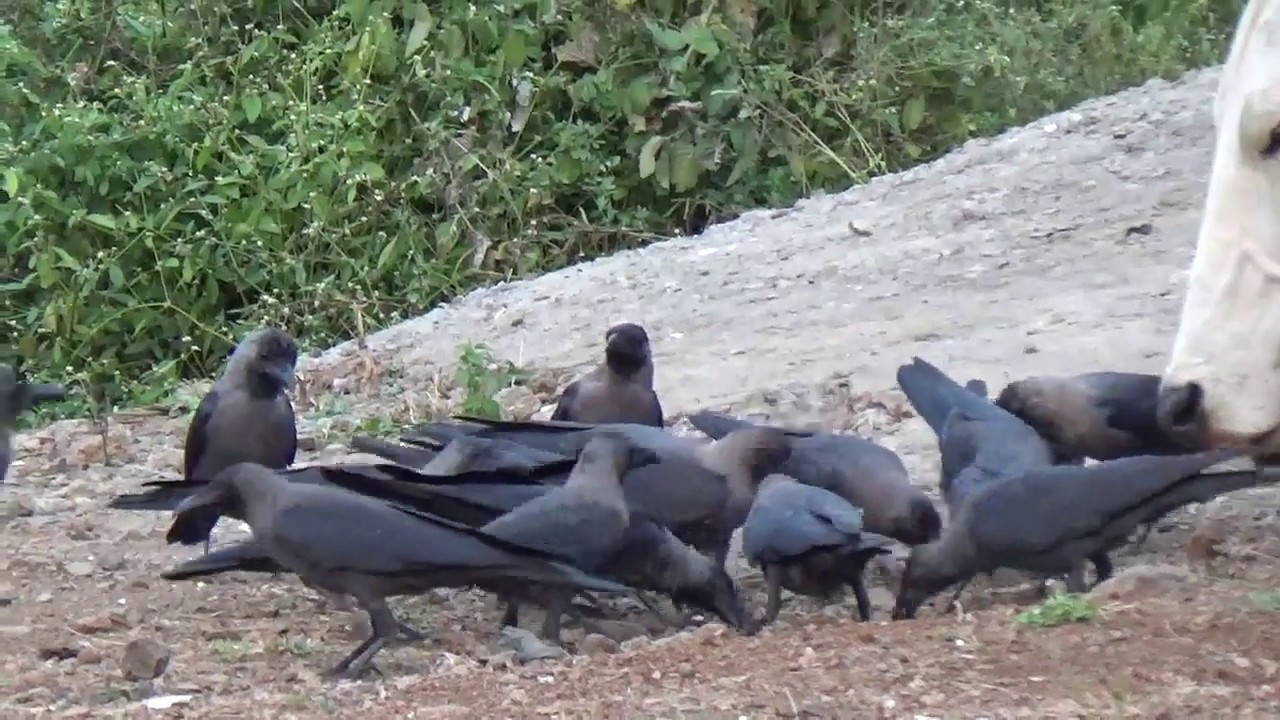
House Crow (Corvus splendens) is a widespread resident in India. Size: 42 cm Weight: 250-350 gm.
Identification: Plumage is glossy black, except for the nape, sides of the head, upper back and breast, which are grey. Bill, legs, and feet also black. Sexes alike.
Food: Omnivorous. Diet includes seeds, fruit, grain, nectar, berries, bird’s eggs, nestlings, mammals, reptiles, amphibians, fish, insects, wide range of carrion.
Call: Normal call a harsh qua qua or a nasal kaan kaan. It also has a couple of softer calls when resting or during courtship.
Habits: Highly vocal, gregarious birds, seemingly unafraid of humans. Aggressive, will attack and chase off any large bird of prey. Birds have been reported taking food from school children and killing chicks of domestic fowls. Breeding pairs will repeatedly dive bomb humans near the nest.
Habitat: Wholly dependent on human habitation; consequently found in villages, towns, and cities throughout its range. Resorts to altitudinal and seasonal local movements in colder northern areas in winter. Replaced by Large-billed Crows and Jungle Crows in mountains and forests respectively.
Breeding: Solitary nester except in areas of high population density. Will use trees, buildings, or other artificial structures for rough stick nest lined with coir or other fibre. Four to five pale blue-green eggs, speckled with brown. Breeding season March through July. Incubation 16–17 days; fledging 21–28 days. Its nest regularly brood-parasitized by Asian Koel.
Distribution: All over India except in high altitudes and forests. Also in Iran, Sri Lanka, Pakistan and Burma, self-introduced to East Africa, Indian Ocean islands, Malaysia, and South Africa. Four subspecies: C. splendens splendens, C. splendens zugmayeri (southern Jammu & Kashmir, Punjab and western Rajasthan), C. splendens protegatus (coastal areas, Kerala, Sri Lanka and nearby islets) and C. splendens maledivicus (Maldives islands).
Status: Not threatened. Abundant in its range to the point of being a pest and a threat to other bird species.
The Punjab Raven breeds throughout the Punjab (except perhaps in the Dehra Ghazee Khan district), in Bhawulpoor, Bikaner, and the northern portions of Jaipur and Jodhpur, extending rarely as far south as Sambhur. To Sindh it is merely a seasonal visitant, and I could not learn that they breed there, nor have I ever known of one breeding anywhere east of the Jumna. Even in the Delhi Division of the Punjab they breed sparingly, and one must go further north and west to find many nests.
The breeding-season lasts from early in December to quite the end of March; but this varies a little according to season and locality, though the majority of birds always, I think, lay in January.
The nest is generally placed in single trees of no great size, standing in fields or open jungle. The thorny Acacias are often selected, but I have seen them on Sisoo and other trees.
The nest, placed in a stout fork as a rule, is a large, strong, compact, stick structure, very like a Rook's nest at home, and like these is used year after year, whether by the same birds or others of the same species I cannot say. Of course they never breed in company: I never found two of their nests within 100 yards of each other, and, as a rule, they will not be found within a quarter of a mile of each other.
Five is, I think, the regular complement of eggs; very often I have only found four fully incubated eggs, and on two or three occasions six have, I know, been taken in one nest, though I never myself met with so many. I find the following old note of the first nest of this species that I ever took:
"At Hansi (Haryana), in Skinner's Beerh, December 19, 1867, we found our first Raven's nest. It was in a solitary Kikar tree, which originally of no great size had had all but two upright branches lopped away. Between these two branches was a large compact stick nest fully 10 inches deep and 18 inches in diameter, and not more than 20 feet from the ground. It contained five slightly incubated eggs, which the old birds evinced the greatest objection to part with, not only flying at the head of the man who removed them, but some little time after they had been removed similarly attacking the man who ascended the tree to look at the nest. After the eggs were gone, they sat themselves on a small branch above the nest side by side, croaking most ominously, and shaking their heads at each other in the most amusing manner, every now and then alternately descending to the nest and scrutinizing every portion of the cavity with their heads on one side as if to make sure that the eggs were really gone".
Mr. W. Theobald makes the following note of this bird's nidification in the neighborhood of Pind Dadan Khan and Katas in the Salt .
Please see for more Info Thanks from http://www.birding.in/a_hume/nests_an... Crow

Информация по комментариям в разработке