CMU Podcast EP16/2025
CMU Researchers Discover New Lentinus Mushroom Species with Promising Economic Potential
Researchers at Chiang Mai University (CMU) have identified a new edible mushroom species, Hed Khon Khao Saisamorn, notable for its tolerance to temperatures up to 37°C, suggesting significant economic potential. The discovery team includes Dr. Nakarin Suwannarach and Dr. Jaturong Kamla from the Faculty of Science’s Centre of Excellence in Microbial Diversity and Sustainable Utilization, along with master’s student Mr. Atsadawut Kaewnunta.
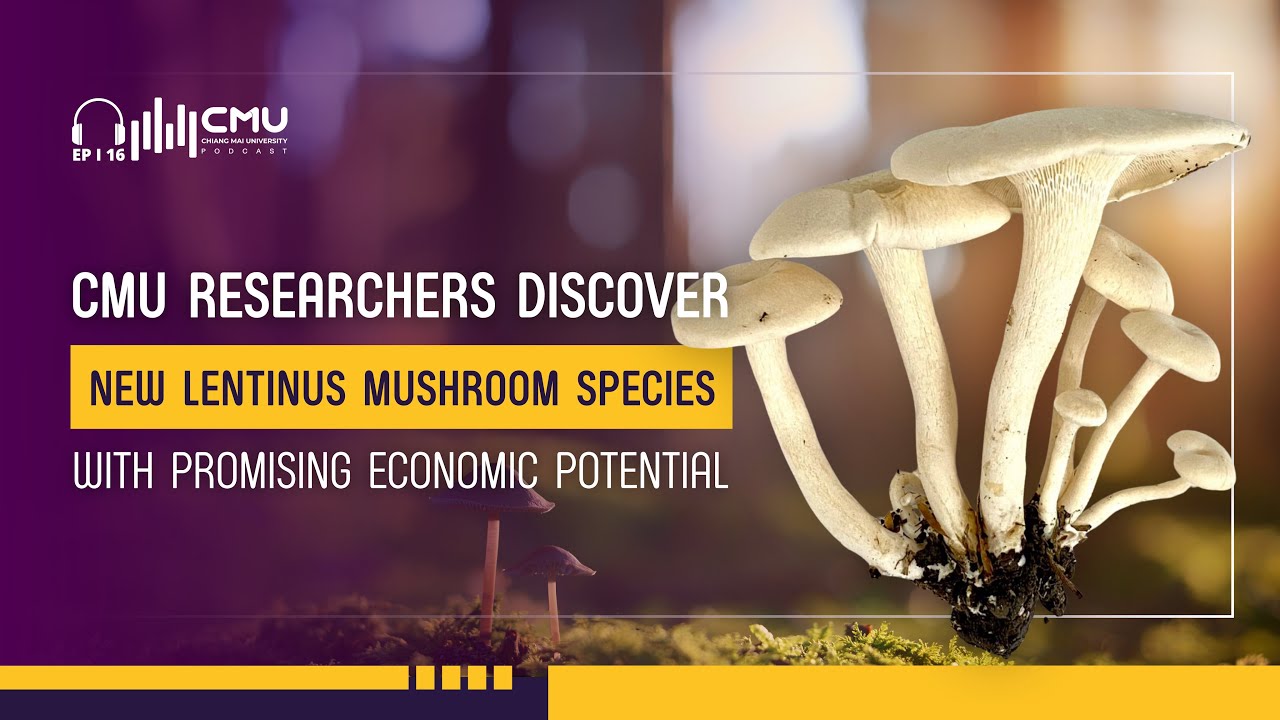
The team’s research focused on studying macrofungi diversity within the university grounds to establish a database, evaluate fertility, and assess mushroom resource utilization in the initial carbon cycle. Samples were collected and subsequently analyzed in the laboratory using modern taxonomic methods combined with DNA molecular biology techniques. Results indicate that this newly discovered Lentinus species differs morphologically from common variations. Hed Khon Khao Sai Samorn exhibits a white pileus and white cap at maturity, contrasting with the light brownish-yellow to light brown pileus and brownish-yellow mature cap of the common Hed Khon Khao. Additionally, the new species features a longer stipe at maturity but shorter spores compared to typical variations.
Based on DNA sequence data, typical Hed Khon Khao and Hed Khon Khao Sai Samorn differ in the ITS, LSU, and RPB2 gene regions. Phylogenetic analyses, a method used to study the evolutionary relationships between organisms or genes, confirms that they do represent distinct species. The research team applied modern taxonomic methods, integrating morphological characteristics with multigene DNA analysis and phylogenetic reconstruction. Specifically, the internal transcribed spacer (ITS) region was used to determine the genus, while the large subunit ribosomal DNA (LSU) and RNA polymerase II second largest subunit (RPB2) regions were analyzed to resolve species-level differences. This comprehensive approach followed established principles in fungal taxonomy and incorporated traditional mycological and microbiological techniques. Mycelial culture studies further supported the findings. Together, the evidence confirmed that the examined fungus represents a new species, warranting formal nomenclatural recognition.
The novel mushroom species, Lentinus Saisamorniae, was discovered between 2019 and 2024 growing on decaying tree roots in a yard. Morphological and DNA analyses, including phylogenetic evaluation, confirmed its classification within the genus Lentinus, establishing it as a new species. This research marks the first report of this edible mushroom. The species name, Saisamorniae, honors Emeritus Professor Dr. Saisamorn Lamyong for her 35 years of significant contributions to mycology, coinciding with her 75th birthday.
Laboratory studies successfully induced mycelial culture and fruiting body development, with further successful cultivation in a glasshouse. Future research will explore inducing natural fruiting body formation, investigate its nutraceutical properties for value addition, and assess its potential as a future economic mushroom through cultivation using natural materials available at CMU.
This research significantly contributes to Thailand's national biodiversity database, establishing the Northern region, specifically Chiang Mai, as a key reporting site for novel fungal discoveries. The Lentinus Saisamorniae mushroom, notable for its ability to tolerate temperatures up to 37 degrees Celsius, demonstrates considerable economic potential. Its discovery and subsequent research align with the Sustainable Development Goals (SDGs) policy of the Centre of Excellence in Microbial Diversity and Sustainable Utilization, highlighting its role in sustainable resource management and biodiversity conservation.

Информация по комментариям в разработке