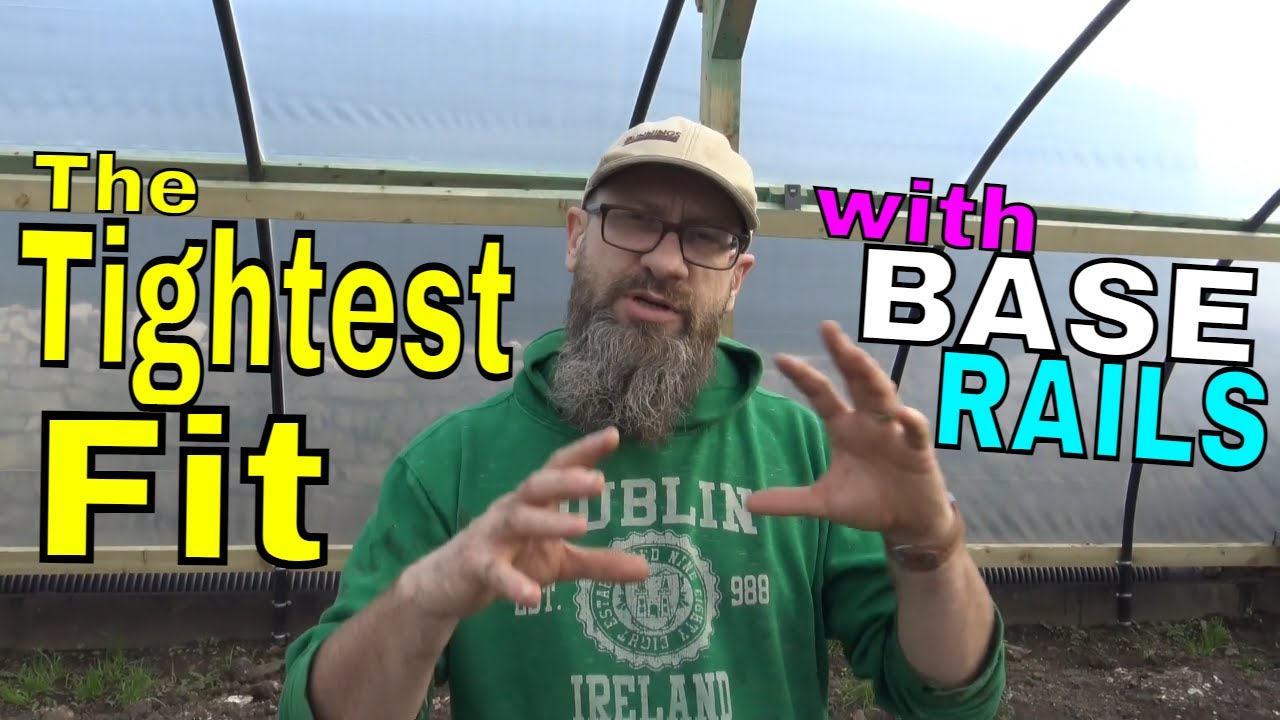
In this video I discuss the benefits of having a base rail connected to the bottom edge of the greenhouse/polytunnel. I saw many videos with people burying their poly plastic covers under the earth, and I understand that this is the most traditional and certainly cheapest way to secure the poly tunnel cover down, it is immensely hard work and you have to dig up the plastic from the earth next time you replace the cover, digging for people over 40 years old can put quite a strain on the heart. (I'm 45 and I use a Fitbit to monitor my heartrate and take breaks when regularly, & drink water too)
I talk about the ease of how you can pull a plastic cover over your greenhouse/hoophouse and secure it to battens you made along the length of your hoop-house or polytunnel. I wedge some 2X4" blocks under the rails so that there is a 4" (10cm) gap between the base rail and the base of the greenhouse proper. once the cover is all secured down, with the plastic fixed between the battens you can then take away the 2X4" blocks which will allow the rail to come down flush with the base of your greenhouse. This is the prequel to the actual video where my wife and I pull down the cover completely, stretching the plastic 10cms on each side, making it a 20 stretch when you count both sides. The front and back didn't get such a serious pull, they only went down 2" or 5cm front and back because I was afraid of ripping the poly plastic. Greenhouse plastic is only really designed to be stretched from the "sides" the length of the plastic is not as flexible, and could tear, that is why you MUST double check which way you orient your plastic. Both front to back, and inside and outside. On the outside there is a UV protection barrier to protect the polytunnel from the sun, if you put it upside down, the plastic will degrade faster, and its life will shorten, not dramatically, but it's a mistake that can be easily remedied if you catch it at the right time. Be careful: If you orient your greenhouse plastic the wrong way, ie front and back are turned to left and right sides to the front and back. If you turn the plastic and do it wrong, there is a good chance that the plastic will tear in a big wind, and it will not be covered in any kind of customer warranty. Its a big deal, but its an easy thing to spot considering most greenhouses are longer than they are wide, so unravel the full length of the plastic to get your bearings, you can even make it with permanent marker which end is the front and which end is the back. The plastic folds out from the center on both sides, so its quite easy to throw the plastic up there. There is text printed along the plastic telling you which side is inside and which side is outside, if you are inside the greenhouse when the plastic goes up, you will be able to read " this side facing down" when you can read the words, you are doing it right, conversely, if you are outside the greenhouse frame when it goes up, the words will be backwards. If you can read "this side faces down" when you are outside, just flip the whole cover, its easy to move when there are 2 people doing the job together. For me, because of the scale of my greenhouse, 3 people makes it even easier to get the greenhouse covered properly, 2 people to do the pulling, and one observer to say if it's straight or "needs to come down a little" here or there.

Информация по комментариям в разработке