Talk at: FOMUS 2016. For all Talks and more information, slides etc. see: http://fomus.weebly.com/
Multiversism and Naturalism by Claudio Ternullo (University of Vienna, Austria)
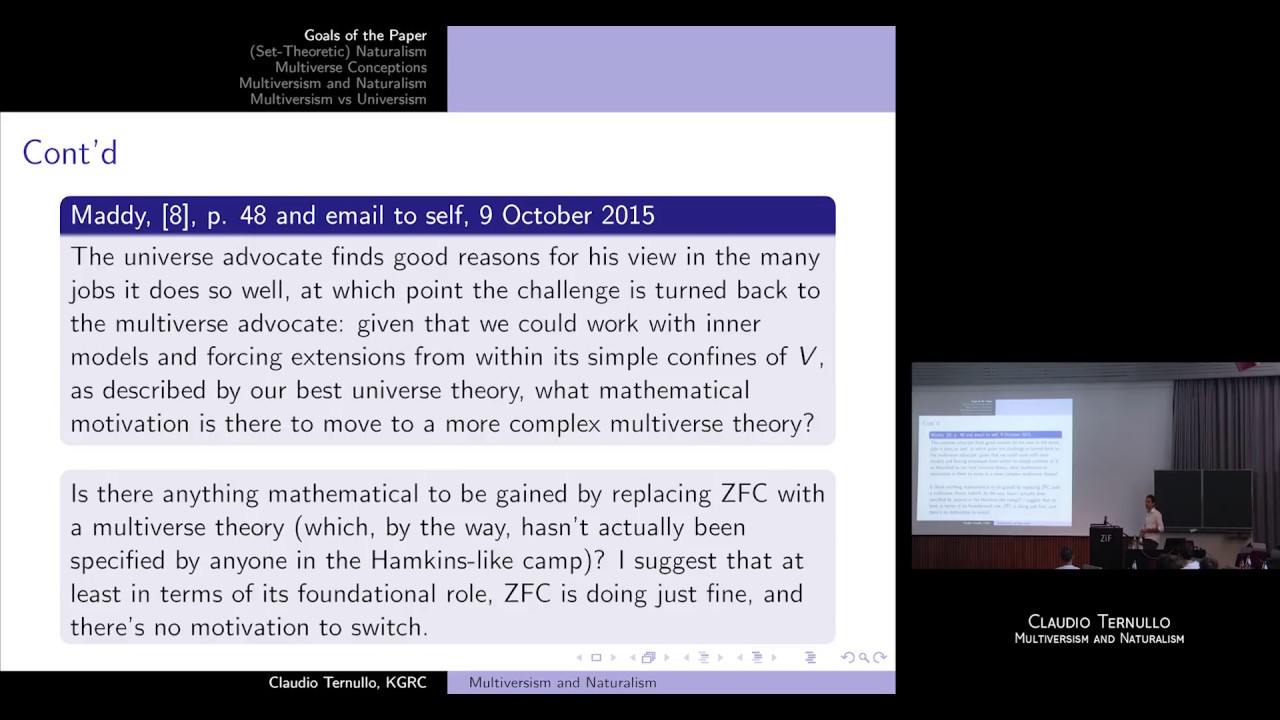
Abstract: In a recent paper, [3], Maddy has argued that there is presently no conclusive reason to construe set theory as being concerned with a multiverse rather than with the universe V. The overall goal of my talk is to provide a careful response to Maddy, which should, ideally, help make a full case for the multiverse view.
First, I will briefly review alternative accounts of the set-theoretic multiverse as can be found in the literature (e.g., [2], [4], [5], [6] and, specially, my [1]) and I will then argue that a multiverse theory may be epistemically more attractive than a universe theory, in particular with reference to foundational requirements that a maddian naturalist or arealist is likely to feel as most prioritary, such as, for instance:
Unification. Set theory is meant to be a conceptually unified arena where the whole of maths can be carried out and its results adequately interpreted. However, a universe theory fails to provide, at least prima facie, an adequate interpretation of the independence phenomenon. On the contrary, a multiverse theory, by suggesting the existence of alternative concepts of set, seems more apt to represent current set-theoretic practice.
Elucidation. A multiverse theory has better prospects to elucidate the conceptual nature of tools, such as forcing, inner models, ultrafilter constructions, etc. needed to produce set-theoretic models (along the lines, for instance, of Hamkins’ use of a naturalist account of forcing in [2]). While there certainly are ways to construe the existence of different models also within a universe theory, I will argue that it is epistemically more advantageous to resort to a multiverse framework.
Demise of robust realism. A (mathematical) naturalist/arealist is interested in existence and truth claims, insofar as they serve the purpose of developing mathematics. In particular, the choice of alternative set-theoretic axioms only conforms to internal epistemic criteria, such as success, expedience, omprehensiveness. A multiverse theory seems to be more adequate to reflect the wealth of available choices, as well as connect them to internal criteria of evidence. In particular, a multiverse framework makes the issue of whether a set-theoretic axiom should be adopted on the grounds of its being ‘true’ in V irrelevant.
I will also briefly hint at how a multiverse theory can fulfil one further goal, that is, that of concretely studying different concepts of set, or set-theoretically relevant concepts (such as that of continuum) and axioms, by studying inter-universe relationships. This is still work in progress.
[1] C. Antos, S.-D. Friedman, R. Honzik, and C. Ternullo. Multiverse Conceptions in Set Theory. Synthese, 192(8):2463–2488, 2015.
[2] J. D. Hamkins. The Set-Theoretic Multiverse. Review of Symbolic Logic, 5(3):416–449, 2012.
[3] P. Maddy. Set-Theoretic Foundations. September 2015.
[4] J.R. Steel. Gödel’s Program. In J. Kennedy, editor, Interpreting Gödel. Critical Essays, pages 153–179. Cambridge University Press, Cambridge, 2014.
[5] J. Väänänen. Multiverse set theory and absolutely undecidable propositions. In J. Kennedy, editor, Interpreting Gödel. Critical Essays, pages 180-205. Cambridge University Press, Cambridge, 2014.
[6] W. H. Woodin. The Realm of the Infinite. In W. H. Woodin and M. Heller, editors, Infinity. New Research Frontiers, pages 89–118. Cambridge University Press, Cambridge, 2011.
This workshop was organised with the generous support of the Association for Symbolic Logic (ASL), the Association of German Mathematicians (DMV), the Berlin Mathematical School (BMS), the Center of Interdisciplinary Research (ZiF), the Deutsche Vereinigung für Mathematische Logik und für Grundlagenforschung der Exakten Wissenschaften (DVMLG), the German Academic Merit Foundation (Stipendiaten machen Programm), the Fachbereich Grundlagen der Informatik of the German Informatics Society (GI) and the German Society for Analytic Philosophy (GAP).

Информация по комментариям в разработке