The Fukagata Laboratory in Keio Universitys Faculty of Science and Technology is doing research with the aim of achieving flexible control of fluids - the general term for gases and liquids.
Q. Flow occurs in various everyday situations. For example, when automobiles, bullet trains, and Maglevs move at high speed, they experience aerodynamic drag. The faster something moves, the greater the drag is, and this causes energy loss in high-speed transportation. If we could reduce such aerodynamic drag
So far, in the design of cars and bullet trains, various efforts have been put to reduce the drag and noise. These methods are classified as passive control, which doesnt require external power input. In addition to passive control, the Fukagata Lab is focusing on active control, which changes the flow state by exerting a force on the flow.
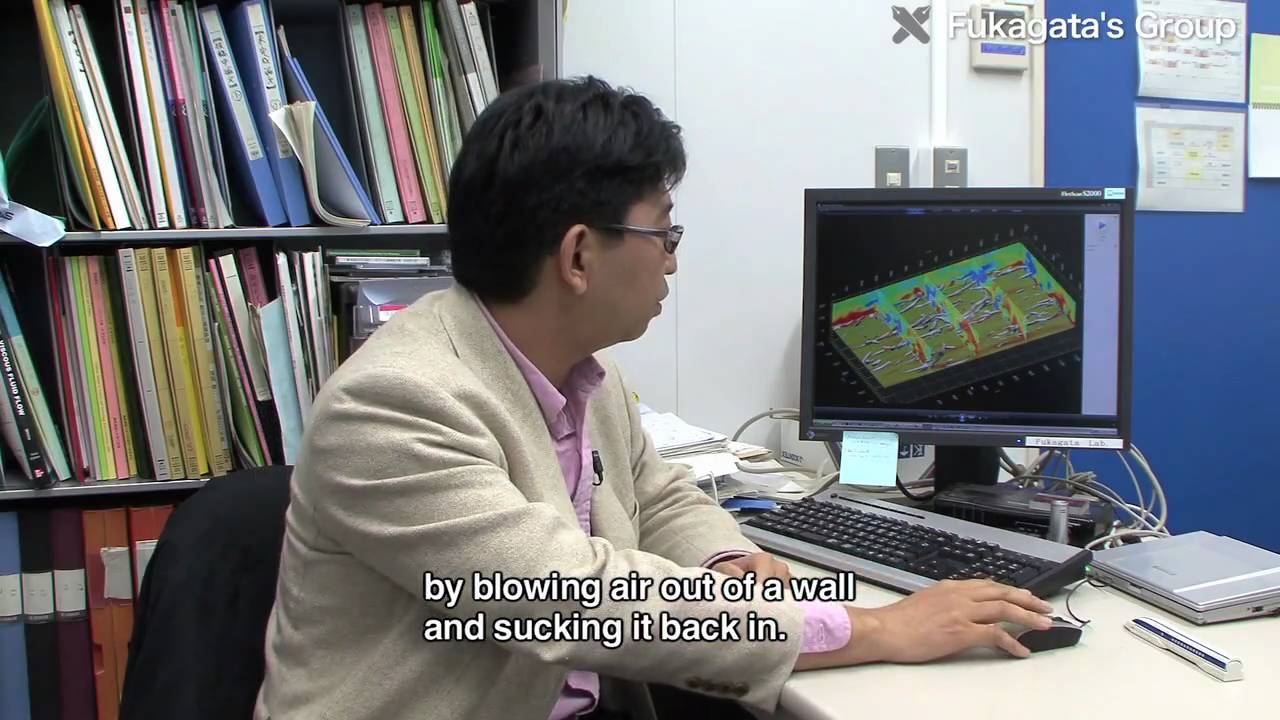
Q. For example, one idea is to reduce friction drag through active control, by blowing air out of a wall and sucking it back in. That quickly makes these kinds of eddy structures disappear. This sort of thing becomes possible with active control.
Its said that in turbulence, numerous vortex structures exist, and their generation increases friction. In 2002, Professor Fukagatas group discovered the detailed relationship between the friction drag and turbulence, by mathematically transforming the Navier-Stokes equation, which is the foundation of fluid mechanics. In this identity equation, the left-hand side represents the friction drag, while on the right, the first term represents the drag in laminar flow with no turbulence, and the second term represents the drag that increases with turbulence. According to this identity equation, to reduce the friction drag, its enough to reduce turbulent stress, called the Reynolds shear stress, near the wall.
Q. To control flow as we want, we first need to develop accurate, efficient numerical simulation methods for turbulence, and multiphase flow, which involves different fluids. Then we need to develop a control theory for flow problems. Our approach is to firstly consider control that could achieve our goals, and evaluate it using numerical simulations. If it becomes clear that the method is likely to work, the next thing we do is a wind tunnel experiment or the like, to check our results using actual objects. Until now, simulations have tended to lag behind experiments, but wed like to do the opposite, by using this type of numerical simulation to pioneer the design of new control methods and control devices.

Информация по комментариям в разработке