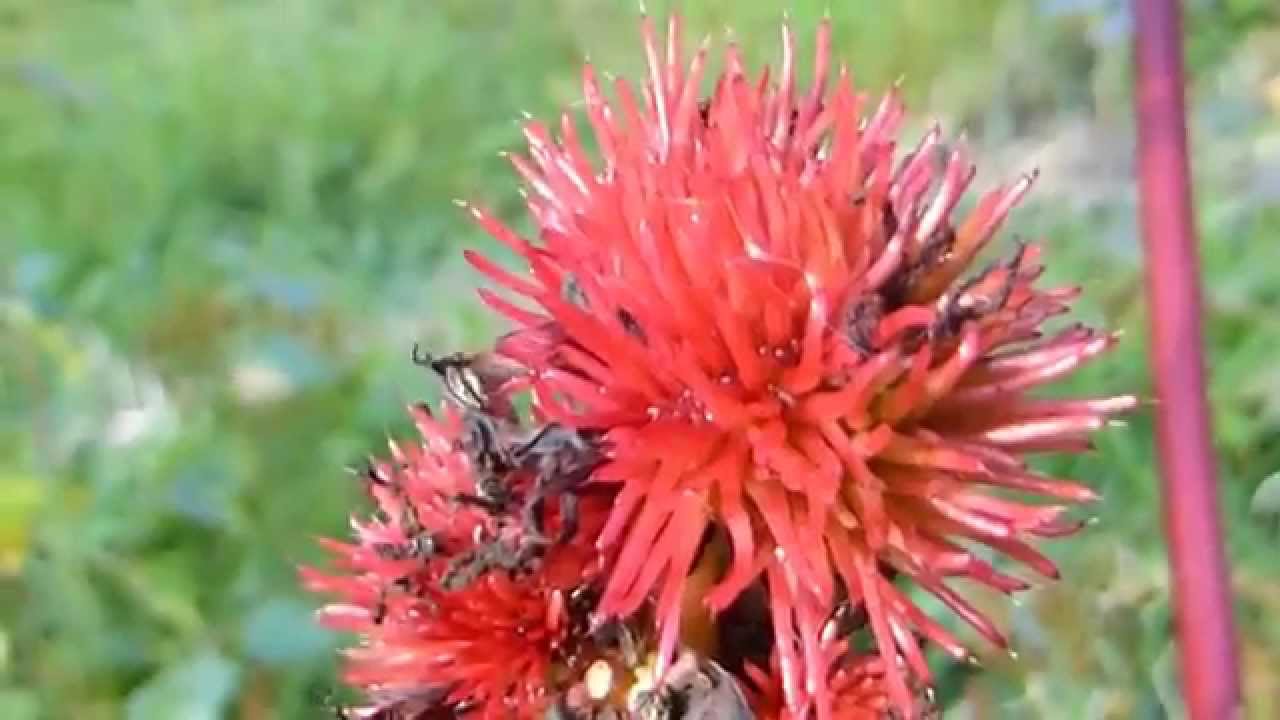
Toxic Herbs - Poisonous Plants - Castor oil plant - Ricinus communis 'Impala' - Kristspálmi - Wunderbaum - Palma Christi Wunderbaum - Kastorolíuplanta - Castorolíuplanta - Olíuplanta - í blóma - is compact (only 1.2 metres or 3.9 feet tall) with reddish foliage and stems, brightest on the young shoots. The seeds are poisonous to people, animals and insects. All plant parts are poisonous if ingested.
The castor oil plant (Ricinus communis) is a species of flowering plant in the spurge family, Euphorbiaceae. It belongs to a monotypic genus, Ricinus, and subtribe, Ricininae. The evolution of castor and its relation to other species are currently being studied using modern genetic tools. The toxicity of raw castor beans is due to the presence of ricin. Although the lethal dose in adults is considered to be four to eight seeds, reports of actual poisoning are relatively rare. According to the 2007 edition of Guinness World Records, this plant is the most poisonous in the world. Despite this, suicides involving ingestion of castor beans are unheard of in countries like India where castor grows abundantly on the roadsides. The aversion to the use of the beans in suicide could be due to the painful and unpleasant symptoms of overdosing on ricin, which can include nausea, diarrhea, tachycardia, hypotension and seizures persisting for up to a week. However, the poison can be extracted from castor by concentrating it with a fairly complicated process similar to that used for extracting cyanide from almonds. If ricin is ingested, symptoms may be delayed by up to 36 hours but commonly begin within 2–4 hours. These include a burning sensation in mouth and throat, abdominal pain, purging and bloody diarrhea. Within several days there is severe dehydration, a drop in blood pressure and a decrease in urine. Unless treated, death can be expected to occur within 3–5 days, however in most cases a full recovery can be made. Poisoning occurs when animals, including humans, ingest broken seeds or break the seed by chewing: intact seeds may pass through the digestive tract without releasing the toxin.Toxicity varies among animal species: four seeds will kill a rabbit, five a sheep, six an ox or horse, seven a pig, and eleven a dog. Ducks have shown far more resistance to the seeds: it takes an average of 80 to kill them. See more: http://en.wikipedia.org/wiki/Castor_o...
A stunning and exotic specimen plant with large palmate leaves, coloured from dark green to red-bronze. The creamy-yellow flower spikes, whilst attractive, are not as interesting as the spiky maroon-red seed pods. In warmer climates ricinus can grow to the size of a small tree up to 15ft high, but it is usually grown as an annual in the UK and is unlikely to reach a height of much more thn 4ft/1.3m. However, it may be possible to over-winter container plants in a warm conservatory. Note: All parts of the plant are poisonous, particularly the seeds. Handle the plant with care, as the sap may cause rritation to some individuals. See more:
http://www.norfolkcottagegarden.co.uk...
This plant is very poisonous to animals like horses,cows,dogs,cats etc It can make honey toxic aswell.
Ricinus communis 'Impala' is a compact variety and grows to a reasonable garden height of around 120cm with gorgeous copper-red palmate leaves with vibrant red veins. The leaves have deeply incised lobes and grow 30 to 75cm across. The plants have red stems and in late summer clusters of creamy yellow blooms are followed by stunning scarlet seeds pods. The plants are remarkably architectural and can be used very effectively in the centre of island beds or at the back of the border. In frost free areas they are grown in large borders or allowed to naturalise in the back of the landscape. In frosty climates, the Castor Oil plant is one of the best ways to quickly create a tropical effect in the garden. This fast growing plant tends to grow straight up at first, developing branches later in the season to form a well-proportioned shrub with sturdy stems and a dense canopy. Plants can be pruned to limit the size, or may need staking if top heavy; otherwise this plant needs very little maintenance. Temperatures below 10°C are tolerated for a short time, but growth is inhibited. The plant is killed when the temperature drops below 0°C. The seeds, or "beans" (they are not true beans), are only produced where the growing season is long enough (140 to 180 days). The shiny, intricately mottled seeds are quite attractive, each with their own unique design in colours of black, gray, brown, yellow-brown, maroon and white. The intricately mottled seeds have a spongy caruncle at one end which helps absorb water for germination when planted. Seeds remain viable for 2 to 3 years. See more: http://www.seedaholic.com/ricinus-com...

Информация по комментариям в разработке