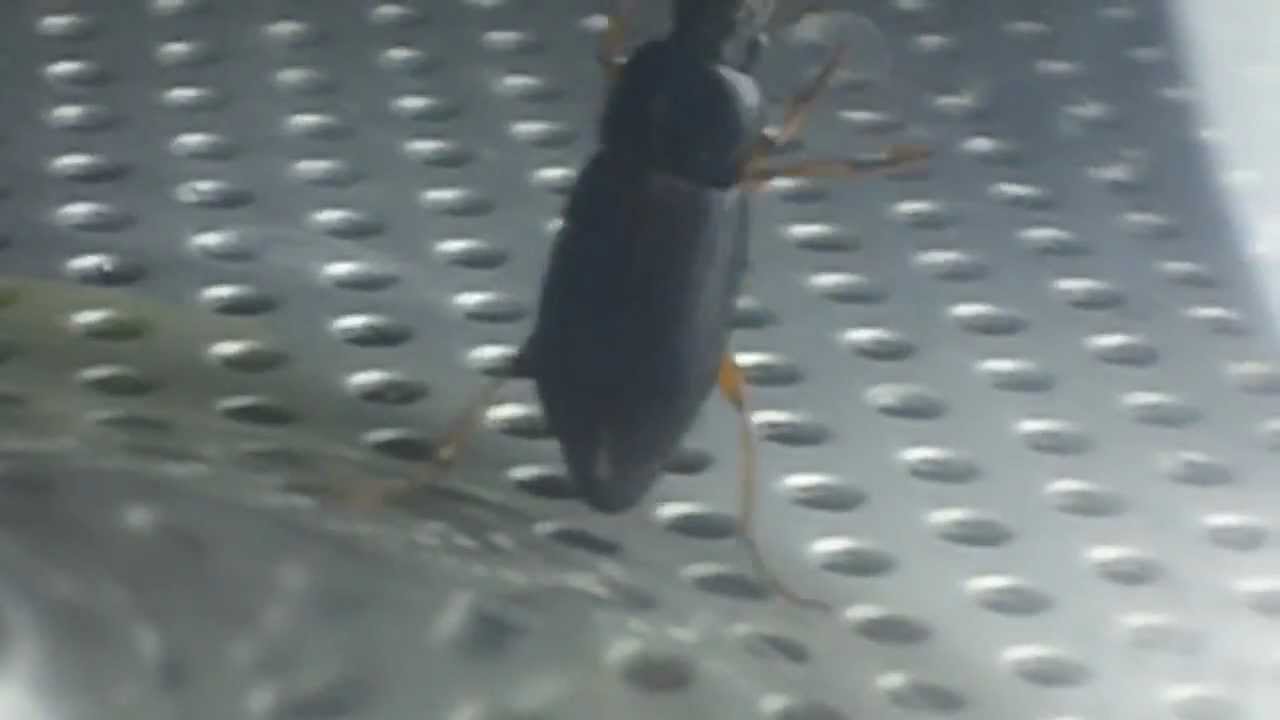
A beetle captured by The Bug Hunter! Ground beetles are a large, cosmopolitan family of beetles, Carabidae, with more than 40,000 species worldwide, approximately 2,000 of which are found in North America and 2,700 in Europe. Although there is some variation in their body shape and coloring, most are shiny black or metallic and have ridged wing covers (elytra). The elytra are fused in some species, particularly large Carabinae, rendering the beetles unable to fly. The genus Mormolyce is known as violin beetles due to their peculiarly shaped elytra. All carabids except the quite primitive flanged bombardier beetles (Paussinae) have a groove on their foreleg tibiae bearing a comb of hairs. This is used for cleaning their antennae. Typical for the ancient beetle suborder Adephaga to which they belong, they have paired pygidial glands in the lower back of the abdomen. These are well developed in ground beetles, and produce noxious or even caustic secretions used to deter would-be predators. In some, commonly known as bombardier beetles, these secretions are mixed with volatile compounds and ejected by a small combustion, producing a loud popping sound and a cloud of hot and acrid gas which can injure small mammals like shrews, and is liable to kill invertebrate predators outright. To humans, getting "bombed" by a bombardier beetle is a decidedly unpleasant experience. The "bombing" ability has evolved independently twice as it seems -- in the flanged bombardier beetles (Paussinae) which are among the most ancient ground beetles, as well as in the typical bombardier beetles (Brachininae) which are part of a more "modern" lineage. The Anthiini, meanwhile, can mechanically squirt their defensive secretions for considerable distances and are able to aim with a startling degree of accuracy; in Afrikaans they are known as oogpisters ("eye-pissers"). In one of the very few known cases of a vertebrate mimicking an arthropod, juvenile Heliobolus lugubris lizards are colored similar to the aposematic oogpister beetles, and move in a way that makes them look surprisingly similar to the insects at a casual glance. As predators of invertebrates, including many pests, most ground beetles are considered beneficial organisms. The caterpillar hunters (Calosoma) are famous for their habit of devouring insect larvae and pupae in quantity, eagerly feeding on tussock moth (Lymantriidae) caterpillars, processionary caterpillars (Thaumetopoeidae) and woolly worms (Arctiidae), which due to their urticating hairs are avoided by most insectivores. Large numbers of the Forest Caterpillar Hunter (C. sycophanta), native to Europe, were shipped to New England for biological control of the Gypsy Moth (Lymantria dispar) as early as 1905.
A few species are nuisance pests. Zabrus is one of the few herbivorous ground beetle genera, and on rare occasions Zabrus tenebrioides for example occurs abundantly enough to cause some damage to grain crops. Large species, usually Carabinae, can become a nuisance if present in numbers, particularly during outdoor activities such as camping; they will void their defensive secretions when threatened, and if they hide among provisions this can despoil food. Since ground beetles are generally reluctant or even unable to fly, it is usually easy to block their potential routes of entry mechanically or with a topical insecticide.

Информация по комментариям в разработке