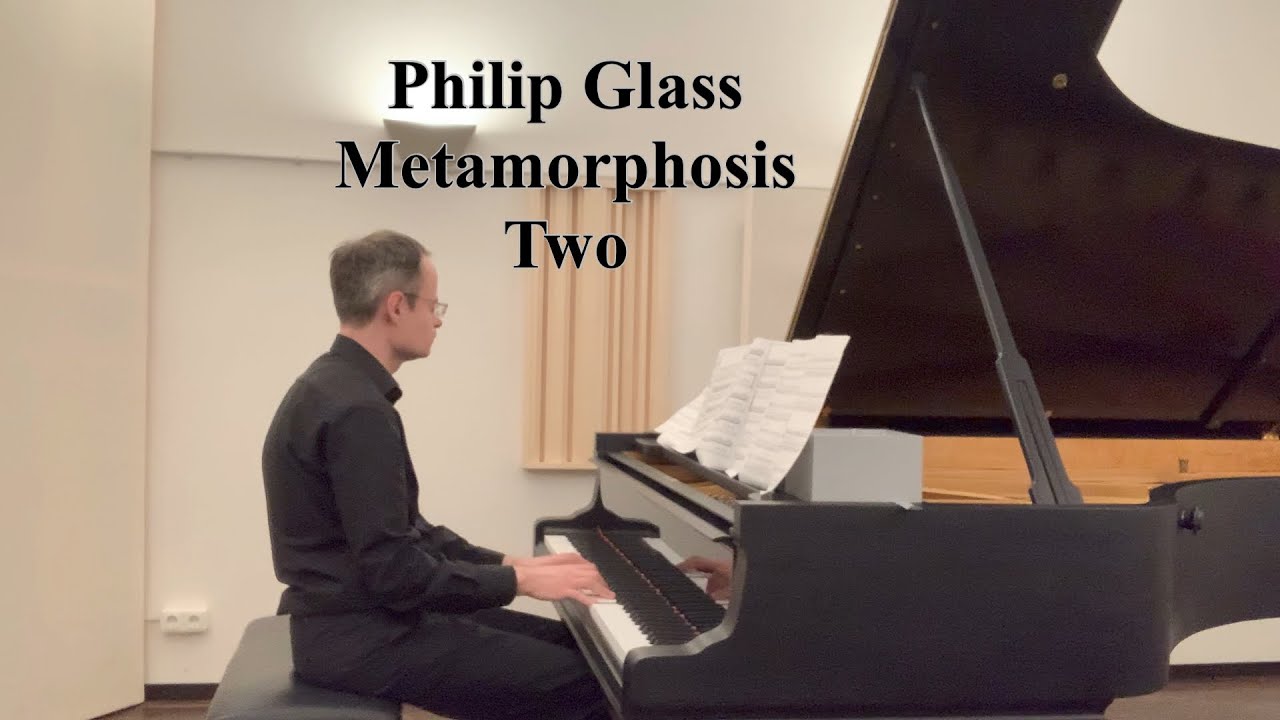
Hi Guys! For the first time I'm playing something by Philp Glass on YouTube: "Metamorphosis Two" from his 1989 album Solo Piano. His music is like a landscape you travel through, seemingly the same but constantly changing.
Thanks for watching! Subscribe to this channel for more piano recordings:
https://www.youtube.com/user/Klangzau...
Philip Glass (born January 31, 1937 in Baltimore, Maryland) is an American musician and composer. Along with Steve Reich, Terry Riley and La Monte Young, he is considered one of the most important pioneers of minimal music.
Glass's oeuvre includes numerous operas and musical theater works, twelve symphonies, eleven concertos, eight string quartets and various other chamber music and film music compositions. Three of his film compositions were nominated for an Oscar. Glass is considered one of the most prolific composers of our time.
Philip Glass grew up in a Jewish family with music: his father was a record dealer in Baltimore. The boy's first instrument was the violin, followed by the flute. He became a student at the Peabody Conservatory at the age of eight and was already playing in local orchestras at the age of ten. From 1952 to 1956 he studied mathematics and philosophy at the University of Chicago and earned a Bachelor of Arts degree. During this time he worked intensively on the twelve-tone technique.
From 1959 to 1962 he studied mainly piano at the Juilliard School of Music in New York, where he did a Master of Science (a classmate was Steve Reich, who studied composition there), and in Aspen with Darius Milhaud. In the meantime he had turned away from the music of the Schönberg successors and opened himself up to moderate American modernism, such as that embodied by Aaron Copland. In 1964 he went to Europe, where he was a student of Nadia Boulanger in Paris for two years, an encounter that had a decisive influence on him as a composer.
In Paris in 1965 Glass met the Indian composer and sitar player Ravi Shankar. Shankar recorded music for the film ”Chappaqua” there and wanted his works to be playable by Western musicians as well. Glass was chosen for the necessary transcriptions. This is how he came into contact with Indian music and tradition of thought for the first time, especially with the Asian understanding of rhythm and time. Deeply impressed, Glass took tabla lessons from Alla Rakha in 1967, mediated by Shankar, and traveled to India and other Asian countries. He became a Buddhist. In 1972 he met Tendzin Gyatsho, the fourteenth Dalai Lama; since this meeting, Glass has been considered an important supporter of the Tibetan struggle for freedom.
In 1965, Glass began composing for his first wife, JoAnne Akalaitis' acting company. His first work was a composition for two saxophones based on Samuel Beckett's play Play. Over the next ten years, Glass repeatedly wrote such theater music, then his own stage works. Glass describes himself primarily as a "theater composer". After returning to the United States, Glass formed the Philip Glass Ensemble in 1970 to have his compositions performed, as no orchestra asked him to. He became his own organizer, booking concert halls and occasionally venues where no contemporary music was otherwise performed. The most important work of these years is the four-hour composition Music in Twelve Parts, which Glass began in 1971 and changed again and again until 1974. This work began as a single work in instrumentations for twelve instruments, but then developed into a cycle summarizing Glass's musical development since 1967.
In 1976, Glass' most successful opera Einstein on the Beach, the result of his first collaboration with Robert Wilson, premiered in Avignon. The triumphant premiere made the composer known worldwide. After this opera, Glass composed another work for the stage, Dance, which combines dance, film and music - another collaboration with the American choreographer Lucinda Childs, who had also previously worked with him in Einstein on the Beach as a choreographer and dance soloist.
Another success followed in 1980: the Mahatma Gandhi opera Satyagraha, premiered by De Nederlandse Opera in Rotterdam under the direction of his fellow countryman and fellow Juilliard student Bruce Ferden. In 1983 another opera followed, Akhnaten about the Pharaoh Echnaton, which premiered at the Staatstheater Stuttgart. These three operas form a trilogy about men who changed the world non-violently.
His music for the film Koyaanisqatsi (1982) in particular increased Glass's popularity outside the classical music community, and he was now regarded as a composer of the New Age movement. Other film scores by the composer include a new score for the classic horror film Dracula, the music for the Martin Scorsese film Kundun (first Oscar nomination), and the media satire "The Truman Show”.
#MetamorphosisTwo #Glass #SoloPiano

Информация по комментариям в разработке