A tale of mystery, wisdom, and redemption in Ancient Egypt.
In Abydos, a scribe guided by the god Thoth uncovers a scroll that can change fate itself.
Experience the temples, hieroglyphs, and divine silence of Egypt’s sacred city.
Whispers of the Nile return with The Scribe of Shadows — where truth is written in light.
If you enjoyed this story, you’ll love our next journey through Ancient Egypt
Abydos, one of the oldest and most revered cities of Ancient Egypt, lies along the western bank of the Nile, about eleven kilometers from the modern town of el-Balyana. Its sacred reputation reaches back over five thousand years. In the earliest dynasties, it served as the burial place of Egypt’s first kings, and by the Middle Kingdom it had become the symbolic gateway to the afterlife. Every Egyptian hoped to make a pilgrimage here, to pay homage to Osiris, lord of resurrection.
The most famous monument of Abydos is the Temple of Seti I, begun around 1290 BCE and completed under Ramesses II. Its reliefs remain some of the finest in all Egyptian art: crisp, deeply carved, and still bearing traces of their original pigment. Behind its main halls lies a mysterious structure known as the Osireion, thought to represent the tomb of Osiris himself—a subterranean chamber surrounded by water, symbolizing both death and rebirth. Archaeologists such as Flinders Petrie and Émile Amélineau excavated these sanctuaries in the late nineteenth century, uncovering fragments of painted papyri, offering tables, and ritual vessels bearing dedications to the god of truth and wisdom, Thoth.
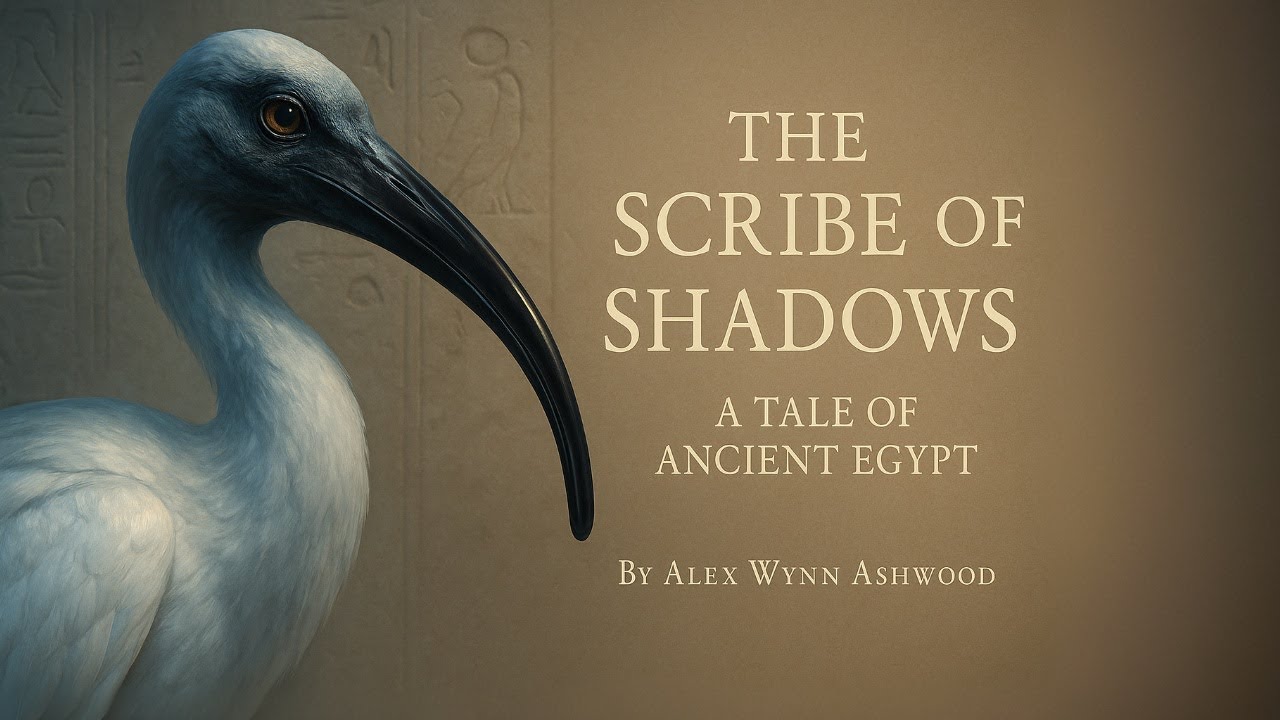
In Egyptian religion, Thoth (Djehuty) was the divine scribe, inventor of hieroglyphs, and guardian of all sacred knowledge. Depicted with the head of an ibis or occasionally as a baboon, he presided over writing, mathematics, astronomy, and the reckoning of time. Thoth’s cult was centered mainly in Hermopolis (Khmunu) in Middle Egypt, yet his veneration spread widely, and Abydos—being a hub of learning and ritual—hosted multiple shrines in his honor. In temple inscriptions, Thoth is described as “the tongue of Ra and the heart of Maat,” meaning that divine order was expressed through his words. Every act of creation, judgment, or remembrance required his pen.
Scribes in Ancient Egypt saw their craft not as mere bureaucracy but as sacred duty. The House of Life (Per-Ankh) attached to major temples functioned as both school and archive. Here, priests copied hymns, medical treatises, astronomical charts, and royal decrees. To write was to preserve cosmic balance. Many scribes signed their work with short prayers to Thoth, asking him to “make the ink flow true.” Women, though fewer in number, could also serve as scribes or record-keepers, particularly in temple or estate administration—a tradition that inspired our protagonist, Nefru, whose skill and moral courage echo those of real figures.
The story’s imagery—the glowing scroll, the ibis guide, and the dream of moonlit revelation—draws directly from ancient Egyptian thought. The ibis was believed to embody the lunar aspect of Thoth: graceful, precise, and ever-vigilant. Some New Kingdom papyri depict Thoth’s ibis leading the souls of the justified to their eternal resting place, a motif mirrored here as Nefru follows her divine guide through the temple’s hidden passages. Archaeological discoveries at Abydos have indeed revealed concealed chambers and false walls, suggesting that secret repositories of texts and ritual objects once existed behind the main sanctuaries.
The idea of a “lost scroll” preserving justice is more than poetic invention. The Egyptians believed that writing had magical agency (heka). To record truth was to make it real; to erase a name was to destroy it. The act of rewriting—a key moment in our tale—echoes the daily temple ritual in which priests re-inscribed sacred formulae to renew the world’s harmony. When Thoth appears at the climax, his role is not punitive but restorative: he seals falsehood with silence and restores the rightful word.
Linguistically, the final line spoken in the video — “ꜥḥʿ n ḥȝyt. šm r ḥtp.” — is based on reconstructed Middle Egyptian, the classical language of the Middle Kingdom (ca. 2000 BCE). It translates approximately to “The story is complete. Go in peace.” The phrase reflects how ancient Egyptians closed ritual texts or offering formulas, signaling not merely an ending but a return to order.
Through its imagery and sound, The Scribe of Shadows invites the viewer to step inside that world: the echoing halls of stone, the scent of burning resin, the delicate balance between truth and silence. Each tale in this series seeks to bridge myth and history, imagination and archaeology—offering a glimpse of how the Egyptians themselves might have felt when the voice of a god brushed against the still air of the temple.
📜 Written and produced by Alex Wynn Ashwood
🎵 Original score inspired by ancient Egyptian modes and temple acoustics

Информация по комментариям в разработке