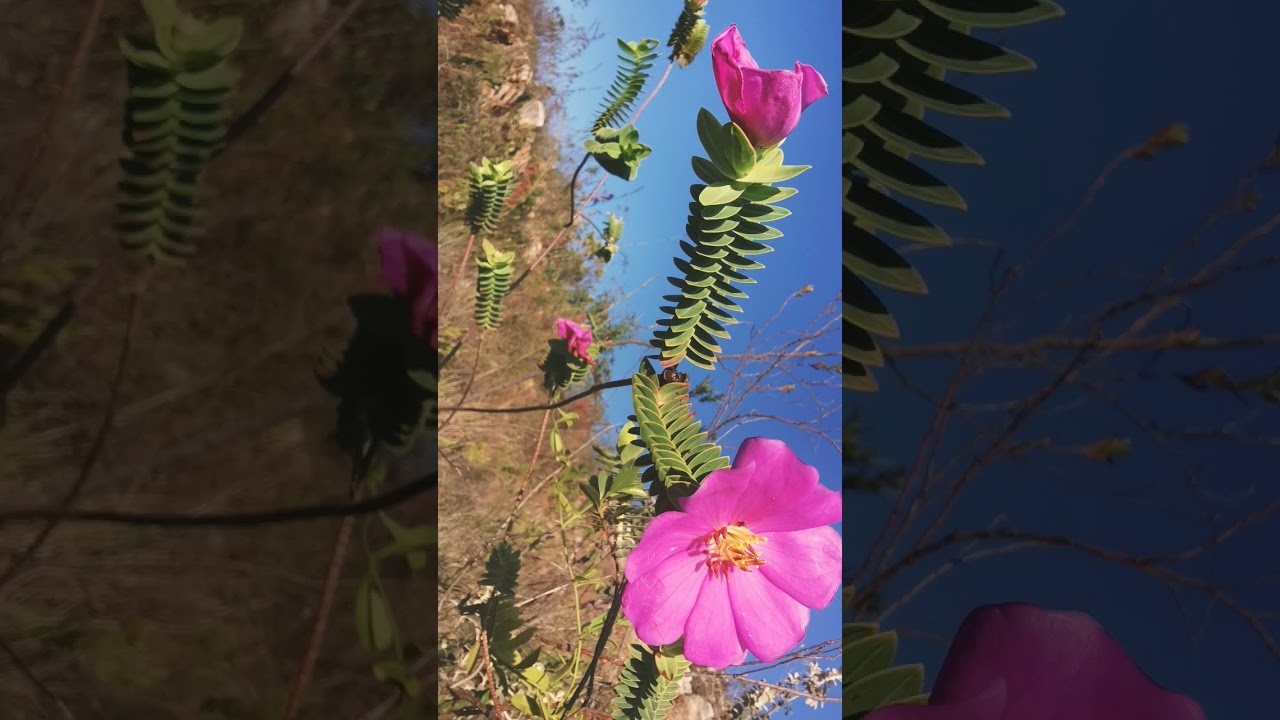
▪︎ Cataphract Microlicia (Microlicia cataphracta) in Melastome Family (Melastomataceae) native to Brazil. It is found in a widespread area throughout country, growing primarily in Atlantic Forest & seasonally dry tropical biomes.
Microlicia was first described by David Don in 1823. From mikros meaning 'small' + eileo meaning 'to roll up'. This likely refers to a specific feature of flowers or foliage of type species. Specific Epithet cataphractafrom kataphraktos meaning 'covered with armor', 'armored' or 'sheathed' due to plant's characteristic strongly overlapping & coriaceous (leathery) leaf blades, which give stems a heavily armored or scaled appearance.
Is a subshrub or treelet that can grow up to 8 meters tall, though it can also be a much smaller shrub.
It is a polymorphic species & leaf shape is one of its varying morphological characteristics. High degree of variation in leaf shape, indumentum (hairiness) & other characteristics across different populations led researchers to classify it as an 'ochlospecies'. An ochlospecies is a term for a species with high polymorphism partially correlated with ecology & geography.
Leaves grow opposite & decussate. Are leathery (coriaceous) & heavily overlap (imbricate) on stems. Venation is acrodromous, with veins running in parallel arcs from base to leaf tip. Leaf margin is noticeably thickened, a feature described as 'callose' (callus-like). Leaf shape & size are variable within species. Common shapes include ovate, oblong & lanceolate. When dried, leaf blades are often discolorous (different colors on upper & lower surfaces). Are typically glabrous (smooth) but may be covered with tiny, spherical glands.
Inflorescence of is composed of small, solitary, five-petaled White flowers. In contrast to other Microlicia species that may have flowers in clusters (dichasia), flowers of M. cataphracta grow individually. The species flowers during rainy season.
● 5 Sepals are oblong & feature glandular hairs along their margins & on central vein.
● 5 Petals flowers - varies in color & can be White, Pink or Reddish. This plant is considered an ochlospecies.
● 10 Stamens & anthers: has dimorphic Stamens & bicolored anthers. Stamens are arranged in two cycles of different sizes & colors.
○ Larger (antesepalous) Stamens: 5 Stamens with Pink filaments, vinaceous anthers & Yellow ventral appendages.
○ Smaller (antepetalous) Stamens: 5 Stamens with Pink filaments, Yellow anthers & Yellow ventral appendages.
● Hypanthium: cup-like floral tube, is an important feature for identification. It is oblong to oblong-campanulate & ribbed.
● Ovary: flower contains a semi-inferior Ovary, which is positioned below attachment of Petals & Sepals. Locules - Ovary is divided into six compartments or locules.
Fruit is a capsule that dehisces (splits) from top (apex) down to base. Mature, dried capsules are typically Brown to Blackish & have a cylindrical shape. They are initially encased by hypanthium, cup-like floral base, which eventually ruptures & flakes away.
Seeds found within capsule are described as reniform (kidney-shaped) or oblong. They have a foveolate testa, a surface texture that is pitted or covered with small depressions. Seeds are small & round, with a light Brown color.
Used for timber, fuel & as an ornamental plant.
___
🌹 Clade Superrosids • 105204, 4093 Genera
☆¹⁸ Order Saxifragales • 3302, 127
♤ Clade Rosids • 101902, 3966
○ ☆¹⁷ Order Vitales • 1022, 20
○ ♤ Clade Eurosids • 100880, 3946
● ♤ Clade Fabids • 65417, 2229
● ♤ Clade Malvids • 35463, 1717
♤ Clade Malvids • 35463, 1717
...
☆¹⁰ Order Myrtales • 14931, 387
...
___
☆¹⁰ Order Myrtales • 14931, 387
•¹ Family Alzateaceae • 1, 1
•² Combretaceae • 585, 10 - White Mangrove
•³ Crypteroniaceae • 13, 3
•⁴ Lythraceae • 688, 28 - Loosestrife
•⁵ Melastomataceae • 6052, 176 - Melastomes
•⁶ Myrtaceae • 6445, 129 - Myrtle
•⁷ Onagraceae • 867, 22 - Evening Primrose, Willowherb
•⁸ Penaeaceae • 32, 9
•⁹ Vochysiaceae • 248,
___
•⁵ Family Melastomataceae • 6564, 184 - Melastomes
◇¹ Subfamily Kibessioideae • 21, 1
◇² Subfamily Melastomatoideae • 5963, 170, T²¹
◇³ Subfamily Olisbeoideae • 580, 6
___
◇² Subfamily Melastomatoideae • 5963, 170, T²¹
■¹ Tribe Astronieae • 150, 5
■² Tribe Bertolonieae • 57, 1
■³ Tribe Cyphostyleae • 29, 4
■⁴ Tribe Dinophoreae • 11, 2
■⁵ Tribe Dissochaeteae • 92, 6
■⁶ Tribe Eriocnemeae • 10, 3
■⁷ Tribe Feliciadamieae • 1, 1
■⁸ Tribe Henrietteeae • 98, 3
■⁹ Tribe Lavoisiereae • 382, 3
■¹⁰ Tribe Lithobieae • 1, 1
■¹¹ Tribe Marcetieae • 186, 20
■¹² Tribe Melastomateae • 1025, 44
■¹³ Tribe Merianieae • 320, 9
■¹⁴ Tribe Miconieae • 1965, 1
■¹⁵ Tribe Pyramieae • 79, 3
■¹⁶ Tribe Pyxidantheae • 219, 2
■¹⁷ Tribe Rhexieae • 123, 3
■¹⁸ Tribe Rupestreeae • 2, 1
■¹⁹ Tribe Sonerileae • 1165, 54
■²⁰ Tribe Stanmarkieae • 4, 2
■²¹ Tribe Trioleneae • 44, 2
-
■⁹ Tribe Lavoisiereae • 382, 3
▪︎ Genus Microlicia • 350
Poteranthera • 6
Rhynchanthera • 26
-
___


Информация по комментариям в разработке