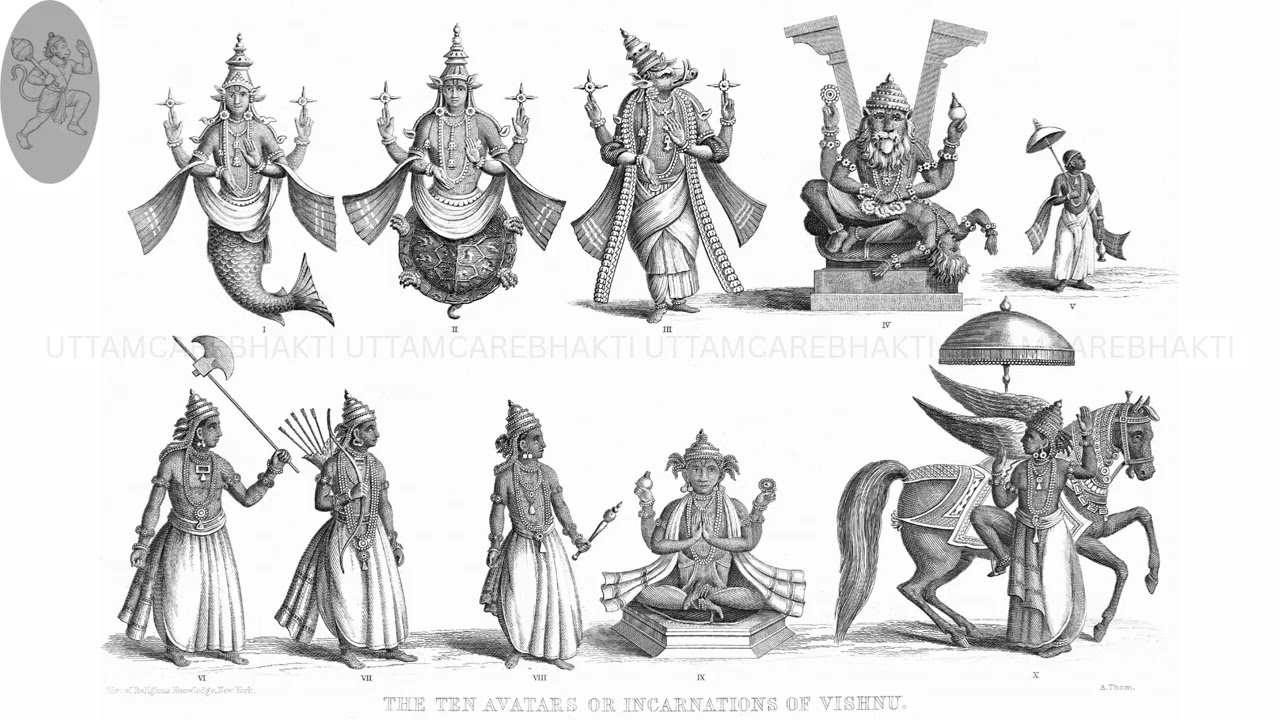
🐟 1. MATSYA AVATAR (The Fish)
Era: Satya Yuga
Purpose: To protect the Vedas and save Manu during the great deluge (Mahapralaya).
The fish begged for shelter and gradually grew larger. Eventually, Manu realized that the fish was none other than Lord Vishnu himself. The fish informed Manu about the impending great deluge and helped him transport all creatures, seeds, and sages to a safe place on a boat. Lord Matsya, in the form of a gigantic fish, tied the boat to his horn and rescued them.
🐢 2. KURMA AVATAR (The Tortoise)
Era: Satya Yuga
Purpose: To provide a base for Mount Mandara during the churning of the ocean.
Story: When the Devas (gods) and Asuras (demons) churned the Kshira Sagar (Ocean of Milk) to obtain Amrita (nectar of immortality), Mount Mandara began to sink. Lord Vishnu, taking the form of Kurma (tortoise), supported the mountain on his back, which helped the churning to succeed.
🐗 3. VARAHA AVATAR (The Boar)
Era: Satya Yuga
Purpose: To rescue the Earth from the demon Hiranyaksha.
Story: The demon king Hiranyaksha had submerged the Earth in water and taken it to Patala (the netherworld). Lord Vishnu, assuming the form of Varaha (boar), fought with Hiranyaksha for a thousand years, slew him, and lifted the Earth from Patala with his tusks, establishing it in the universe.
🦁 4. NARASIMHA AVATAR (The Man-Lion)
Era: Satya Yuga
Story: Hiranyakashipu had received a boon from Brahma that he could not be killed by man or beast, during day or night, inside or outside his home. His son Prahlada was a devout follower of Lord Vishnu, whom Hiranyakashipu tried to kill in numerous ways. Lord Vishnu manifested as Narasimha (half-man, half-lion), and at twilight, on a threshold, tore Hiranyakashipu apart with his claws.
🧑🦲 5. VAMANA AVATAR (The Dwarf)
Era: Treta Yuga
Purpose: To humble King Bali and restore the kingdom of heaven to Indra.
Story: The demon king Bali (grandson of Prahlada), through severe penance, had become the ruler of the three worlds. Lord Vishnu, taking the form of Vamana (a dwarf Brahmin), approached Bali and requested three paces of land. When Bali gladly granted the boon, Vamana expanded into a gigantic form, covering the Earth and sky in one step and heaven in the second. For the third step, Bali offered his own head, upon which Vishnu placed his foot, pleased with his humility, and made him the ruler of Patala.
⚔️ 6. PARASHURAMA AVATAR (The Warrior with an Axe)
Era: Treta Yuga
Story: Parashurama, the son of sage Jamadagni and Renuka, is the sixth avatar of Vishnu. He received a parashu (axe) after propitiating Lord Shiva. When the Haihaya king Kartavirya stole his father's divine cow Kamadhenu, Parashurama killed him. In retaliation, Kartavirya's sons killed Jamadagni. Enraged, Parashurama took a vow to destroy the Kshatriya rulers from the Earth twenty-one times, and he fulfilled it.
🏹 7. SHRI RAMA AVATAR (The Prince of Ayodhya)
Era: Treta Yuga
Purpose: To end the tyrannical demon Ravana and establish Dharma.
Story: Rama, the son of King Dasharatha of Ayodhya, is considered the ideal king and Maryada Purushottama (the perfect man). When his wife Sita was abducted by Ravana, the king of Lanka, Rama, with the help of vanaras (monkeys) like Vali, Sugriva, and Hanuman, attacked Lanka, killed Ravana, and rescued Sita. His life story is described in the epic Ramayana.
🎶 8. SHRI KRISHNA AVATAR (The Divine Statesman)
Era: Dwapara Yuga
Purpose: To destroy demons like Kamsa, Jarasandha, and Shishupala; to impart the Bhagavad Gita to Arjuna in the Mahabharata war; and to establish Dharma.
Story: Shri Krishna, the eighth avatar of Vishnu, was the son of Vasudeva and Devaki. He was taken to Gokul as a child to protect him from his uncle Kamsa, and grew up in the house of Nanda and Yashoda. He killed many demons like Putana, Kaliya, and Keshi, and later slew Kamsa, installing Ugrasena as the king of Mathura. In the Mahabharata war, he guided Arjuna towards the path of Dharma through the teachings of the Bhagavad Gita.
🧘 9. BUDDHA AVATAR (The Enlightened One)
Era: Kali Yuga
Purpose: To spread the message of non-violence and compassion, and to oppose evil practices like animal sacrifice.
Story: In some traditions, especially within the Puranas, Gautama Buddha is considered the ninth avatar of Lord Vishnu. He taught the path of non-violence, compassion, and the middle way, opposing the prevalent violence and superstitions in society. (Note: In some Vaishnava traditions, Balarama is considered the ninth avatar instead of Buddha).
🐎 10. KALKI AVATAR (The Future Warrior)
Era: Kali Yuga (in the future)
Purpose: To end Adharma (unrighteousness) and establish a new Satya Yuga.
Story: This is the only avatar yet to appear. It is believed that at the end of Kali Yuga, when unrighteousness reaches its peak, Lord Vishnu will manifest as Kalki, riding a white horse and wielding a sword. He will destroy the wicked, re-establish Dharma, and usher in a new Satya Yuga (Golden Age).













Информация по комментариям в разработке