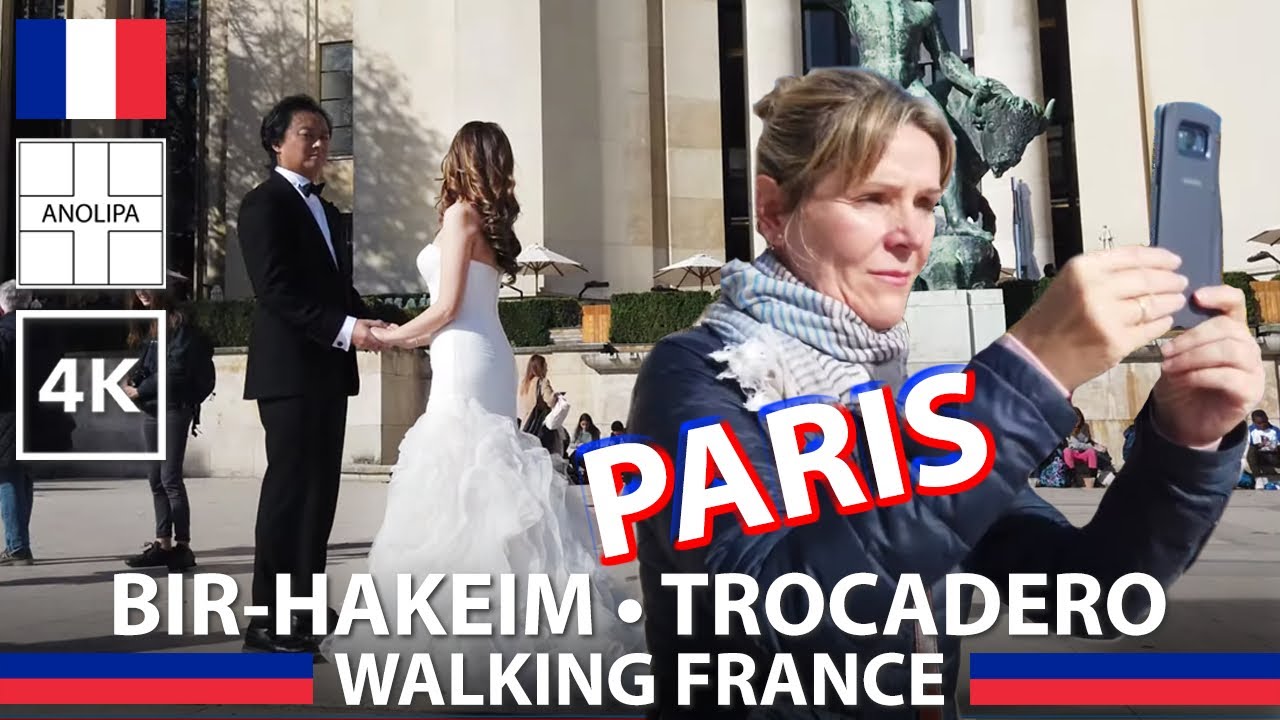
Walking tour in Paris. From BIR-HAKEIM bridge toTROCADERO.
Views of the Eiffel tower.
The Pont de Bir-Hakeim (English: Bridge of Bir-Hakeim), formerly the Pont de Passy (Bridge of Passy), is a bridge that crosses the Seine in Paris. It connects the 15th and 16th arrondissement, passing through the Île aux Cygnes. The bridge, made of steel, is the second to have stood at the site. It was constructed between 1903 and 1905, replacing an earlier bridge that had been erected in 1878. An arch bridge, it is 237 metres (777 ft) long and 24.7 metres (81 ft) wide.
It was designed by the architect Jean-Camille Formigé, who also designed the Viaduc d'Austerlitz, the Jardin des Serres d'Auteuil, as well as the park below the Sacré-Cœur; he also restored the Roman amphitheatre in Arles and the Roman theatre in Orange.
The bridge has two levels: one for motor vehicles and pedestrians, the other being a viaduct (Viaduc de Passy) built above the first one, through which passes Line 6 of the Paris Métro. The railway viaduct is supported by metal colonnades, except where it passes over the Île aux Cygnes, where it rests on a masonry arch. Many commemorative plates decorate the viaduct bridge, including several dedicated to soldiers fallen in Belgium during the Second World War.
In addition, the central arch of the viaduct, at the level of the island, is decorated with four monumental stone statues in high-relief: figures of Science and Labour by Jules-Felix Coutan, Electricity and Commerce by Jean Antoine Injalbert. The road level of the bridge extends out in a belvedere where it passes over the Île aux Cygnes which covers the eastern end of the island. Here stands a statue named La France renaissante.
Originally named the Pont de Passy (after the former commune of Passy, which it reaches), it was renamed in 1948 to commemorate the Battle of Bir Hakeim, fought by Free French forces against the German Afrika Korps in 1942.
Many movies have featured the bridge, including Rififi,[1] Ascenseur pour l'échafaud, Zazie dans le Métro, Last Tango in Paris, Peur sur la ville, National Treasure: Book of Secrets and Inception
The Trocadéro (pronounced [trɔkadeʁo]), site of the Palais de Chaillot, is an area of Paris, France, in the 16th arrondissement, across the Seine from the Eiffel Tower. It is also the name of the 1878 palace which was demolished in 1937 to make way for the Palais de Chaillot.[1] The hill of the Trocadéro is the hill of Chaillot, a former village.
The place was named in honour of the Battle of Trocadero, in which the fortified Isla del Trocadero, in southern Spain, was captured by French forces led by the Duc d'Angoulême, son of the future King of France, Charles X, on 31 August 1823. France had intervened on behalf of King Ferdinand VII of Spain, whose rule was contested by a liberal rebellion. After the battle, the autocratic Spanish Bourbon Ferdinand VII was restored to the throne of Spain.[2]
François-René de Chateaubriand said "To stride across the lands of Spain at one go, to succeed there, where Bonaparte had failed, to triumph on that same soil where the arms of the fantastic man suffered reverses, to do in six months what he couldn't do in seven years, that was truly prodigious!"[3]
Nowadays the square is officially named Place du Trocadéro et (and) du 11 Novembre (for the WWI armistice), although it is usually simply called the Place du Trocadéro.
The hill of Chaillot was first arranged for the 1867 World's Fair. For the 1878 World's Fair, the (old) Palais du Trocadéro (1878-1936) was built here (where meetings of international organizations could be held during the fair). The palace's form was that of a large concert hall with two wings and two towers; its style was a mixture of exotic and historical references, generally called "Moorish" but with some Byzantine elements. The architect was Gabriel Davioud.[4]
The concert hall contained a large organ built by Aristide Cavaillé-Coll; the first large organ to be installed in a concert hall in France (it has since been modified twice, and eventually moved in 1977 to the Auditorium Maurice Ravel in Lyon, where it is still in use today)...
Just walking for the cities.
Enjoy a visual walking tour.
🎧 I recommend using headphones for a better audio experience 3D audio.
Everything seems a bit but, there are small details, subtleties that the curious eye notices: color palettes in clothing, cars and shops. Type of products sold, accent and volume when speaking, foreign languages and type of tourists, physical distance between people, hygiene in the streets. Fashion and trends. Type of feeding on public roads. Number of people with pets or babies. Speed and way of walking. Characteristics of the traffic. Genetic composition of society, entertainment and leisure. Noise level, hygiene and vandalism, architectural trend, infrastructure, transport development, security, etc. - God is in details 😉
#paris #trocadero #birhakeim

Информация по комментариям в разработке