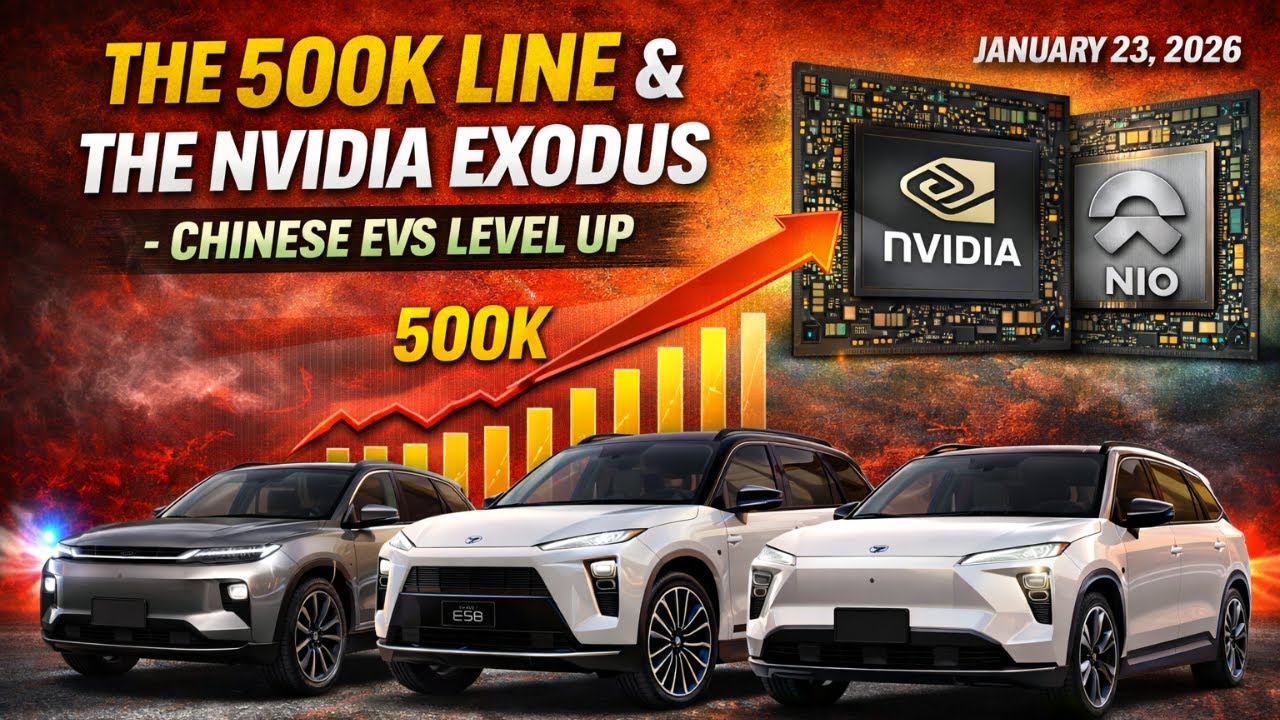
Two stories that define where Chinese EVs are right now: the magic sales number you need to survive, and why NIO, XPeng, and Li Auto are collectively telling NVIDIA "we don't need you anymore."
This isn't startup chaos. This is mature industry power plays. And the implications for investors are MASSIVE.
🔥 STORY ONE: THE 500K SAFETY LINE
Forget the "2 million units to survive" take from that Tongji professor. For Chinese EV startups, the REAL safety line is 500,000 annual units. Here's why:
→ Financial Breakeven: At 200K-300K yuan average pricing, 500K units = 100-150 billion yuan revenue = "100-billion club" = profitability threshold. This is where you stop losing money on every car and R&D costs start getting properly amortized.
→ Strategic Breathing Room: Li Auto hit 500K in 2024, dropped to 400K in 2025 (-20%), and they're STILL FINE. Why? Because crossing 500K builds institutional resilience. Below that line, one bad quarter kills you. Above it, you can absorb punches.
→ Operational Efficiency: Your workforce, sales network, service centers all become more productive per unit at this scale. Basic economies of scale, but critical in tight-margin industries.
→ Community Critical Mass: 500K vehicles on the road creates self-sustaining ecosystems. Owners become evangelists. Consumer anxiety about brand survival disappears. Customer acquisition costs plummet.
→ Supply Chain Power: At 500K scale, you have negotiating leverage and can start justifying vertical integration investments (like custom chips 👀).
WHO'S SAFE, WHO'S NOT:
Li Auto: Crossed line 2024, dropped to 400K in 2025, but SAFE due to muscle memory + highest ASP + strongest family user understanding
Leapmotor: Just crossed 500K (hit 600K!), suddenly seen as legitimate contender, positive unit economics
XPeng: 430K units (126% YoY growth), but 41% from budget MONA M03 (119,800 yuan). Close but not safe yet.
NIO: 326K across 3 brands. Problem: cost structure SO HIGH they probably need 600-700K to be safe. Battery swap + NIO Houses + phones + international = massive burn.
HarmonyOS: 590K total, Aito 423K alone, but doesn't matter—Huawei backing changes the game entirely.
🔥 STORY TWO: THE NVIDIA EXODUS
NIO, XPeng, Li Auto ALL abandoning NVIDIA for in-house chips:
→ XPeng: Jan 8 launch of G6, G7, G9, P7+ ALL use self-developed Turing AI chip. Previous gen used NVIDIA. He Xiaopeng: "Best AI companies will develop own chips."
→ Li Auto: M100 chip taped out Q1 2025, entering mass production for L9 refresh. Performance: 1 M100 = 2 NVIDIA Thor-U for LLM tasks, 3 Thor-U for computer vision. Li Auto DELAYED product cycle waiting for Thor, cost them sales momentum.
→ NIO: Spent $300M+ on NVIDIA Orin X in 2024. Shenji NX9031 solution: 2 chips = 8 Orin X equivalent, saves 10,000 yuan per vehicle. Rolling out to ET5, ET5T, ES6, EC6—eventually full lineup.
WHY THE EXODUS:
Supply Chain Disaster: Thor promised 2,000 TOPS, delivered 700 TOPS. Multiple delays. Overheating issues. Threw off product roadmaps for Li Auto, XPeng, Zhiji.
Cost Savings: At 400K-600K unit scale, 10,000 yuan savings per car = BILLIONS annually.
Strategic Independence: Don't want foreign chip dependency for core differentiator after watching semiconductor sanctions play out.
NVIDIA'S CHINA PROBLEM:
Market share: 33.5% (2023) → 39% (2024) → 25% (2025) despite having both Orin AND Thor
1.16M+ units from just NIO+XPeng+Li Auto in 2025 moving away from NVIDIA
Add HarmonyOS (uses Huawei) + Leapmotor (uses Qualcomm) = 2M+ annual units systematically shut out
Short-term revenue impact: ~1% of NVIDIA revenue, so stock won't care
Long-term strategic impact: Most advanced autonomous driving market building own silicon, NVIDIA ecosystem might be for everyone EXCEPT the leaders
THE CONNECTION:
These stories are the SAME narrative. The 500K line gives brands scale to make independent strategic decisions. The NVIDIA exodus is them EXERCISING that independence to control technology and costs.
When you're at 100K units, you MUST use NVIDIA. At 500K units, vertical integration makes financial sense—$200-300M chip development amortized across volume pays back in 2-3 years.
Autonomous driving is now the core differentiator in Chinese EVs. If that's your key advantage, why outsource to a chipmaker that's unreliable, serves your competitors, and charges premium?
You wouldn't. They're not.
📊 KEY STATS:
Safety line: 500,000 annual units
Li Auto 2025: ~400K (-20% vs 2024)
Leapmotor 2025: ~600K (crossed line)
XPeng 2025: 430K (+126% YoY), MONA M03 = 41%
NIO 2025: 326K (needs 600-700K for their cost structure)
NIO NVIDIA spend 2024: $300M+
NIO Shenji savings: 10,000 yuan per vehicle
NVIDIA China share: 39% (2024) → 25% (2025)
Perfect for: NIO investors, XPeng analysis, Li Auto stock, Chinese EV investing, NVIDIA stock, autonomous driving, semiconductor industry, automotive technology, EV market analysis
#NIO #XPeng #LiAuto #NVIDIA #ChineseEVs #AutonomousDriving #SemiconductorStocks #EVInvesting #StockAnalysis

Информация по комментариям в разработке