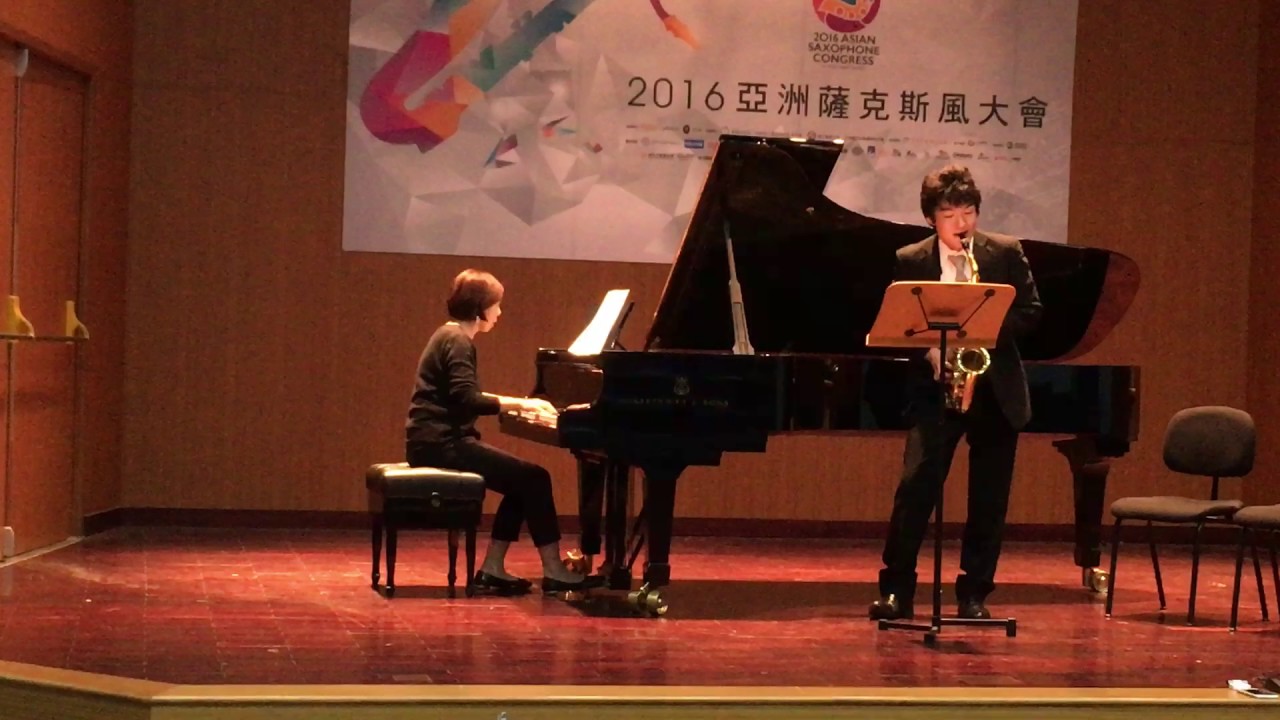
For alto saxophone and piano, performed by Ryo Nakajima and I-An Chen at the 1st Asian Saxophone Congress on Dec. 16, 2016.
Brief Program Notes: Yuán Xiāng原鄉 (Hometown/homeland) for alto saxophone and wind ensemble (with piano reduction), is specifically tailored for the final round of 1st Asian Saxophone Congress International Competition. The composition was inspired by Taiwanese music (from hok-lo, hakka and aboriginal), the history of LC Sax, and the development of saxophone music in the west (jazz and classical, etc.) The title quotes the statement indicating the birth of LC Sax: “Houli—The home of Taiwanese saxophone”.
Detailed Program Notes:
Yuán Xiāng原鄉 (Hometown/homeland) is a composition that I was asked by the 1st Asian Saxophone Congress International Competition to specifically tailor for the final round of the Senior Division.
This piece emphasizes three important facts: Music from Taiwan (hok-lo, hakka, aboriginal, etc.), the significance of Taiwanese saxophone manufacturer Lien Cheng Chang (張連昌), and the development of saxophone music in the west. The beginning starts with a reference to the Taiwanese aboriginal music Pasi but but from Bunun Tribe (recognized through UNESCO World Heritage), a ritual polyphonic music that involves a build-up of seconds (in a sedate, chanting-like scenery) up to eight voices. In addition, the piece includes Gloria from the Paiwan Tribe, which was sung at the Taiwanese presidential inauguration of President Tsai Ing-wen, the first female president in the history of Taiwan in 2016. Hla'alua’s takiaru and Kanakanavu’s mikong (music from the rituals of the two most recent recognized Taiwanese aboriginal tribes in 2014) are also referred to in this piece. Moreover, Hok-lo’s chantefable (臺灣說唱), liam koa-a (唸歌仔) and song of persuasion勸世歌, as well as Hakka’s Eight Tones and mountain songs (sang’ge) (客家八音、客家山歌及勸世歌) are important elements.
For saxophone, one of the world renowned brands is LC Sax, which was researched and developed by Mr. Lien Cheng Chang in Houli, Taiwan. LC Chang formed a jazz band with friends as a saxophonist. He spent three years to build a saxophone part by part after it was destroyed by a fire. The process inspired him to become the LC Sax manufacturer. The title “Yuán Xiāng原鄉” comes from the statement: The Hometown of Taiwanese Saxophone: Houli (臺灣薩克斯風的原鄉—-后里)
The last influence is the development of saxophone music in the west, with its invention by Adolphe Sax in 1840, importance in classical concert music, marching and military band, and ultimately in the creation of jazz. Many composers wrote significant repertoires for this recent invention, such as Gershwin, Ravel, Bizet, etc. and including one of my mentors: William Albright.














Информация по комментариям в разработке