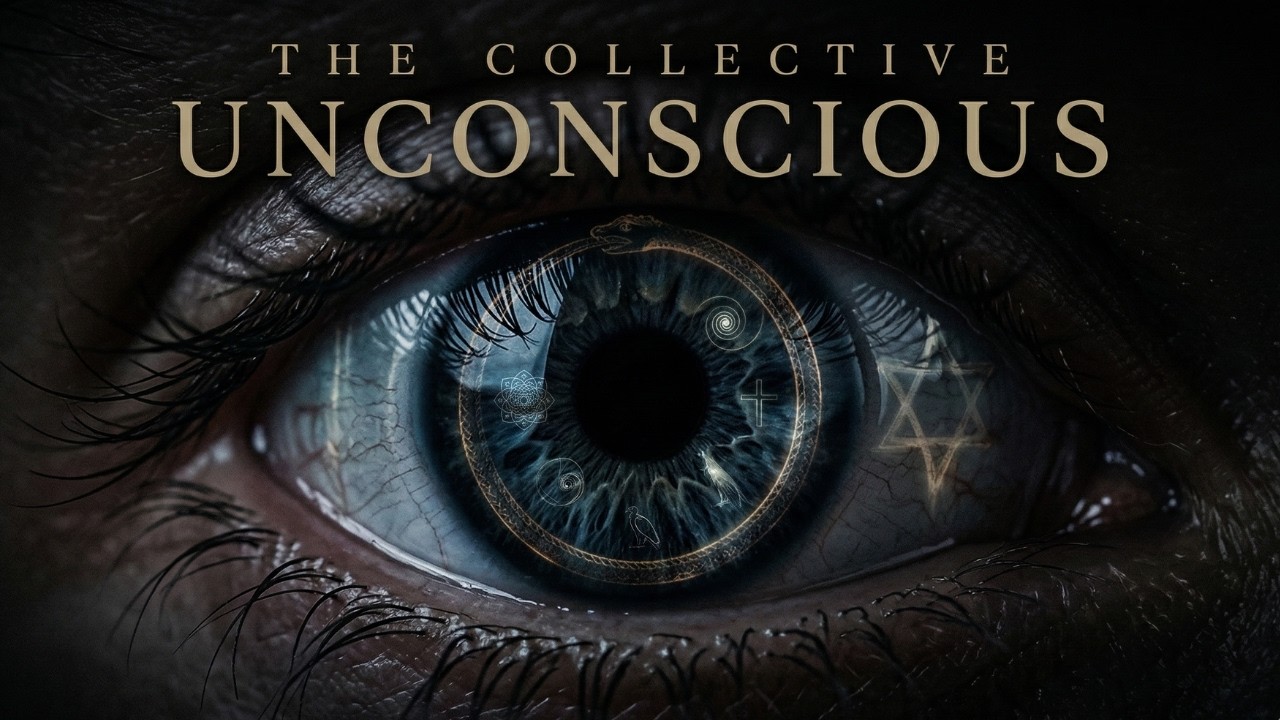
While Sigmund Freud was busy exploring the "basement" of the human mind—filled with our repressed memories and private desires—his protégé-turned-rival, Carl Jung, decided to dig a little deeper. He discovered that beneath our personal secrets lies a vast, subterranean ocean shared by every human being who has ever lived.
He called this the Collective Unconscious.
What is the Collective Unconscious?
At its core, the collective unconscious is the part of the psyche that is not shaped by personal experience. Unlike the personal unconscious (which contains things you’ve forgotten or pushed aside), the collective unconscious is hereditary.
Jung argued that just as our bodies have evolved with certain physical structures—two arms, a heart, a complex nervous system—our minds have evolved with "psychic structures." You aren't born a blank slate; you’re born with a pre-installed operating system containing the blueprint of human history.
The Personal vs. The Collective
To visualize this, imagine a series of islands in the sea:
The Island Tip: Your conscious mind (what you’re thinking right now).
The Beach/Waterline: Your personal unconscious (your childhood memories, your specific fears).
The Ocean Floor: The collective unconscious (the bedrock that connects every island).
The Inhabitants: Archetypes
If the collective unconscious is the library, archetypes are the books. Jung defined archetypes as universal, primal symbols and images that exist across all cultures and time periods. They aren't specific memories, but rather "patterns of instinctual behavior."
Think of them as dry riverbeds: they provide the path, but your life experiences provide the water that fills them. Some of the most prominent archetypes include:
The Persona: The "mask" we wear to function in society. It’s the version of you that shows up to job interviews or first dates.
The Shadow: The "dark side" of the ego. It contains everything we deny about ourselves (anger, selfishness, or even hidden talents). Jung famously noted, "Everyone carries a shadow, and the less it is embodied in the individual’s conscious life, the blacker and denser it is."
The Anima/Animus: The inner feminine side of a man and the inner masculine side of a woman. Jung believed we must integrate these to become whole.
The Self: The ultimate goal of the human journey—the unification of consciousness and unconsciousness.
Why Did Jung Believe This?
Jung wasn’t just guessing; he was an obsessive observer of symbols. He noticed that his patients often had dreams containing complex mythological themes they had never studied.
He found it striking that a child in 20th-century Switzerland could dream of a "Solar Phallus" (a specific ancient Egyptian motif) without ever seeing a book on Egyptology. To Jung, this suggested that certain symbols—the Hero, the Great Mother, the Wise Old Man, the Trickster—are "hard-wired" into the human brain.
The Goal: Individuation
Why does any of this matter? For Jung, the point of understanding the collective unconscious wasn't just academic—it was about Individuation.
Individuation is the process of becoming the person you were always meant to be. It requires a "dialogue" with the collective unconscious. If you ignore these deep-seated patterns, they don't go away; they simply control you from the shadows. As Jung wittily observed:
"Until you make the unconscious conscious, it will direct your life and you will call it fate."
By acknowledging the archetypes within us, we stop being "puppets" of ancient instincts and start becoming conscious, integrated individuals.
The Legacy of the Concept
Jung’s theory changed everything from psychology to storytelling. Without the collective unconscious, we wouldn't have Joseph Campbell’s The Hero with a Thousand Faces, which means we might not have Star Wars, The Lion King, or the Marvel Cinematic Universe. We recognize these stories because they tap into the "universal software" Jung identified nearly a century ago.
While modern neuroscience might describe these "archetypes" as evolutionary survival mechanisms or cognitive shortcuts, Jung’s poetic framing remains one of the most profound ways to understand the shared "soul" of humanity.









![Роберт Сапольски — Биология религиозности [Vert Dider]](https://i.ytimg.com/vi/7l1NhZ4EbEE/maxresdefault.jpg)




![Биология поведения человека. Лекция #1. Введение [Роберт Сапольски, 2010. Стэнфорд]](https://i.ytimg.com/vi/ik9t96SMtB0/maxresdefault.jpg)
Информация по комментариям в разработке