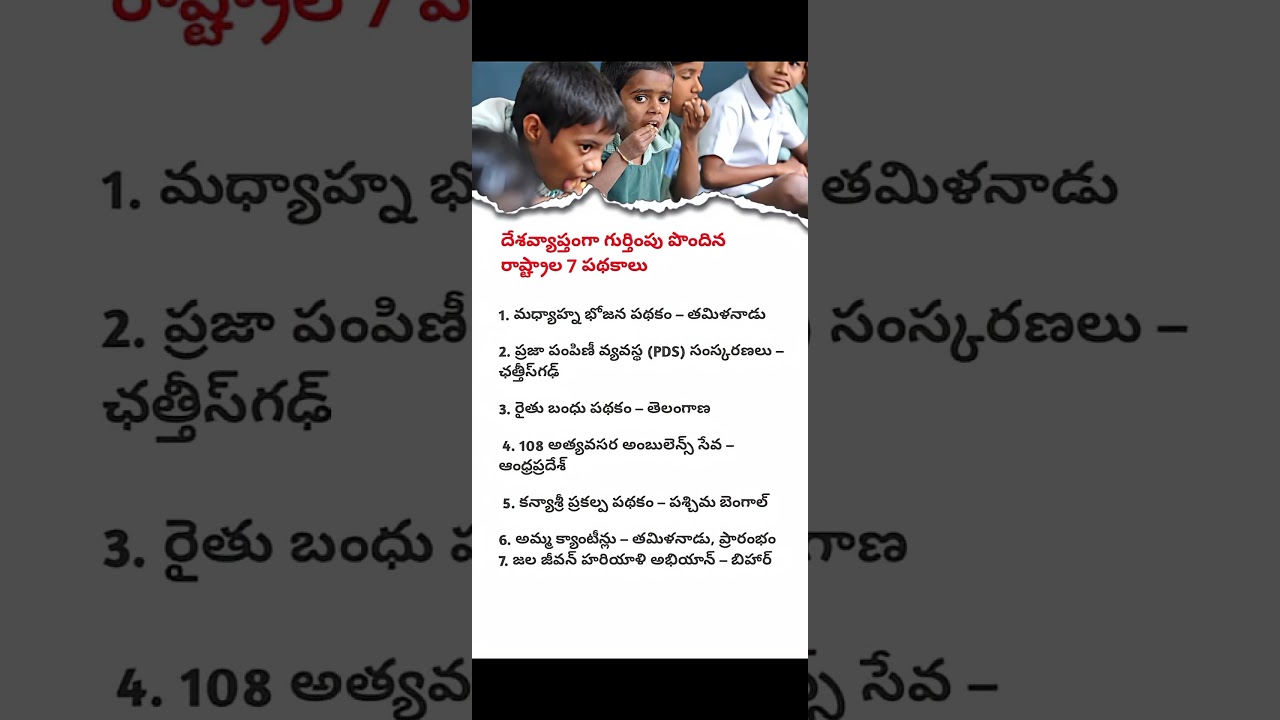
Tamil Nadu was the first state to start the Mid-Day Meal Scheme in schools. This program provides free lunches to school children to improve their nutrition and encourage them to attend school regularly. This simple but powerful idea has increased school attendance and reduced dropout rates. The Central Government later adopted this model and made it a national scheme under the name Mid-Day Meal Scheme. Tamil Nadu’s initiative proved that feeding children is not just a welfare act, but an investment in the country’s future.
2. Public Distribution System (PDS) Reforms – Chhattisgarh
Chhattisgarh transformed its Public Distribution System (PDS), making it more transparent and effective. It focused on giving food grains and essential commodities to poor people through ration shops with minimum corruption and leakage. The state implemented digital ration cards, biometric authentication, and GPS tracking of food delivery trucks. These innovations were later replicated in many other states. The central government also took notes from this model to improve the national PDS system.
3. Rythu Bandhu Scheme – Telangana
The Rythu Bandhu scheme was launched by the Telangana government to support farmers directly. Under this scheme, farmers receive financial assistance for every acre they cultivate. This gives them security and helps them buy seeds, fertilizers, and other agricultural inputs. The scheme was praised across the country and inspired the Government of India to introduce a similar scheme at the national level called PM-KISAN. Telangana showed how supporting farmers directly can reduce their dependence on loans and improve their lives.
4. 108 Emergency Ambulance Services – Andhra Pradesh
Andhra Pradesh introduced the 108 Emergency Ambulance Service, a free medical emergency response system. It allows anyone to dial 108 and get quick help in case of accidents, heart attacks, pregnancies, or any critical situation. The service is available 24/7 and is equipped with medical staff and equipment. This model was so successful that it was soon adopted by many other states in India. It has saved countless lives and improved access to healthcare in rural areas.
5. Kanyashree Prakalpa Scheme – West Bengal
West Bengal’s Kanyashree Prakalpa scheme was aimed at empowering girls by providing them with financial support for their education and to prevent child marriage. Girls between the ages of 13 and 18 receive an annual scholarship, and a one-time grant is given once they turn 18, if they remain unmarried and continue their education. This helped reduce dropout rates among girl students and discouraged early marriages. The scheme has received international recognition, including awards from the United Nations.
6. Amma Canteens – Tamil Nadu, Started in Chennai
Amma Canteens were started by the Tamil Nadu government to provide affordable and hygienic food to the poor and working-class people. In these canteens, breakfast is served at ₹1, lunch at ₹5, and dinner at ₹5. The idea was to make sure that no one sleeps hungry. These canteens gained national attention for their efficiency and low cost. Inspired by this, many other states launched similar programs like Indira Canteens (Karnataka) and Aam Aadmi Canteens (Delhi). It became a shining example of food security and urban welfare.
7. Jal Jeevan Hariyali Abhiyan – Bihar
Bihar’s Jal Jeevan Hariyali Abhiyan is an ambitious campaign to promote water conservation, tree planting, and environmental awareness. The aim is to improve groundwater levels, prevent floods, and create a healthy green environment. Under this program, lakhs of trees have been planted, and awareness campaigns are conducted to save water and protect nature. It became a model for other states to start similar green and water conservation initiatives. Environmental protection is not just a state duty but a responsibility of every citizen, and Bihar’s campaign has brought this into public focus.
These schemes highlight how local governance and state leadership can lead the way for the entire nation. When one state takes an innovative step for the welfare of its people, it creates a ripple effect, motivating others to follow the same. These are not just schemes – they are lifelines for millions of Indians. When governments listen to people's needs and act wisely, the result is a better and more equal society.
India is progressing steadily, and such examples remind us that thoughtful governance at the grassroots level can transform lives. Whether it is feeding children, saving lives, supporting farmers, or protecting the environment, these policies are building blocks of a stronger nation.

Информация по комментариям в разработке