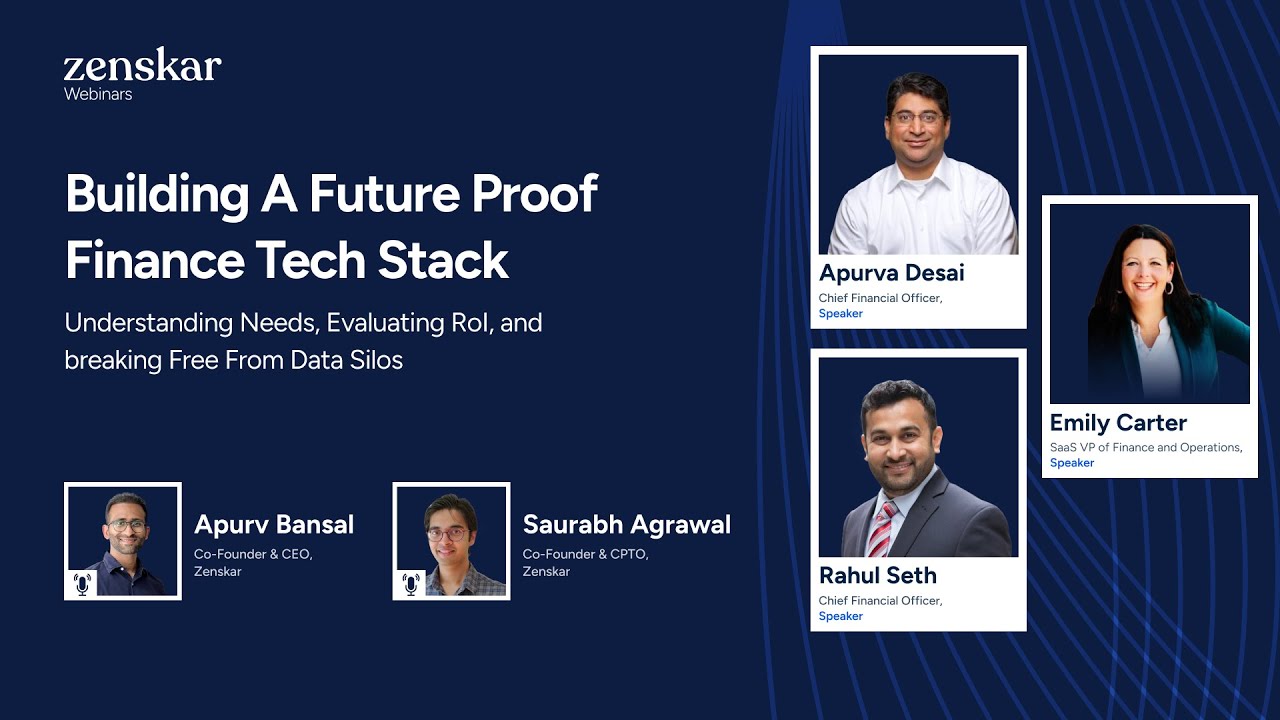
Learn how finance leaders build a future proof finance tech stack, align tools to organizational maturity, prove ROI on finance software, choose integrated suites vs best of breed, harden data security and compliance, and move from siloed data to a unified system. Practical frameworks for stakeholder buy in, implementation, and long term scalability.
Timestamps
00:00 Intro
01:42 How is finance as a function evolving and how does this influence tooling
06:29 How do you justify ROI on finance tools
09:57 How do you do the math of if a tool makes sense
11:32 Who are the stakeholders involved in the decision to buy a tool
15:07 How to pick your tools Do you get something that is integrated or buy tools for specific needs
19:03 How do you think of data security, compliance, and privacy
21:22 What are some challenges with siloed data How did you solve them in the past
23:41 How does a company move from siloed data to a structured org wide data system
27:32 How do you get the most out of a finance tool And any thoughts on implementation
28:48 Are there any other closing recommendations on picking finance tools
What you will learn
• How to build a future proof finance tech stack aligned to team maturity
• Finance software ROI framework time saved, faster close, collections, payback period
• Integrated suite vs best of breed finance tools and when each wins
• How to break data silos and implement a unified finance data system
• Data governance, security, compliance requirements for finance stacks
• Implementation habits that drive adoption and time to value
Deep dive summary
We sat down with three veteran financial professionals with a combined 40 plus years of experience to map the tooling journey for the finance function. In today’s uncertain environment, finance teams carry greater responsibility in navigating the business. Building a resilient tech stack is key to future ready finance operations. Picking the wrong tools slows progress, so this session covers how the function is evolving, the new responsibilities, and a practical path to the right finance tech stack.
Key takeaways
Pick tools in line with the finance team’s maturity stage
Evaluate ROI, plan migration and implementation, and scale over time
Move from data silos to a unified data system
Maturity stages
Stage 1: Possess data, act as the accounting arm, and provide it to internal stakeholders.
Stage 2: Add business acumen and analytics, share insights across the organization.
Stage 3: Move from data possession to active utilization and drive impactful change.
Further Reading:
zenskar.com/blog/deep-dive-into-modern-billing-tool-capabilities
zenskar.com/blog/how-to-evaluate-the-roi-of-your-billing-tool
zenskar.com/blog/where-and-why-is-engineering-bandwidth-consumed-when-solving-billing-problems
zenskar.com/blog/implementing-usage-based-pricing
Speakers
• Apurva Desai, CEO at Sarvian, Inc. Former CFO at Vuclip, ScriptDrop, and Dina. Instructor at the Berkeley Center for Law and Business, University of California.
• Emily Carter, VP of Finance and Operations at Avoma. 15 years of experience. Former Director of Finance at Joynd.
• Rahul Sheth, CFO at Carbyne. Two decades of experience in financial services. Previously established finance systems at Emerge, Socure, and DigitalOcean.
Hosts: Apurv Bansal and Saurabh Agrawal, Founders of Zenskar.
About Zenskar
Everyone believes their billing needs are unique, and they are. At Zenskar, we have built a product that is fundamentally different and can handle any level of complexity in pricing and billing you want.
Socials:
🌐 https://www.zenskar.com/
🎥 https://www.zenskar.com/webinar
📩 Questions? Reach us at: contact@zenskar.com
🔗 X: @ZenskarHQ
LinkedIn: / zenskar
#FinanceOps #TechStack #SaaSFinance #FPandA #DataGovernance
















Информация по комментариям в разработке