next video: • video 5.3. three kinds of hypotheses
prior video: • video 5.1. inferential statistics logic
closed captioning text:
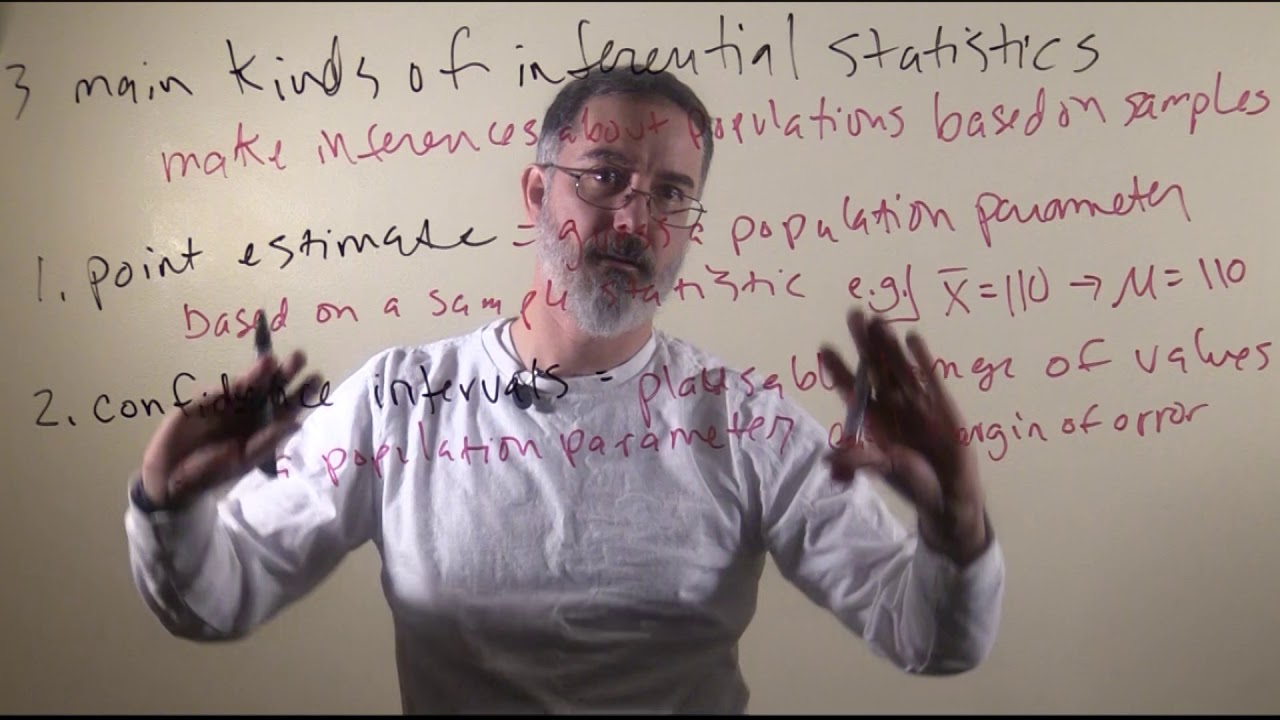
In this class, we are going to talk about three main kinds of inferential statistics. Remember, these inferential statistics are when you make inferences about populations based on samples--on sample data.
Notice, if you measure everybody in the population, you don't have a sample, you have got a census. Then you don't even need inferential statistics, you have all the information that you need. So, all these inferential statistics are about using sample data to make inferences about populations.
The first kind of inferential statistic I want to talk about is called a "point estimate." For these you guess a population parameter--remember these are just descriptive statistics of populations ... means, standard deviations, things like that. For a point estimate, you guess a population parameter based on a sample statistic.
For example, if we are trying to figure out the average intelligence of SUU students and we have a sample, and we measure their intelligence, and the average of that sample's intelligence is 110, then we can use this as our best guess at the average intelligence of all SUU students, which would be a population parameter. So, we would just guess that the SUU students population mean IQ is 110.
The second kind of inferential statistics I want to talk about are called "confidence intervals," and these are a plausible range of values for a population parameter. This is going to be centered around a point estimate. And that range of plausible values is going to be mathematically determined with some probability statistics that we will talk about pretty soon in this class.
These are something that you often see when it is time for presidential elections, where they will say, a margin of error in the polling. And a "margin of error" is a "confidence interval." So, plus or minus five percentage points for President Trump. That would be a margin of error. Or, in this case, what we might have is something like our guess is that the population average IQ for SUU students is 110 plus or minus five IQ points. It does not actually quite look like that, but that is generally the idea of how these confidence intervals would look. In this class, we are going to do a lot of point estimates. Those are a frequent part of doing inferential statistics. They are a subcomponent for the last kind. Maybe I will come back and talk about that at the end.
The third main kind of inferential statistic that we are gonna talk about in this class is called "hypothesis testing." Here you see if your sample data support your research question, your research hypothesis ... that is about a state of the world. So this is about a population, but you just look at a sample to see if the sample is consistent with your hypothesis or not.
Here, for example, you might have a research hypothesis that caffeine increases attention. You could do an experiment. You could give some participants caffeinated coffee, other participants decaffeinated coffee, measure their attention, and if the caffeinated group has higher attention and the decaf group, you would say that your sample data supports the conclusion that caffeine increases attention in the population.
And this is the focus of the second half ... well the rest of this class. And this would count as applied statistics. This isn't theoretical. This is applying statistics to make decisions about the world.
In this class, point estimates are something that we often do as part of hypothesis testing. So point estimates are gonna be a very common thing that we do. Confidence intervals are a topic that we are gonna focus on just for one day, so that you understand how they work, and therefore how to interpret them when you see them in a research article, or how you could produce them if you needed to later on in your own research. But we are not gonna do confidence intervals for every statistical test that we talk about, even though we could do that. It is just not worth the time. We will just introduce these conceptually, and then that is all we will do with confidence intervals in this class. But from this point on in the class, we are really going to focus on these hypothesis testing, inferential statistics. There is a whole bunch of different ones, depending on the scales of measure of your variables. We are going to work through a lot of different kinds of these.

Информация по комментариям в разработке